
What is barge-in in voice AI? A glossary of 30 terms every hospital should know
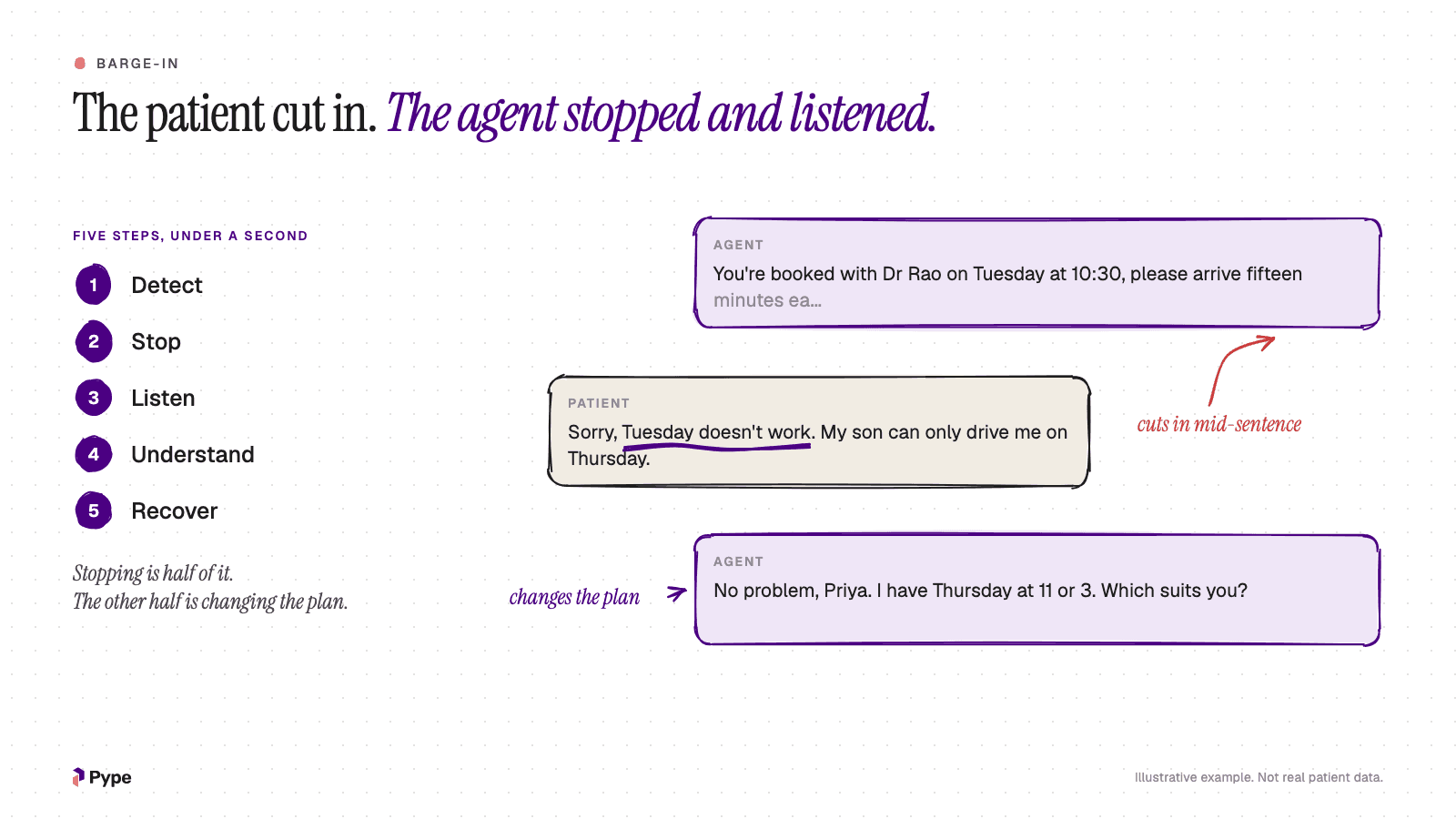
What is barge-in in voice AI? A glossary of 30 terms every hospital should know
Barge-in, ASR, warm transfer, BAA, HIS integration. Thirty voice AI terms in plain words, each with what it means for a patient call and what to ask your vendor.
Ashish Tripathy, Founder, Pype AI | 16 October 2026 | 9 minute read
Barge-in in voice AI is the ability of a caller to interrupt the agent while it is still speaking, and for the agent to stop, listen and respond to what was just said. Without it, a patient has to sit through the whole sentence before they can correct the agent.
Quick context. At Pype AI we build voice agents that talk to patients for hospitals. Every buying conversation about AI voice agents for healthcare runs into the same thirty words, and most sound more technical than they are. So here they are, one short definition each, grouped by where they show up in a call.
If you're new to the topic, start with our plain guide to what AI voice agents for healthcare are. This page is the dictionary you keep open next to it.
What is barge-in in voice AI, and why does it matter on patient calls?
Barge-in matters because patients interrupt. They correct a date, they say "wait", they mention a symptom halfway through the agent's sentence. An agent that can't be interrupted either talks over them or misses what they said.
Classic IVR platforms support barge-in too: they stop a prompt as soon as they detect speech or a keypress. Voice AI agents need more. They have to stop, work out what the interruption meant, and decide what to do next.
Let's take one call. Priya, 64, is confirming a knee follow-up with orthopaedics. The agent starts reading the appointment details:
Agent: "You're booked with Dr Rao on Tuesday the 21st at 10:30, please arrive fifteen minutes early and bring your..."
Priya: "Sorry, Tuesday doesn't work, my son can only drive me on Thursday."
Here's what good barge-in looks like, step by step:
| Step | What happens | Why it matters |
|---|---|---|
| 1. Detect | The agent hears Priya start speaking mid-sentence | It has to tell real speech from a cough or a TV in the background |
| 2. Stop | The agent stops talking within a fraction of a second | If it keeps going, Priya has to raise her voice or repeat herself |
| 3. Listen | It captures the full interruption, not just the first few words | "Tuesday doesn't work" means nothing without "Thursday" |
| 4. Understand | It treats this as a reschedule, not a confirmation | The original plan (confirm and hang up) is now wrong |
| 5. Recover | "No problem. I have Thursday at 11 or 3. Which suits you?" | It doesn't restart the old sentence or forget where it was |
Good barge-in isn't just stopping. It's stopping and then doing the right next thing.
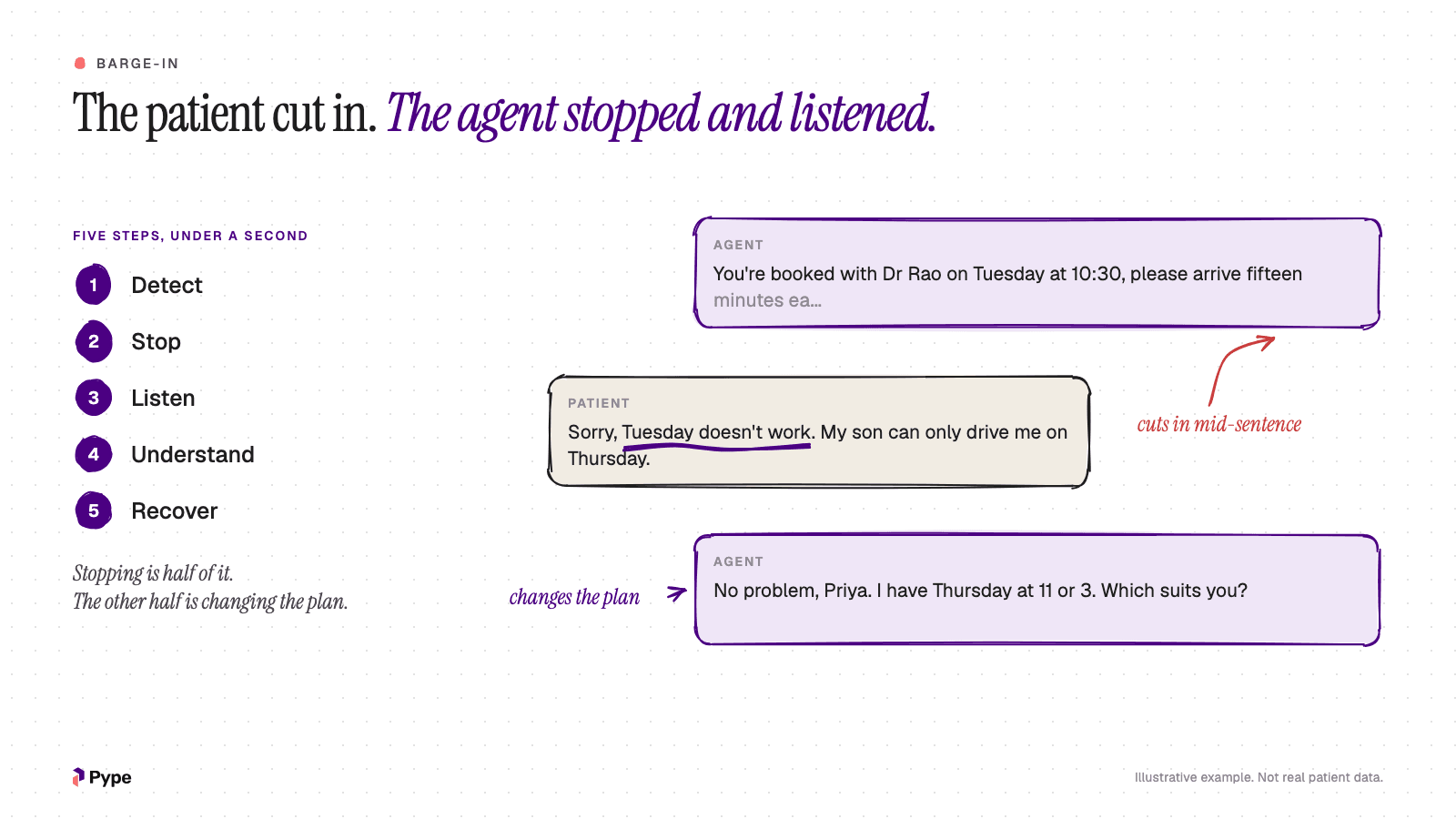
The patient cut in. The agent stopped, listened, and moved the plan.
Two things go wrong most often. False barge-in: the agent stops because of background noise, a hospital ward or a busy street, and the call feels broken. Missed barge-in: the agent keeps talking over a patient who is trying to say something important. On a healthcare call, the second one is worse.
How a voice AI call works: the pipeline terms
These are the parts every AI voice agent is built from. One sentence from a patient passes through all of them in about a second.
1. ASR (automatic speech recognition), also called STT (speech-to-text). The part that turns the caller's voice into text. Drug names and doctor names get misheard here.
2. Word error rate (WER). The standard score for ASR accuracy: the share of words it got wrong, by substituting, dropping or adding a word. Ask for it on your own call audio, not a vendor benchmark.
3. LLM (large language model). The "brain" that reads the transcript, decides what the caller wants and writes the reply.
4. TTS (text-to-speech). Turns the agent's reply back into a voice. Good TTS gets names, dates and numbers right.
5. Latency. The pause between the caller finishing and the agent starting to answer. Too long and callers assume the line dropped.
6. Turn detection (endpointing). How the agent decides the caller has finished speaking. Get it wrong and the agent either interrupts a patient who paused to think, or waits awkwardly. We wrote a deeper piece on turn detection in voice AI.
7. Barge-in. The caller interrupting the agent mid-sentence, and the agent stopping to listen. See the worked example above.
8. VAD (voice activity detection). The small model that decides "is someone speaking right now?" It powers both barge-in and turn detection, and it's what gets fooled by background noise.
9. Full-duplex audio. The line can carry speech in both directions at once, so the agent can listen while it talks. Barge-in needs it.
10. DTMF. The tones your phone sends when you press a key. Still useful when speech recognition struggles.
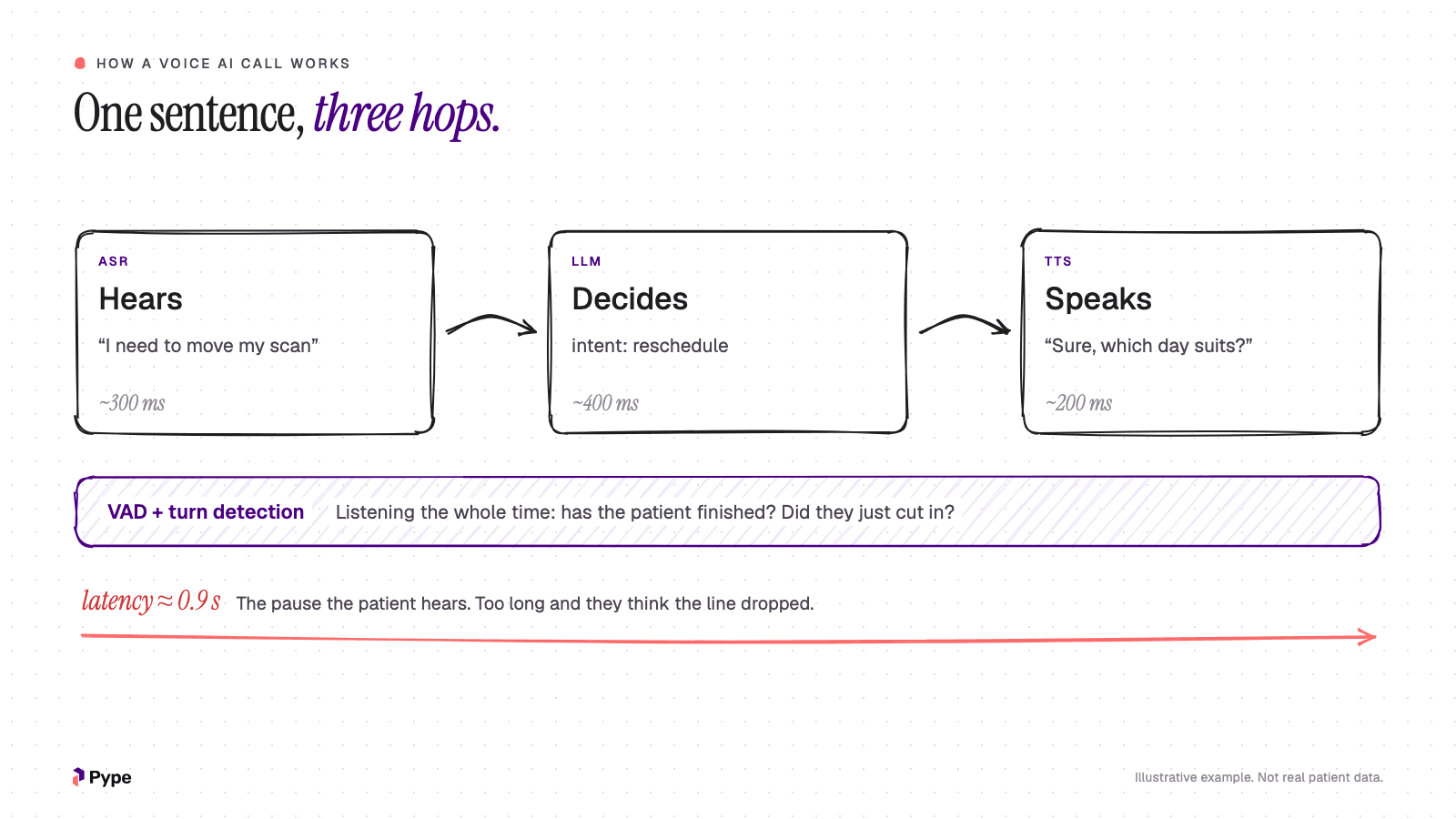
One sentence, three hops, about a second. Every hop is a place a call can go wrong.
What the agent does on a call: conversation terms
11. Intent. What the caller is trying to do: book, reschedule, cancel, ask a question, report a symptom.
12. Entity (slot). A detail the agent needs to finish the job: patient name, date of birth, department, doctor, date. "Slot filling" just means collecting them.
13. Tool call (function calling). When the agent reaches out to another system, for example to check a doctor's free slots or create a booking. In healthcare you want to know why each tool was called (see our post on auditable healthcare AI agents).
14. Knowledge base (RAG). The hospital's own information the agent can look up. RAG (retrieval-augmented generation) means it fetches the right page before answering, instead of guessing.
15. Hallucination. When a language model states something that isn't true with full confidence, like a clinic timing that doesn't exist.
16. Guardrail. A rule the agent must always follow, whatever the conversation. "Never give medical advice." "Always transfer if the patient mentions chest pain."
17. Triage. Deciding how urgent a call is and where it should go: a normal booking, a nurse, or emergency services. On a hospital line, this is the decision that matters most.
18. Escalation. Handing the call to a human when the agent shouldn't handle it alone.
19. Warm transfer. The agent passes the call to a human with context: who is calling, why, and what has been said. The patient doesn't repeat themselves.
20. Cold transfer. The call is simply put through, with no context. The nurse starts with "How can I help?" and the patient tells the whole story again.
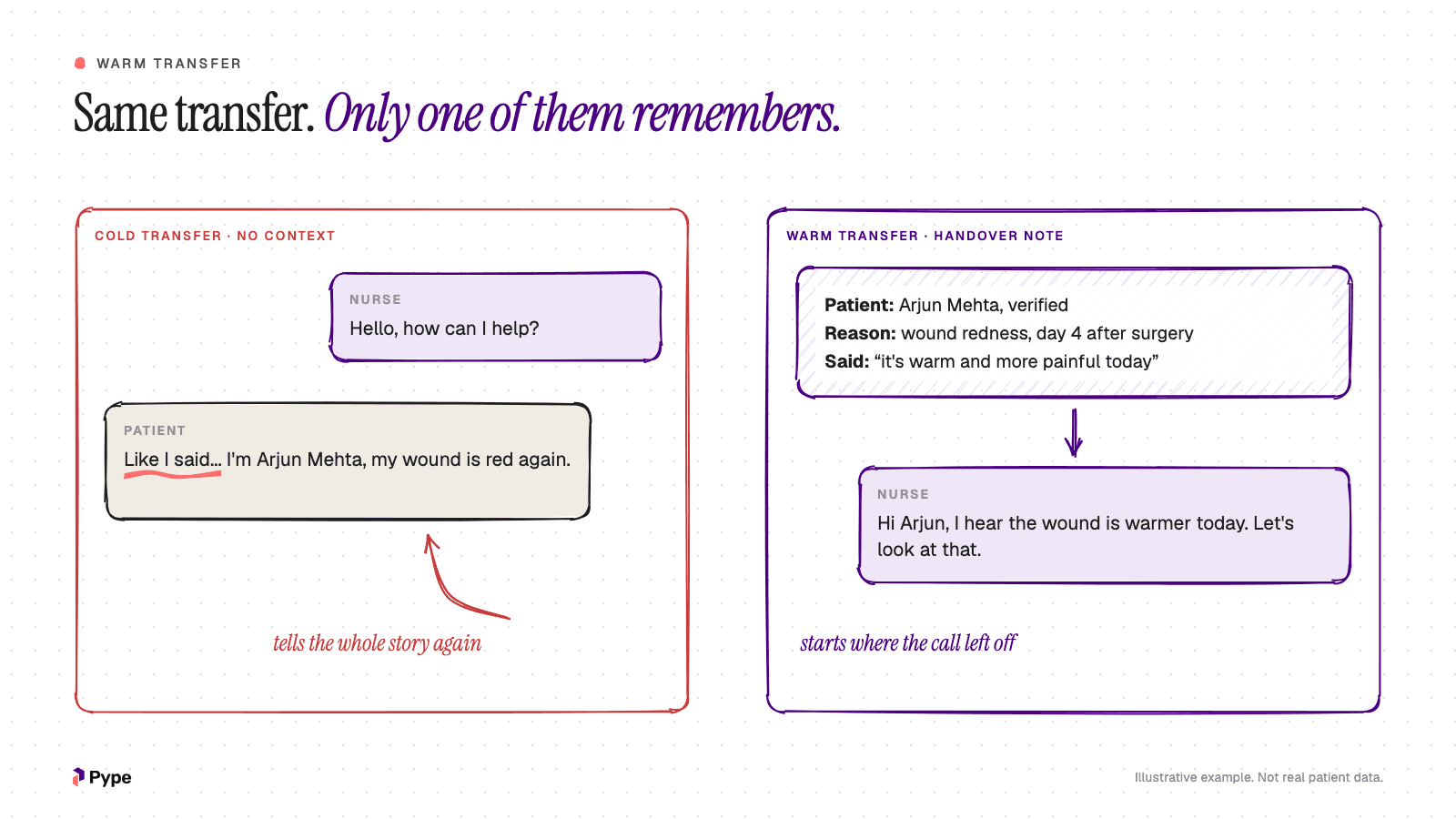
Same transfer. Only one of them remembers what the patient already said.
21. Code-switching. Moving between languages inside one sentence, like Hindi and English ("Hinglish"). Common on Indian hospital lines. Our India hospital FAQ covers it in more detail.
Hospital systems and telephony terms
22. HIS (hospital information system). The hospital's core software for appointments, billing and registration. HIS integration means the agent can read and write to it directly, so a booking on the phone is a real booking.
23. EHR / EMR (electronic health record / electronic medical record). The patient's clinical record. Most voice agents need only a small slice of it. Ask exactly what they touch.
24. SIP trunk. The connection that brings phone calls from your telecom provider to the voice agent over the internet.
25. IVR (interactive voice response). The classic "press 1 for appointments" phone menu. An AI voice agent can replace it, or sit behind it for specific options.
Privacy, compliance and quality terms
26. PHI (protected health information). Under US law (HIPAA), any health information that can identify a patient. A voice call is full of it.
27. BAA (business associate agreement). A contract a US hospital must sign with any vendor that handles PHI on its behalf. The HHS sample provisions show what it covers: how the vendor may use the data, how it protects it, and how it reports breaches. A HIPAA compliant AI voice agent needs one with the vendor, and the vendor needs them with its own subprocessors.
28. DPDP Act. India's Digital Personal Data Protection Act, 2023. It sets rules on consent, purpose and data handling for personal data, including what a voice agent collects on a call.
29. Audit trail (decision trace). A record of what the agent heard, what it decided, how sure it was and which rule it followed, for every step of every call. A transcript gives you the words. An audit trail gives you the reasons.
30. Task completion rate. The share of calls where the agent finished what the caller needed. Useful, but an agent can complete a booking and still miss a symptom that needed a nurse.
Six terms to test before you go live
If you only test six things from this glossary, make them these.
| Term | What to try | What good looks like |
|---|---|---|
| Barge-in | Interrupt the agent mid-sentence with a change of plan | It stops, listens, and changes course |
| Word error rate | Say three of your hardest drug and doctor names | It gets them right, or asks you to repeat |
| Latency | Ask a simple question and count the pause | It feels like a person thinking, not a dropped line |
| Warm transfer | Ask for a human halfway through a booking | The human already knows why you called |
| Guardrail | Mention chest pain during a routine booking | It stops booking and escalates |
| Audit trail | Ask the vendor why the agent did one thing on that call | They can show you, step by step, in minutes |
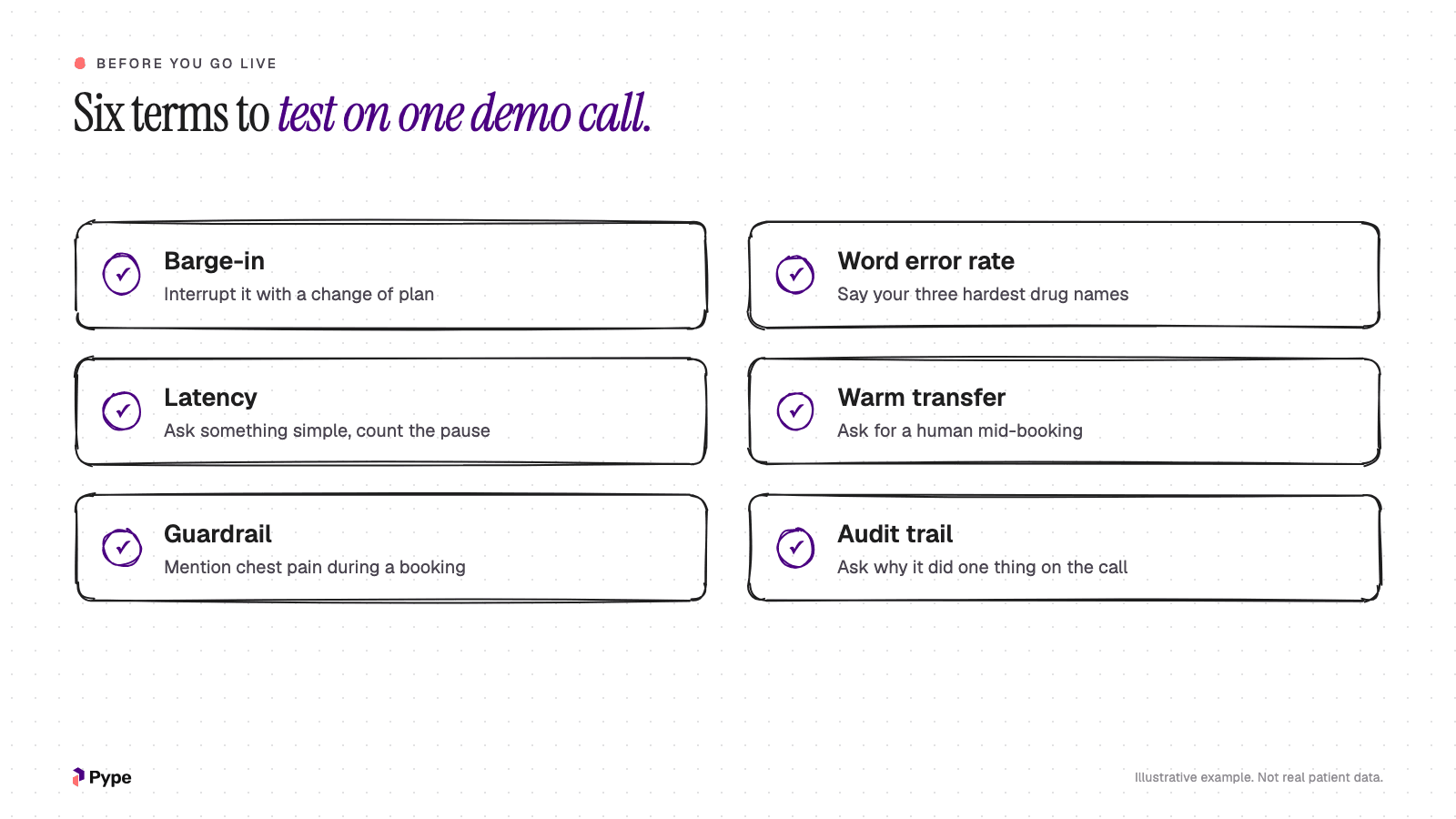
Six quick tests. You can run all of them on one demo call.
For a fuller buying list, see our 10 questions to ask AI voice agent vendors.
How we think about these terms at Pype
Quick note on our side. We treat barge-in, turn detection and transfers as decisions the agent makes, so each one shows up in the call's decision trace with the reason behind it. That's what lets a hospital team check, call by call, that the agent stopped when it should have and handed over when it should have.
Key takeaways
- Barge-in in voice AI means the patient can interrupt and the agent stops, listens and adapts. The "adapts" part is what separates a good agent from a polite one.
- Most voice AI terms map to one of four places: hearing (ASR, VAD), thinking (LLM, intent, triage), speaking (TTS, latency) and handing over (warm transfer, escalation).
- Compliance terms (PHI, BAA, DPDP Act) decide what a vendor may do with call data. Ask about them first, not last.
- An audit trail is the term that makes all the others checkable.
Glossaries aren't glamorous. But the first time a vendor says "full-duplex endpointing with sub-second latency" and everyone in the room knows what that means for a patient, it's worth it :)
Frequently asked questions
What is barge-in in voice AI?
Barge-in is when a caller interrupts a voice agent while it is speaking, and the agent stops to listen and respond. Good barge-in also changes what the agent does next based on what the caller said.
What is the difference between barge-in and turn detection?
Turn detection decides when the caller has finished speaking so the agent can reply. Barge-in handles the caller starting to speak while the agent is still talking. Both rely on voice activity detection.
What are AI voice agents for healthcare?
They are phone agents that talk to patients in natural speech to handle tasks like booking, reminders, follow-ups and enquiries. They combine speech recognition, a language model and text-to-speech, connected to the hospital's own systems.
Does a HIPAA compliant AI voice agent need a BAA?
Yes, in the US. Any vendor that creates, receives, stores or sends PHI for a hospital is a business associate and needs a BAA, and its own subprocessors need one with the vendor.
What is a warm transfer in a hospital call center?
A warm transfer passes the caller to a human along with a short summary of who they are and why they called. The patient doesn't have to repeat their story, which matters most on urgent calls.
What is HIS integration for a voice agent?
It means the voice agent can read from and write to the hospital information system directly, for example checking real doctor availability and creating real bookings, rather than taking a message for staff to enter later.
About the author
Ashish Tripathy is the founder of Pype AI, which builds voice AI agents for hospitals and healthcare providers. Pype also maintains Whispey, an open-source, OpenTelemetry-based observability tool for voice AI agents.