
AI voice agents in Indian hospitals: 15 questions answered (DPDP, Hindi, HIS, cost)
AI voice agents in Indian hospitals: 15 questions answered (DPDP, Hindi, HIS, cost)
Your AI voice agent hospital India FAQ: 15 plain answers on Hindi and Hinglish calls, the DPDP Act, HIS integration, cost and where to start.
Ashish Tripathy, Founder, Pype AI | 15 October 2026 | 9 minute read
An AI voice agent for an Indian hospital is software that answers and makes patient phone calls in natural speech, in Hindi, English, a regional language or a mix, and does real work on the call: booking OPD appointments, sending reminders, answering common questions and passing urgent calls to staff. This AI voice agent hospital India FAQ covers the 15 questions hospital teams ask most.
Quick context. At Pype AI we build voice agents that talk to patients for hospitals. After millions of minutes of these calls, these are the questions that come up in almost every first meeting. So here they are, answered plainly.
The basics
1. What does an AI voice agent actually do in a hospital?
It handles the calls your front desk and call centre handle today. The common ones are OPD appointment booking and rescheduling, reminders before a visit, follow-up calls after discharge, report and timing questions, and routing callers to the right department.
2. Is it the same as an IVR?
No. An IVR makes the patient press 1 for cardiology. A voice agent lets them just say "mujhe heart wale doctor se milna hai" and understands it. It can also look up slots and book them during the call. We explain the difference in more detail in our plain guide to AI voice agents for healthcare.
3. Is an AI receptionist for a hospital meant to replace staff?
It shouldn't. The best setups let the agent take the repetitive calls (timings, bookings, reminders) so staff can focus on the calls that need a person. Any good agent hands over to a human whenever a caller is upset, confused or describing something urgent.
Hindi, Hinglish and regional languages
4. Can an AI voice agent handle Hindi and English calls?
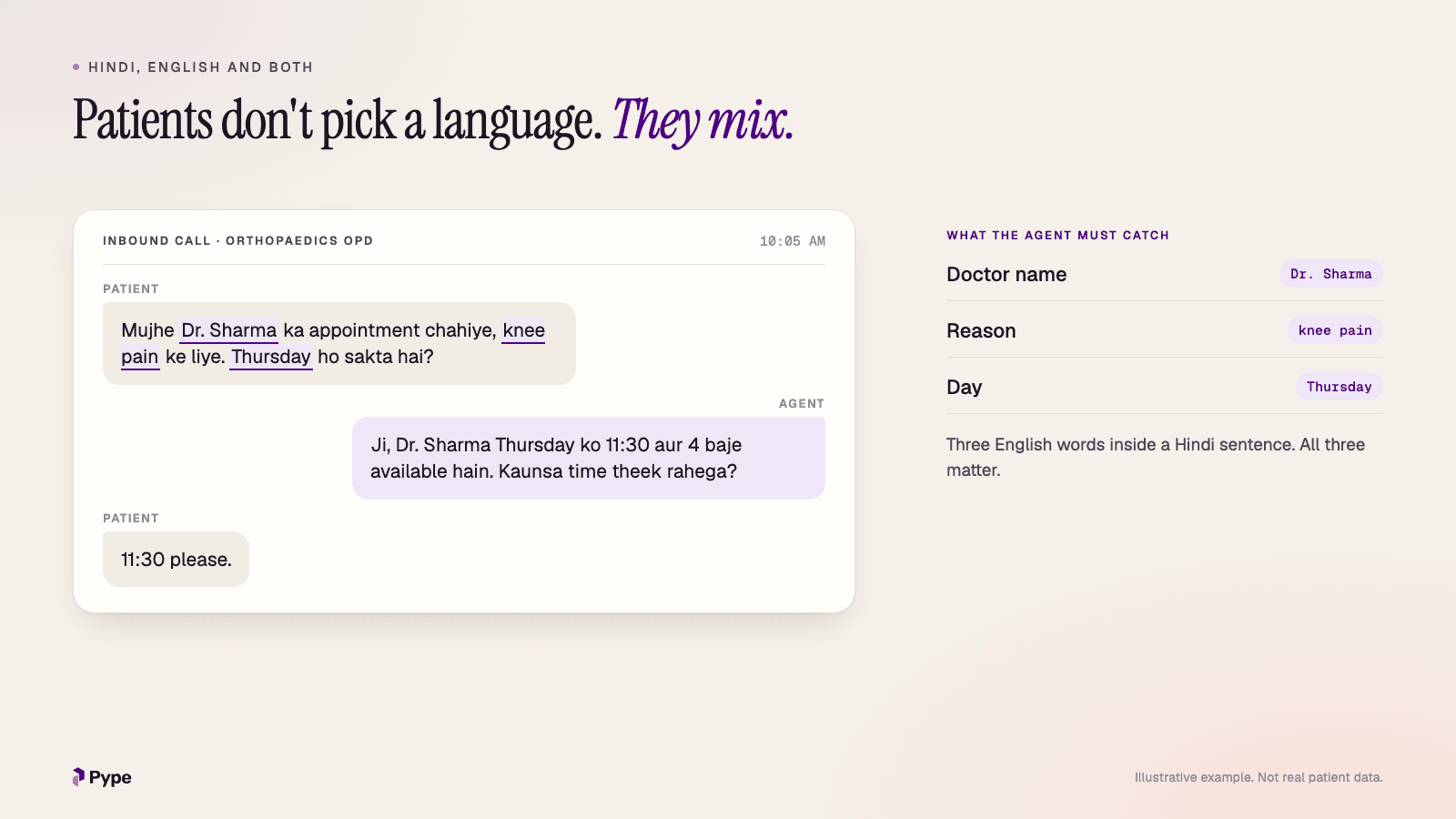
Yes, and in India it has to handle both in the same sentence. Real patients don't pick one language. They mix.
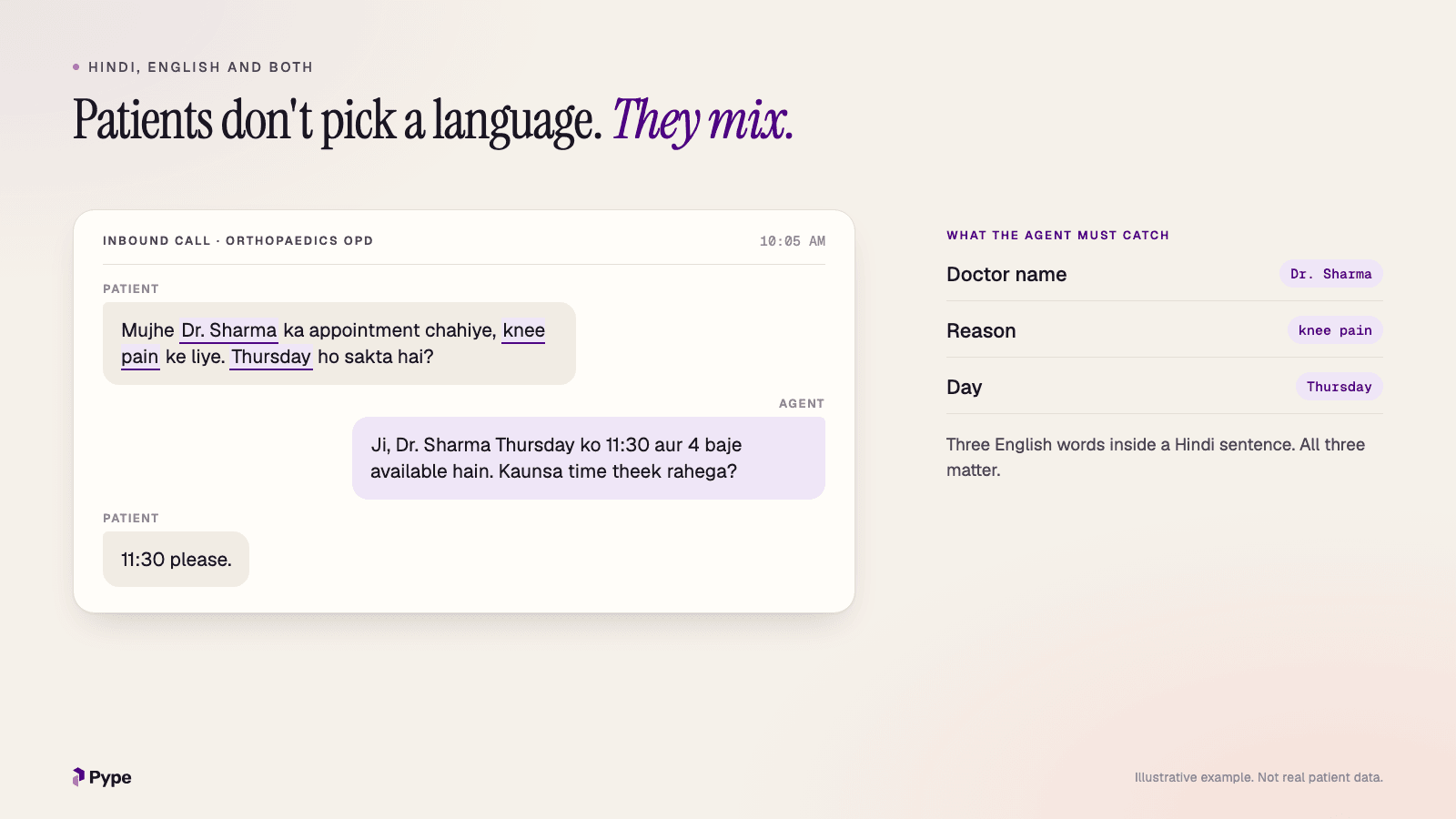
Three English words inside a Hindi sentence. All three matter.
5. What about Tamil, Telugu, Marathi, Bengali and other languages?
Speech technology for Indian languages has improved a lot, but quality still varies by language, accent and phone line. Don't trust a demo. Ask the vendor to run test calls in your languages, with speakers from your city, on ordinary mobile connections.
6. What's the hardest part of Indian language calls?
Names. Doctor names, drug names, department names and place names are where speech-to-text slips most often, because they're rare words. A good agent confirms these back to the caller ("Dr. Sharma, orthopaedics, right?") before acting on them.
The DPDP Act and patient data
7. Does the DPDP Act apply to AI voice agents in hospitals?
Yes. The Digital Personal Data Protection Act, 2023 covers digital personal data, and call recordings, transcripts and booking records all count. The hospital is usually the data fiduciary. The voice AI vendor is usually a data processor acting on its behalf.
8. When do hospitals need to comply?
The DPDP Rules were notified in November 2025 and phase in over 18 months. Most of the core duties (notice, consent, security safeguards, breach reporting) apply from May 2027, as Bar & Bench's summary of the final Rules explains. Our DPDP guide for Indian hospitals goes deeper.
9. What does DPDP mean on an actual phone call?
It's easier to think about it moment by moment.
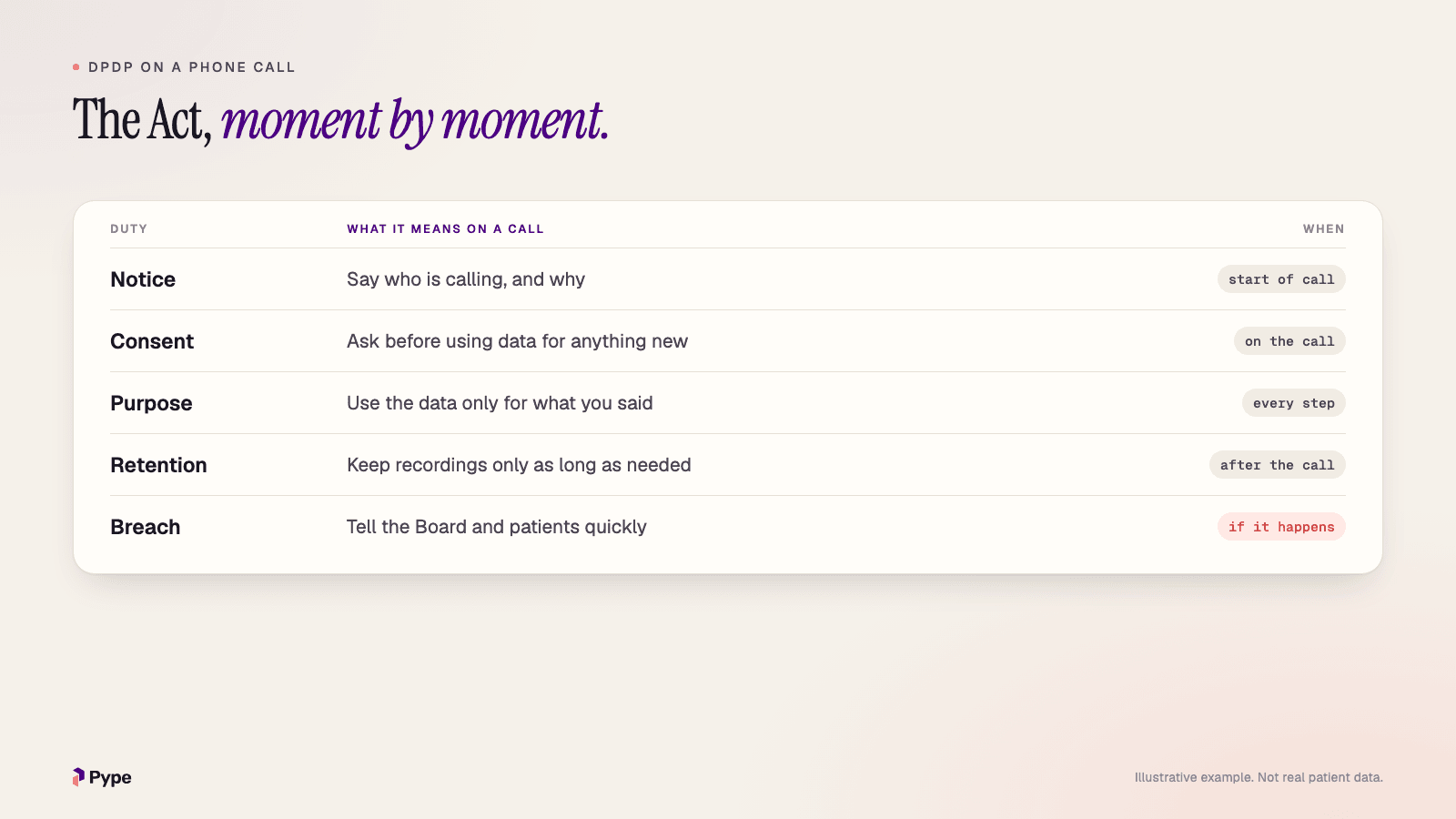
The Act, moment by moment on one call.
The Rules also set specifics worth knowing. A personal data breach must be reported to the Data Protection Board in detail within 72 hours, and processing logs must be kept for at least a year, according to the government's published Rules. Confirm the details with your legal team.
HIS integration
10. Does the voice agent need to connect to our HIS?
For anything beyond answering questions, yes. Without the HIS, the agent can only take a message. With it, the agent can see real OPD slots, book them, and confirm the booking before the call ends.
Let's take one call. Sunita, 54, calls the orthopaedics OPD:
"Mujhe Dr. Sharma ka appointment chahiye, knee pain ke liye. Thursday ho sakta hai?"
Here's what a well-integrated agent does:
| Step | What happens | Where |
|---|---|---|
| 1. Heard | Dr. Sharma, knee pain, Thursday | Speech recognition |
| 2. Looked up | Free OPD slots for Dr. Sharma on Thursday | Read from the HIS |
| 3. Offered | "11:30 ya 4 baje?" | On the call |
| 4. Booked | Sunita picks 11:30, the slot is written back | Written to the HIS |
| 5. Confirmed | SMS or WhatsApp with the time and token details | Messaging |
An illustrative example, not real patient data.
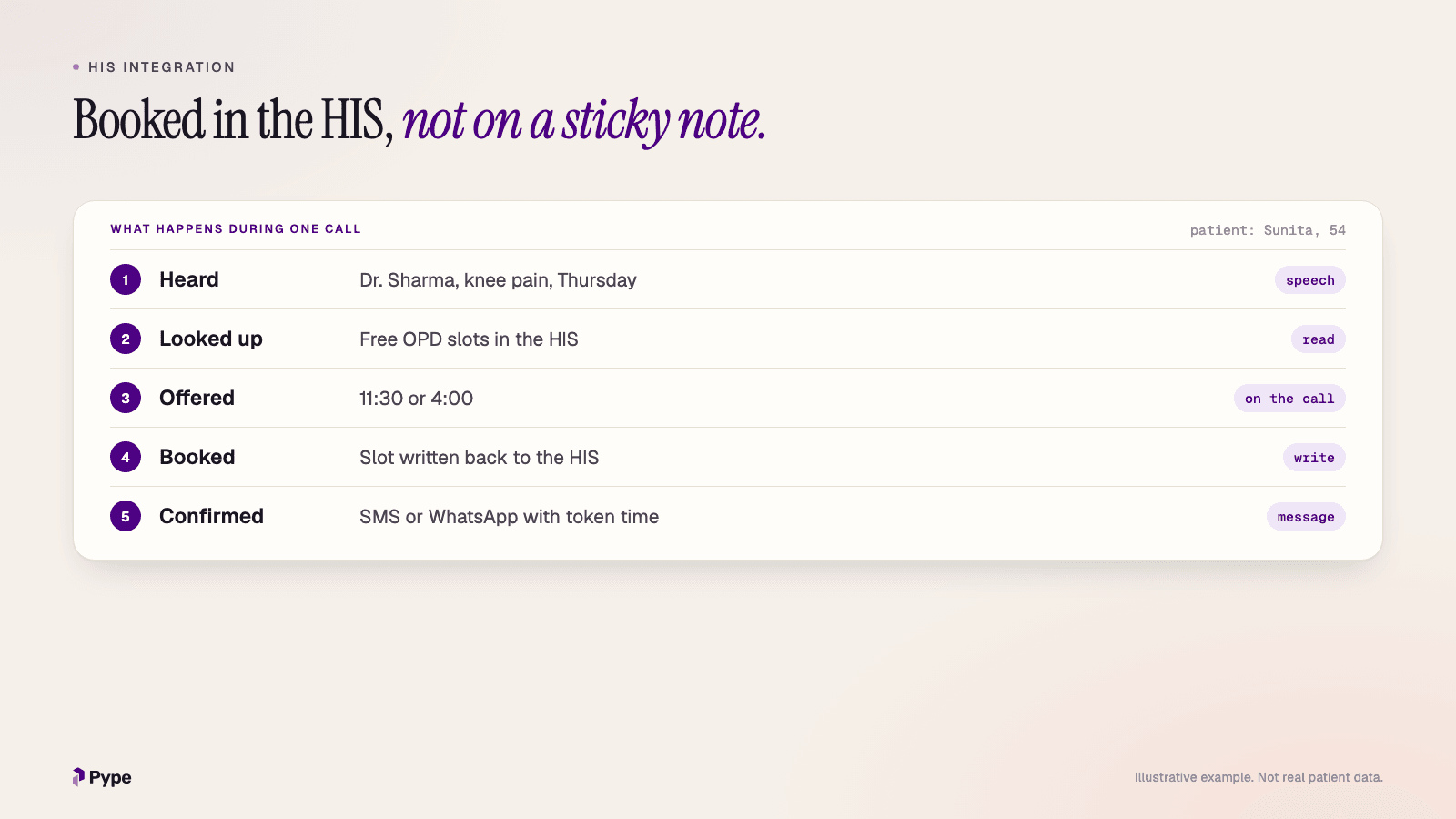
If it isn't in the HIS, it isn't booked.
11. What if our HIS is old or has no API?
This is common. Options include a small middleware layer, a read-only database view, or a shared booking sheet as a stopgap. Ask the vendor which HIS systems they've worked with before, and how they handle a slot that gets taken by the front desk during the call.
12. Does ABDM matter for voice agents?
Increasingly. The Ayushman Bharat Digital Mission had seen close to 69 crore ABHA health IDs created by November 2024, according to the Ministry of Health. A voice agent doesn't need ABDM to book an appointment, but hospitals already on ABDM-certified systems will want new tools to fit that setup, not work around it.
Cost and where to start
13. How much does an AI voice agent cost for a hospital in India?
Pricing is usually per minute of calls or per call handled, plus a setup fee for integration and testing. The real number depends on call volume, languages and how deep the HIS integration goes. Compare vendors on the cost per completed task (a booking actually made), not just the per-minute rate.
14. How do we measure if it's working?
Pick a few numbers before you start: calls answered, tasks completed on the call, calls handed to staff and why, and patient complaints. Then listen to a sample of real calls every week. Dashboards miss things that a five-minute listen catches.
15. Where should a hospital start?
Small. One call type, real languages, one system, clear numbers.
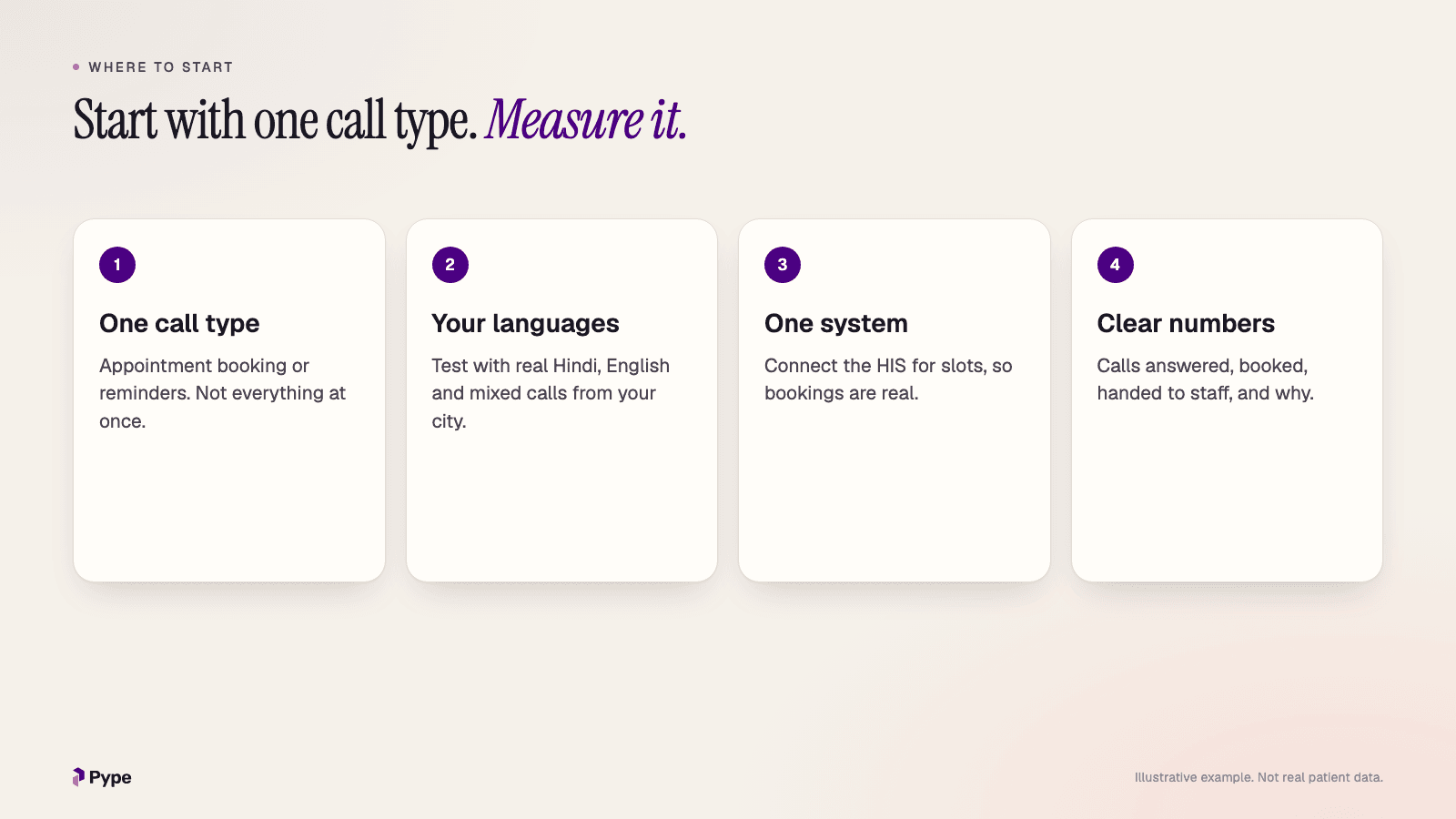
Start with one call type, and measure it.
Appointment reminders or OPD booking are usually the best first step. They're high volume, low risk and easy to measure. For the vendor conversation itself, our 10 questions to ask AI voice agent vendors is a good checklist.
How we approach this at Pype
A short note, since people ask. Our agents handle work like appointment reminders, inbound scheduling, enquiries and patient recall for hospitals, in the languages their patients actually speak. Every change ships as a new agent version, after testing, and we monitor live calls with Whispey, our open-source observability tool for voice agents.
Key takeaways
- An AI voice agent in an Indian hospital handles calls like OPD booking, reminders and follow-ups, in Hindi, English, regional languages and mixes of them.
- Test languages on real calls from your city. Names are where speech recognition slips most.
- The DPDP Act applies. Most core duties start in May 2027, so build notice, consent and retention in now.
- HIS integration turns the agent from a message-taker into something that actually books.
- Start with one call type, measure it, then grow.
None of this is magic. It's a lot of careful testing and a lot of listening to real calls. But when the phones stop ringing out at 9 AM, it's worth it :)
Frequently asked questions
What is an AI voice agent for hospitals in India?
Software that answers and makes patient calls in natural speech, in Hindi, English, regional languages or a mix, and completes tasks like booking OPD appointments and sending reminders. It hands calls to staff when a person is needed.
Can an AI call centre for hospitals work in Hindi and English?
Yes. Good agents handle Hindi, English and Hinglish, including switches mid-sentence. Test with real callers from your region before going live.
Is an AI voice agent compliant with the DPDP Act?
It can be, if the setup includes clear notice, consent where needed, purpose limits, sensible retention and a breach process. The hospital stays responsible as the data fiduciary, so check the vendor's contract and practices.
Does an AI voice agent need HIS integration?
To book real appointments, yes. Without it, the agent can only answer questions or take messages for staff to process later.
What is the best first use case for an AI voice agent in an Indian hospital?
Appointment reminders or OPD booking. They're high volume, low risk and easy to measure, so you learn quickly before expanding.
About the author
Ashish Tripathy is the founder of Pype AI, which builds voice AI agents for hospitals and healthcare providers. Pype also maintains Whispey, an open-source, OpenTelemetry-based observability tool for voice AI agents.