
How to choose an AI voice agent for your hospital: 10 questions to ask vendors
How to choose an AI voice agent for your hospital: 10 questions to ask vendors
There's no single best AI voice agent for healthcare. There's the one that holds up on your calls. Here are the 10 questions that tell you which one that is.
Ashish Tripathy, Founder, Pype AI | 14 October 2026 | 8 minute read
The best AI voice agent for healthcare is the one that handles your hardest patient calls safely, connects to your real systems, hands over to a human when it should, and lets you see why it did what it did. Brand, voice quality and a slick demo matter much less than those four things.
The fastest way to find it is to ask every vendor the same 10 questions, on your own calls, and compare the answers side by side.
Quick context. At Pype AI we build voice agents that talk to patients for hospitals. Over millions of minutes of calls, I've sat on both sides of a lot of vendor conversations. This is the list I'd want a hospital to bring to us, and to everyone else.
If you're new to the category, start with our plain guide, What are AI voice agents for healthcare?. This post picks up where that one ends.
Why "best of" lists won't pick for you
Search for the best voice AI agents for hospital call centers and you'll find plenty of top-10 lists. They're useful for building a shortlist. They can't tell you which agent will work in your hospital.
Here's why. A list compares features. Your risk lives in the details: the patient who mentions chest pain halfway through a booking, the caller who switches from English to Hindi, the nurse line that's busy at 3:40 on a Tuesday. No list tests those for you.
So use lists to shortlist. Use questions to decide.
10 questions to ask before you buy a healthcare voice agent
Bring these to every vendor. Ask them in the same order. Write the answers down.
1. Will you run a live test call on our hardest scenario?
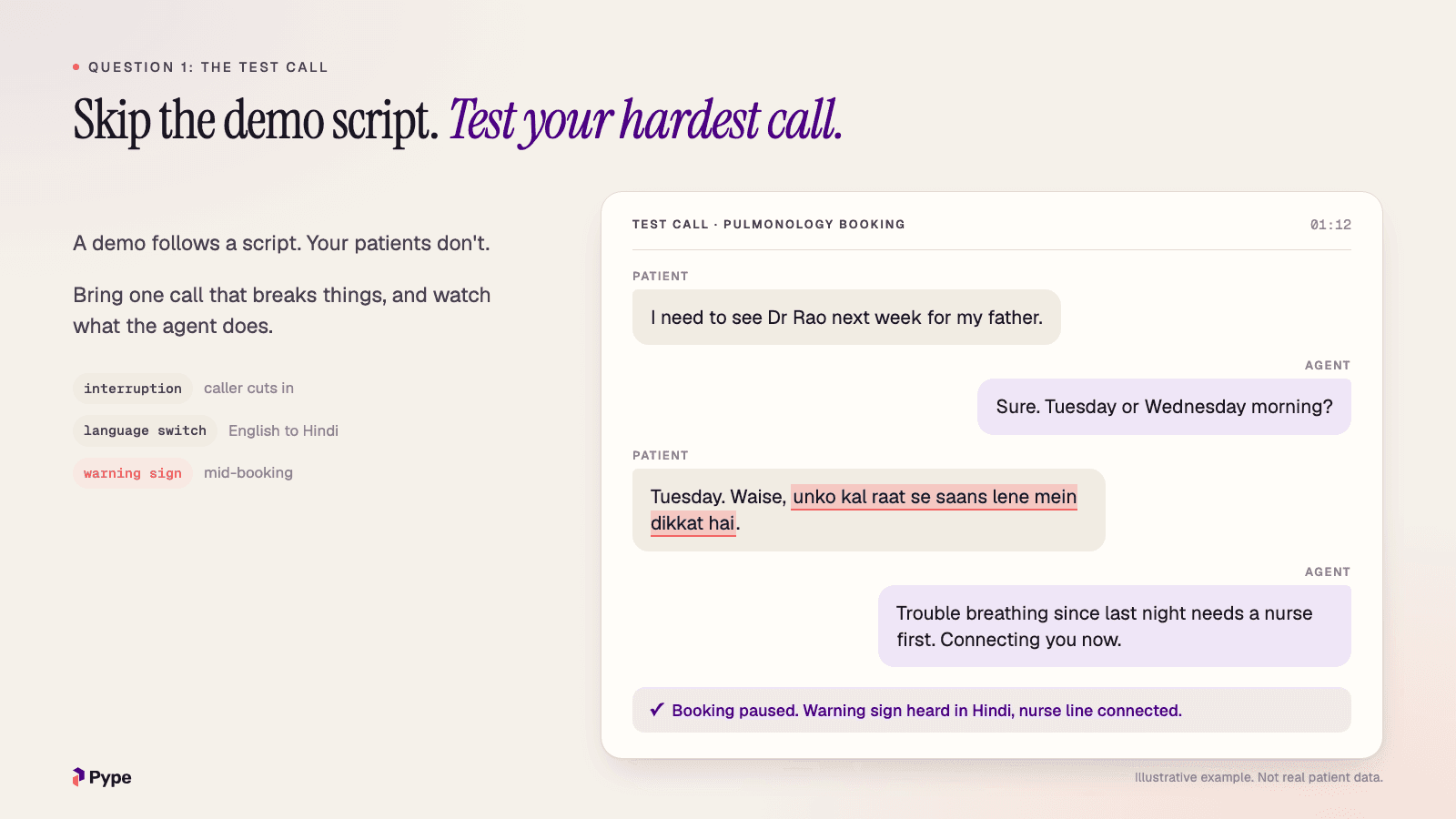
A good vendor says yes without flinching. Don't accept the demo script. Bring one call that breaks things: an interruption, a language switch, and a warning sign in the middle of a booking.
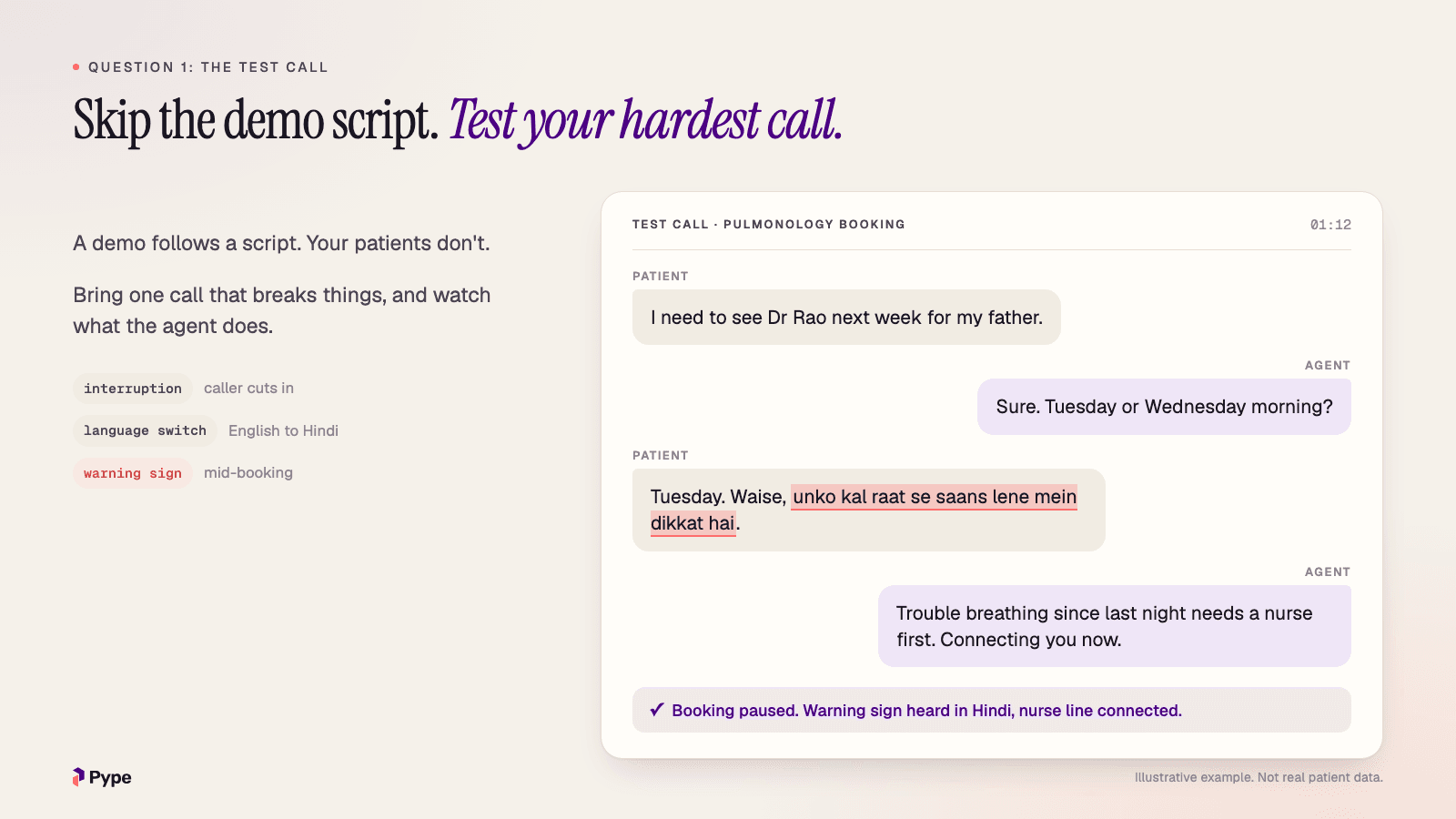 A demo follows a script. Your patients don't.
2. What happens when the agent hears a warning sign?
Ask who wrote the rule, and whether a clinician signed it off. "The model figures it out" is not an answer. A written, versioned rule is. We go deep on this in How to build auditable AI agents for healthcare.
3. And what happens when nobody picks up?
Every vendor says "it escalates to a human." Push one step further. What if the nurse line is busy? How long does the patient wait? What does the agent say while they wait?
The good answer has a fallback. The weak answer has silence.
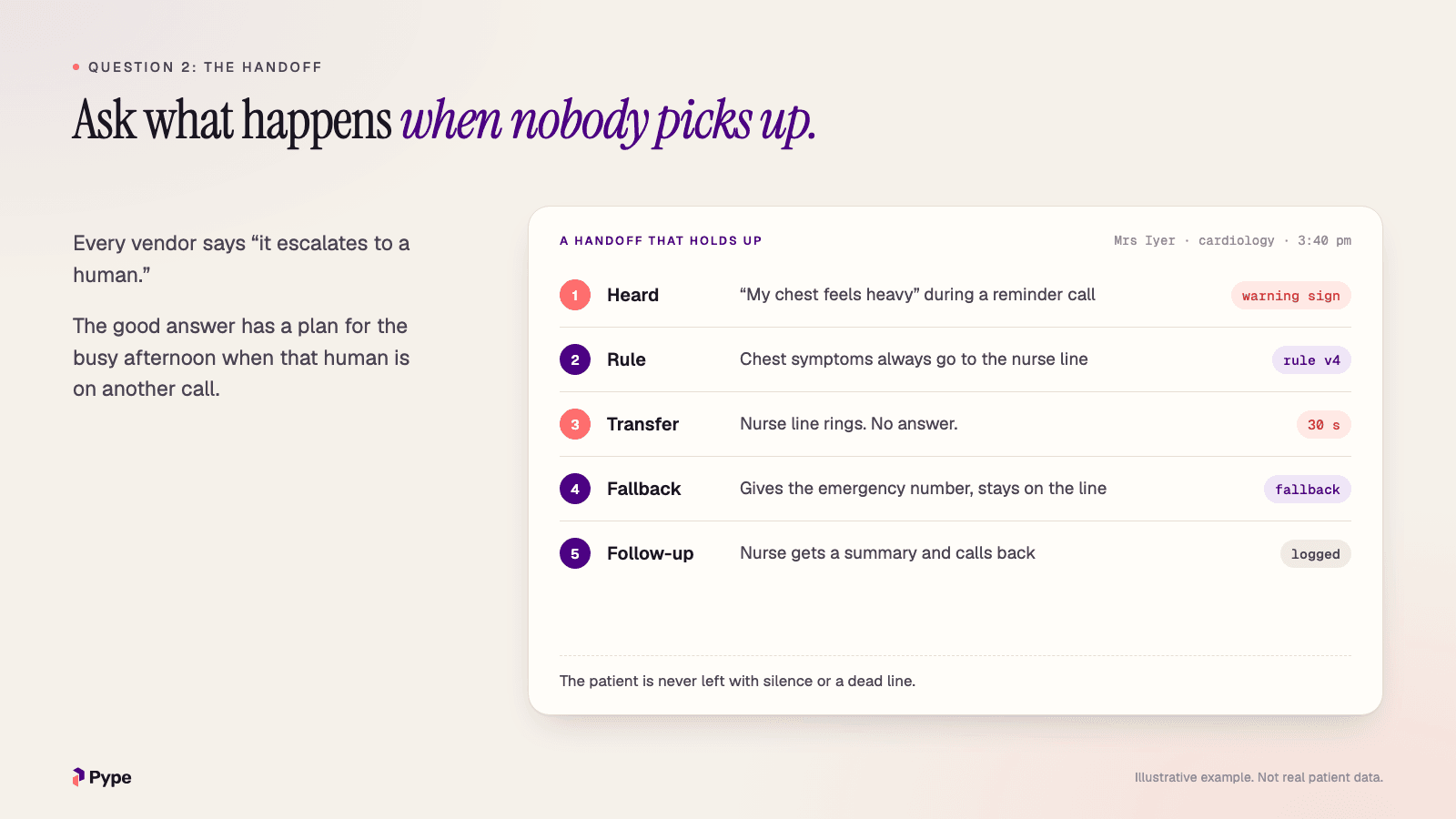 Ask about the busy afternoon, not the perfect one.
4. Does it read and write to our real systems?
If the agent can't see real slots in your HIS, EHR or CRM, it can't really book. It can only take a message. Ask which systems they've connected to before, and what happens when your system is slow or down.
5. How does it handle our languages and accents?
This matters a lot in India, and more than people expect in the US. Ask to hear it with your patients' real speech: mixed languages, elderly callers, bad lines. Ask specifically how it handles drug names, doctor names and department names, because those are the words speech-to-text finds hardest.
6. What can we see after every call?
A transcript is the minimum. You want to see why the agent did what it did: what it heard, how sure it was, which rule it followed. If the vendor can only show you words, you'll struggle to fix anything.
7. How do you test changes before they go live?
Agents change all the time. A prompt tweak, a new rule, a new model. Ask whether every change is a new version, whether safety paths are tested as pass or fail, and who signs off before go-live.
8. How do you review calls once we're live?
Ask how bad calls get found. An automated check, a human review, or both? How often? And how fast does a fix reach production? Our piece on how healthcare teams monitor voice AI in production covers what good looks like here.
9. Is it a HIPAA-compliant AI voice agent, and what about India?
In the US, ask for a signed business associate agreement that covers the AI product itself. HHS guidance is clear that a cloud provider handling patient data is a business associate even if it only stores encrypted data. For outbound reminder calls, also ask about consent: the FCC ruled in February 2024 that AI-generated voices count as "artificial" under the TCPA, so the usual calling rules apply.
In India, the DPDP Rules were notified in November 2025, with most duties phasing in by May 2027. We wrote up what Indian hospitals need to know about the DPDP Act.
Not legal advice. Bring your compliance team in early.
10. Can we start small, and what does the pilot look like?
A vendor confident in their product will happily start with one call type and a written go-live gate. Be wary of anyone who wants every department live in week one.
A worked example: two vendors, one question
Let's take one question, number 3, and two made-up vendors.
You ask: "A patient mentions chest pain during a reminder call. Your agent transfers to our nurse line. Nobody answers. What happens next?"
Vendor A: "Our agent escalates to a human."
Vendor B: "After 30 seconds with no answer, it gives the patient the emergency number and stays on the line. Then it sends the nurse a summary and logs a callback. Here's the rule, and here's the test we run on it before every release."
Same question. Very different answers. Here's how they score.
| What you're checking | Vendor A | Vendor B |
|---|---|---|
| Is there a written rule? | Not mentioned | Yes, and they showed it |
| Is there a fallback if nobody answers? | No | Yes, after 30 seconds |
| Does the patient ever hear silence? | Possibly | No |
| Is the handoff tested before release? | Unknown | Yes, pass or fail |
| Does anyone follow up? | Unknown | Nurse gets a summary |
The vendors are invented. The difference in answers is very real.
Vendor A might still be a fine product. But you've learned nothing you can check. Vendor B gave you something you can test on a live call tomorrow.
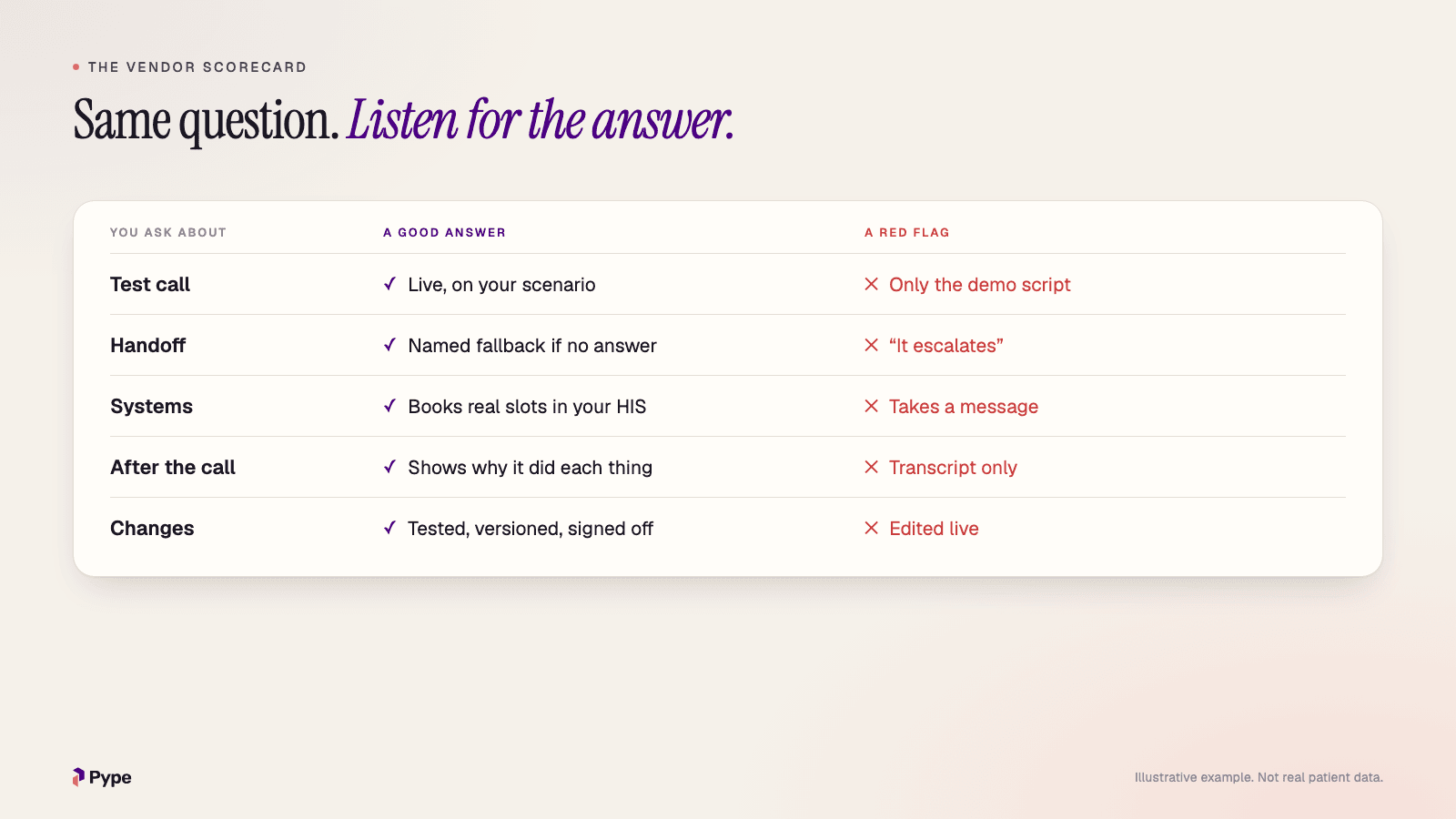 Same question to every vendor. Listen for the specifics.
How to run a fair pilot
Once you've got two or three vendors left, run a short pilot. Keep it simple.
- Pick one call type. Appointment reminders for one department is a great start. Low risk, easy to measure.
- Test the hard paths first. Emergencies, interruptions, language switches. Treat them as pass or fail, not as an average.
- Go live small. A slice of calls, with staff ready to step in.
- Review flagged calls every day. A person reads them. Every fix ships as a new version.
Measure the same things for every vendor: task completion, correct handoffs, patient complaints, and how fast problems get fixed.
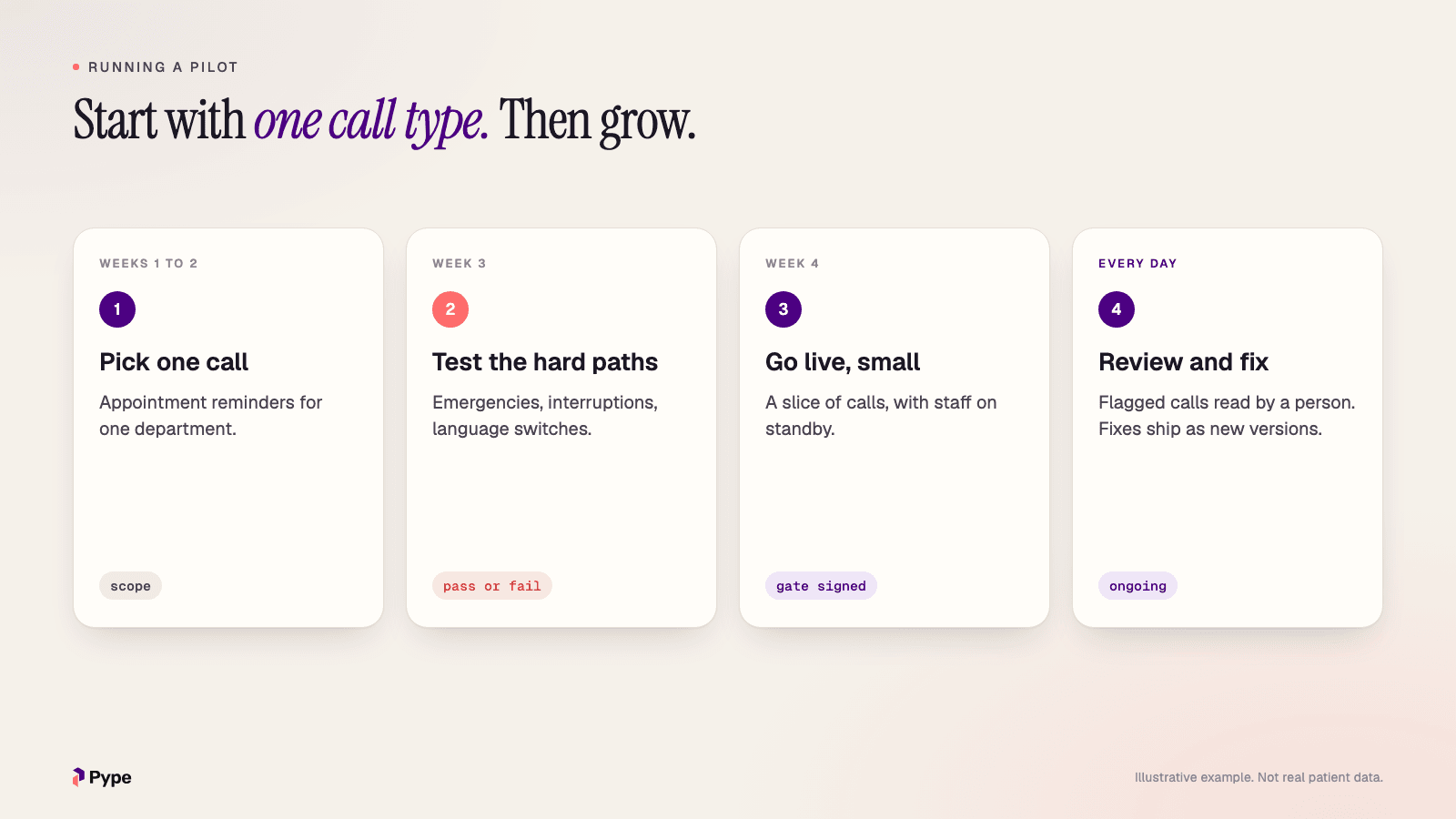 Start with one call. Earn the next one.
How we approach it at Pype
Briefly, since this is our space. We build voice agents for hospitals, for reminders, scheduling, enquiries, procedure prep, recall and consent. Every agent is scored on about two dozen metrics before go-live, goes through two rounds of human QA and the hospital's own testing, and every fix after launch ships as a new version. We'd expect you to ask us all 10 of these questions too.
Key takeaways
- There's no single best AI voice agent for healthcare. There's the one that holds up on your calls.
- Use "best of" lists to shortlist and these 10 questions to decide.
- Test live on your hardest scenario, not the demo script.
- Ask what happens when nobody picks up. The fallback tells you a lot.
- Insist on seeing why the agent did what it did, not just a transcript.
- Check HIPAA, TCPA consent and DPDP with your compliance team early.
- Pilot one call type with a written go-live gate before you scale.
Frequently asked questions
What is the best AI voice agent for healthcare?
There isn't one answer for every hospital. The best AI voice agent for healthcare is the one that handles your hardest calls safely, connects to your systems, hands over to a human reliably, and shows you why it acted. Test shortlisted vendors on your own scenarios to find it.
What should I ask an AI voice agent vendor?
Start with a live test call on your hardest scenario, how warning signs are handled, what happens when nobody answers a transfer, which systems it connects to, and what you can see after every call. Then ask how changes are tested and how calls are reviewed once live.
Is there a HIPAA-compliant AI voice agent for healthcare?
Compliance depends on how the agent is built and contracted, not the product name. In the US, the vendor needs a signed business associate agreement covering the AI product, plus proper safeguards for patient data. Confirm the details with your compliance team.
What are the best voice AI agents for hospital call centers?
The best ones for hospital call centers handle high volume without losing safety: they triage warning signs, transfer reliably, work in your patients' languages, and book directly into your systems. Shortlist from published lists, then run the same pilot with each.
How long should a healthcare voice agent pilot take?
A focused pilot on one call type can run in about four to six weeks: a couple of weeks to set up, a week of hard-path testing, then a small live rollout with daily review. Expand only after the go-live gate is met.
Can an AI voice agent work for small clinics too?
Yes. The same questions apply to an AI voice agent for clinics, just at a smaller scale. Start with reminders or after-hours booking, and make sure there's a clear handoff to your staff.
Picking a vendor is a big decision, but it doesn't have to be a guessing game. Ask the same 10 questions, listen for specifics, and let your hardest call do the judging :)
About the author
Ashish Tripathy is the founder of Pype AI, which builds voice AI agents for hospitals and healthcare providers. Pype also maintains Whispey, an open-source, OpenTelemetry-based observability tool for voice AI agents.