
What are AI voice agents for healthcare? A plain guide for hospitals
What are AI voice agents for healthcare? A plain guide for hospitals
AI voice agents for healthcare answer and make patient phone calls in natural speech. What they do, how one call works, what can go wrong, and how to choose one.
Ashish Tripathy, Founder, Pype AI | 14 October 2026 | 8 minute read
AI voice agents for healthcare (often called healthcare voice agents) are software systems that hold real phone conversations with patients. They listen to what the caller says, understand it, connect to the hospital's systems, and reply in a natural voice, so they can book appointments, send reminders, answer questions and route urgent calls without a patient waiting on hold.
They are not the old phone menus ("press 1 for appointments"). The patient just talks, the way they would to a person at the front desk. That's why you'll also hear them called an AI receptionist for hospitals and clinics.
Quick context. At Pype AI we build voice agents that talk to patients for hospitals. After millions of minutes of these calls, this is the plain guide I wish more hospital teams had before their first conversation with any vendor.
What do AI voice agents for healthcare actually do?
AI voice agents for healthcare take the phone calls that are high in volume and fairly predictable, for hospitals and for smaller practices looking at an AI voice agent for clinics. Most hospitals start with the calls that are high in volume and fairly predictable. The common ones:
- Inbound scheduling. A patient calls to book, move or cancel an appointment.
- Patient appointment reminders. The agent calls ahead of a visit to confirm, reschedule or cancel.
- Enquiries. Timings, directions, which doctor sees which condition, what to bring.
- Procedure prep. Walking a patient through instructions before a scan, surgery or IVF step.
- Patient recall. Reaching patients who are due for a follow-up or a repeat test.
- Lead qualification and consent. Collecting the right details before a human takes over, and recording consent clearly.
The common thread: these are conversations that follow a shape, happen thousands of times a month, and tie up staff who could be doing work only a person can do.
How does an AI voice agent work? One call, step by step
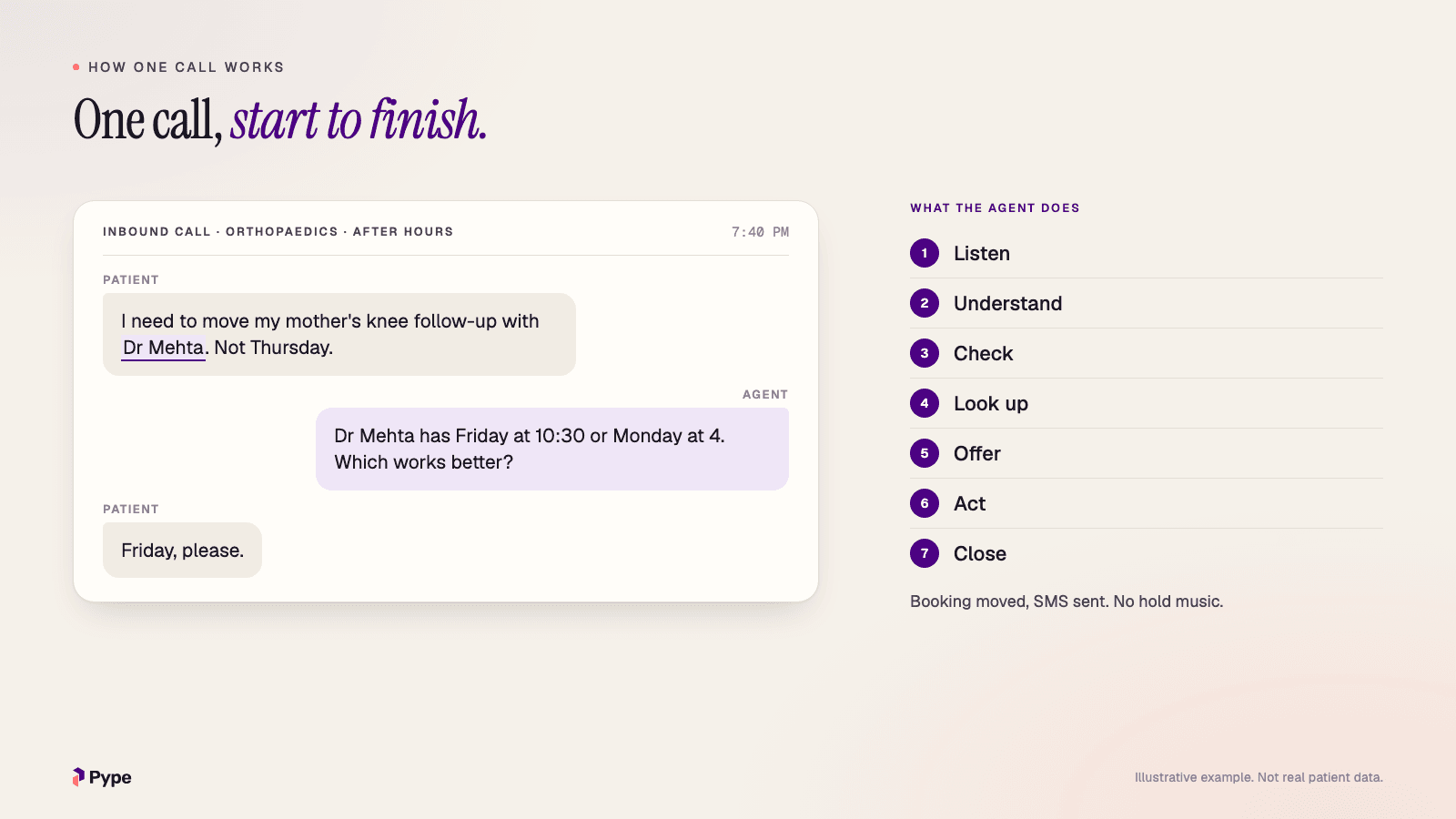
Let's take one call. Mrs Rao rings a hospital at 7:40 in the evening. The front desk closed at 7.
"Hi, I need to move my mother's knee follow-up with Dr Mehta. She can't come on Thursday."
Here's what happens inside the agent, in about the time it takes her to finish the sentence.
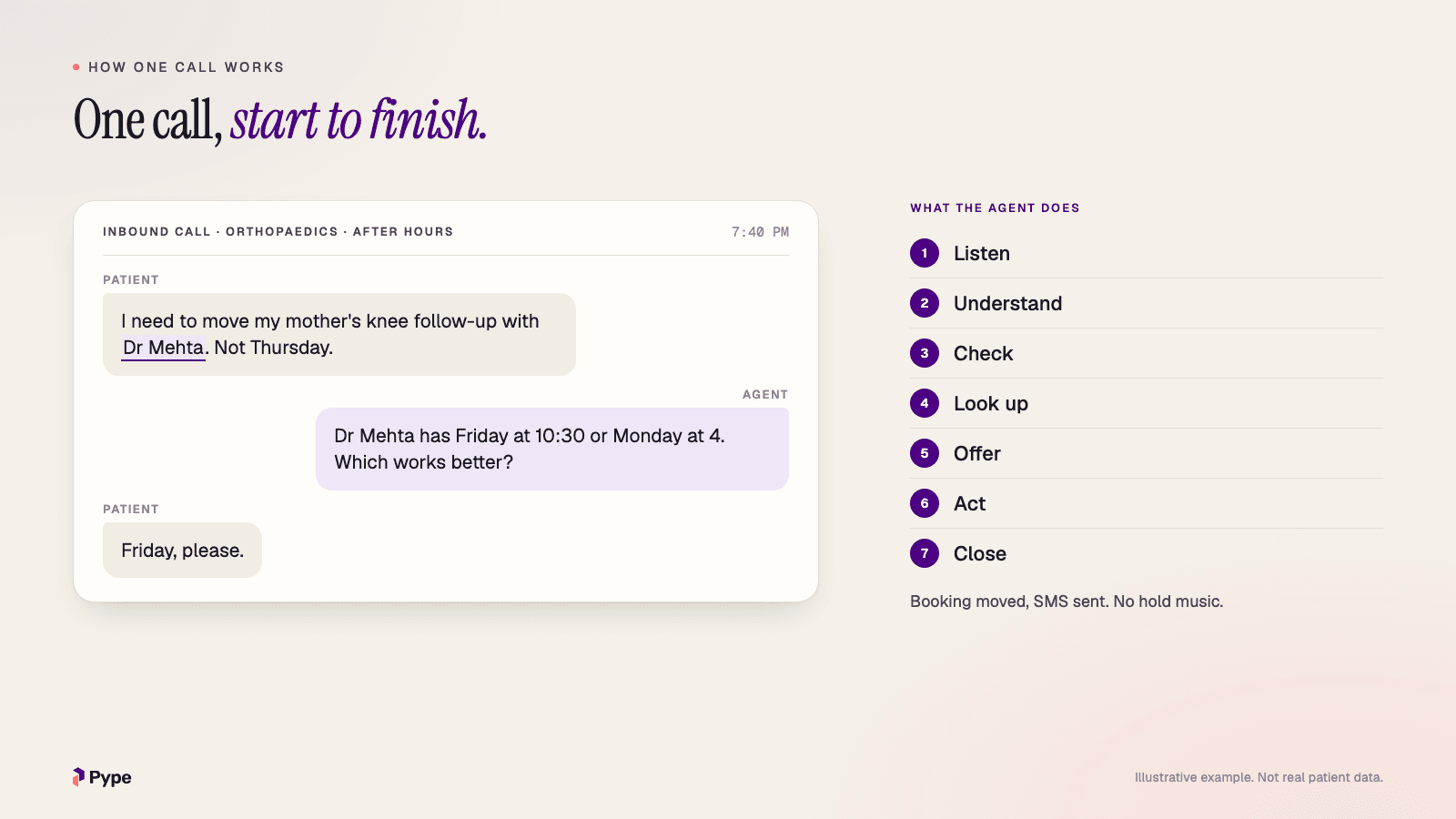 One reschedule at 7:40 in the evening, and the seven steps behind it.
| Step | What happens | Plain version |
|---|---|---|
| 1. Listen | Speech-to-text turns her voice into words | The agent "hears" her |
| 2. Understand | A language model works out the intent and details | Reschedule, patient is her mother, orthopaedics, Dr Mehta, not Thursday |
| 3. Check | The agent confirms who the patient is | Asks for the patient's name and date of birth |
| 4. Look up | It calls the hospital's scheduling system | Finds the current booking and Dr Mehta's open slots |
| 5. Offer | It suggests options in plain speech | "Dr Mehta has Friday at 10:30 or Monday at 4. Which works better?" |
| 6. Act | It moves the booking once she picks | Writes the new slot back to the system |
| 7. Close | It confirms and sends a reminder | Repeats the date and time, sends an SMS |
Behind the scenes there are three core parts: speech-to-text (listening), a language model with rules and tools (thinking and acting), and text-to-speech (talking back). Around those sit the connections to the hospital's systems, usually the HIS, EHR or CRM, so the agent works with real data rather than guessing.
Now change one line. Suppose Mrs Rao adds: "Also, her knee has been very swollen and hot since yesterday." A good agent does not just move the booking. It recognises a possible warning sign, follows the hospital's written rule for it, and hands the call to a nurse or gives the right urgent advice. That handoff is the most important thing to check in any healthcare voice agent, and we'll come back to it.
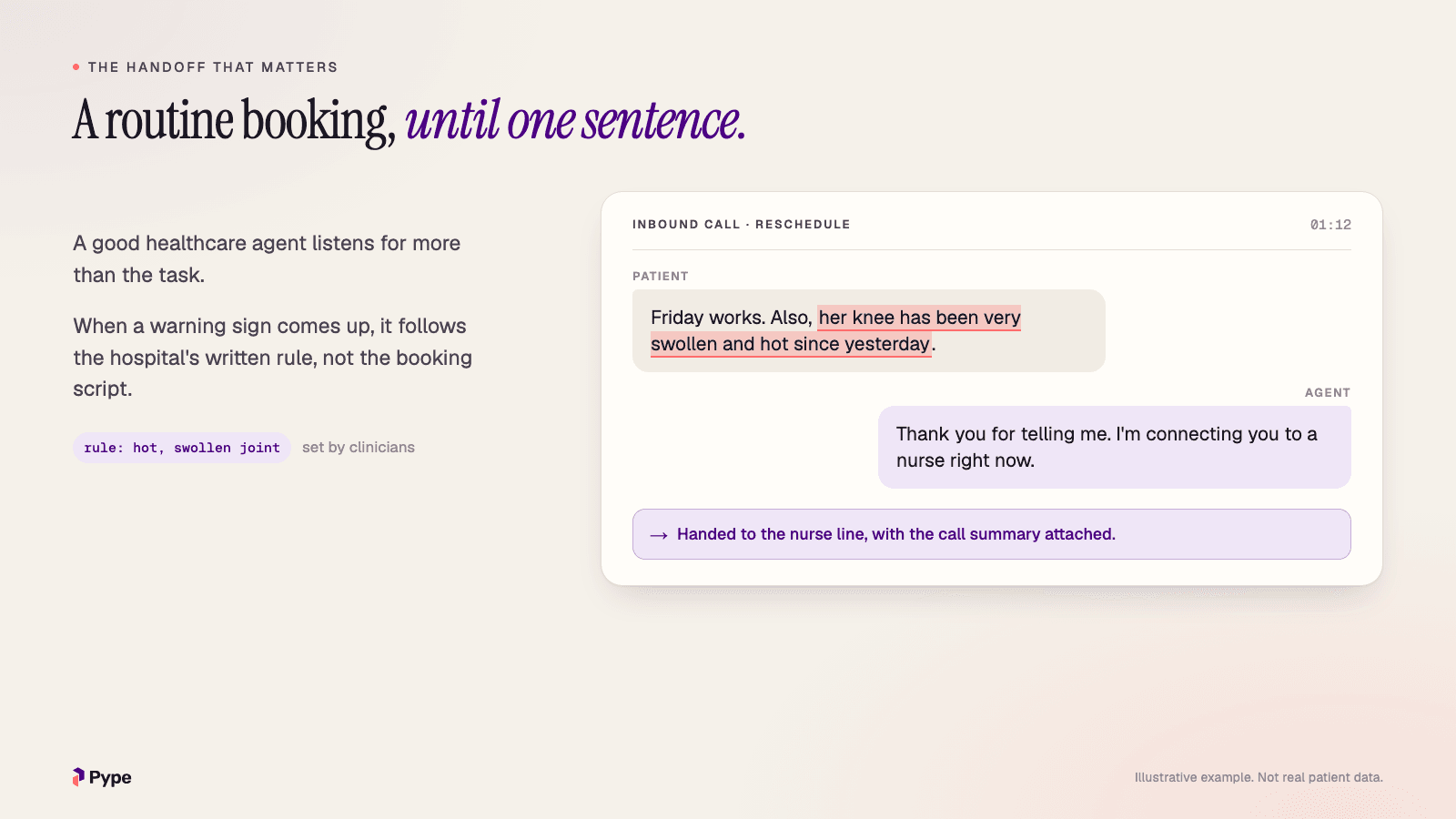 The booking can wait. A warning sign goes to a nurse.
Why are hospitals using healthcare voice agents now?
Three plain reasons, and they're the same ones behind every AI call center for healthcare.
The phone is still the front door. For many patients, especially older ones, calling is how they reach a hospital. And waiting on the line matters to them. A 2019 study in the American Journal of Managed Care found that longer phone waits were linked to patients feeling less able to get timely urgent appointments.
Missed appointments are expensive, and reminder calls reduce patient no-shows. No-show rates in primary care are often reported between 15 and 30 percent. A 2023 systematic review in BMC Health Services Research found strong evidence that reminders, by text, phone or mail, reduce no-shows across many settings. A voice agent can make those reminder calls for every appointment, every day, and actually let the patient reschedule on the same call.
The technology finally sounds human enough. Speech recognition, language models and synthetic voices have all improved enough that a patient can talk normally, interrupt, change their mind, and still be understood. A few years ago that wasn't true.
AI receptionist vs IVR vs a human receptionist
| Phone menu (IVR) | AI voice agent | Human receptionist | |
|---|---|---|---|
| How the patient speaks | Presses keys or says set words | Talks naturally | Talks naturally |
| Hours | 24/7 | 24/7 | Office hours, usually |
| Can it complete a booking? | Rarely | Yes, if connected to the hospital's systems | Yes |
| Handles many calls at once | Yes | Yes | One at a time |
| Judgement in unusual cases | None | Limited, follows written rules | Strong |
| Best used for | Simple routing | High-volume, predictable calls | Complex, sensitive or unusual calls |
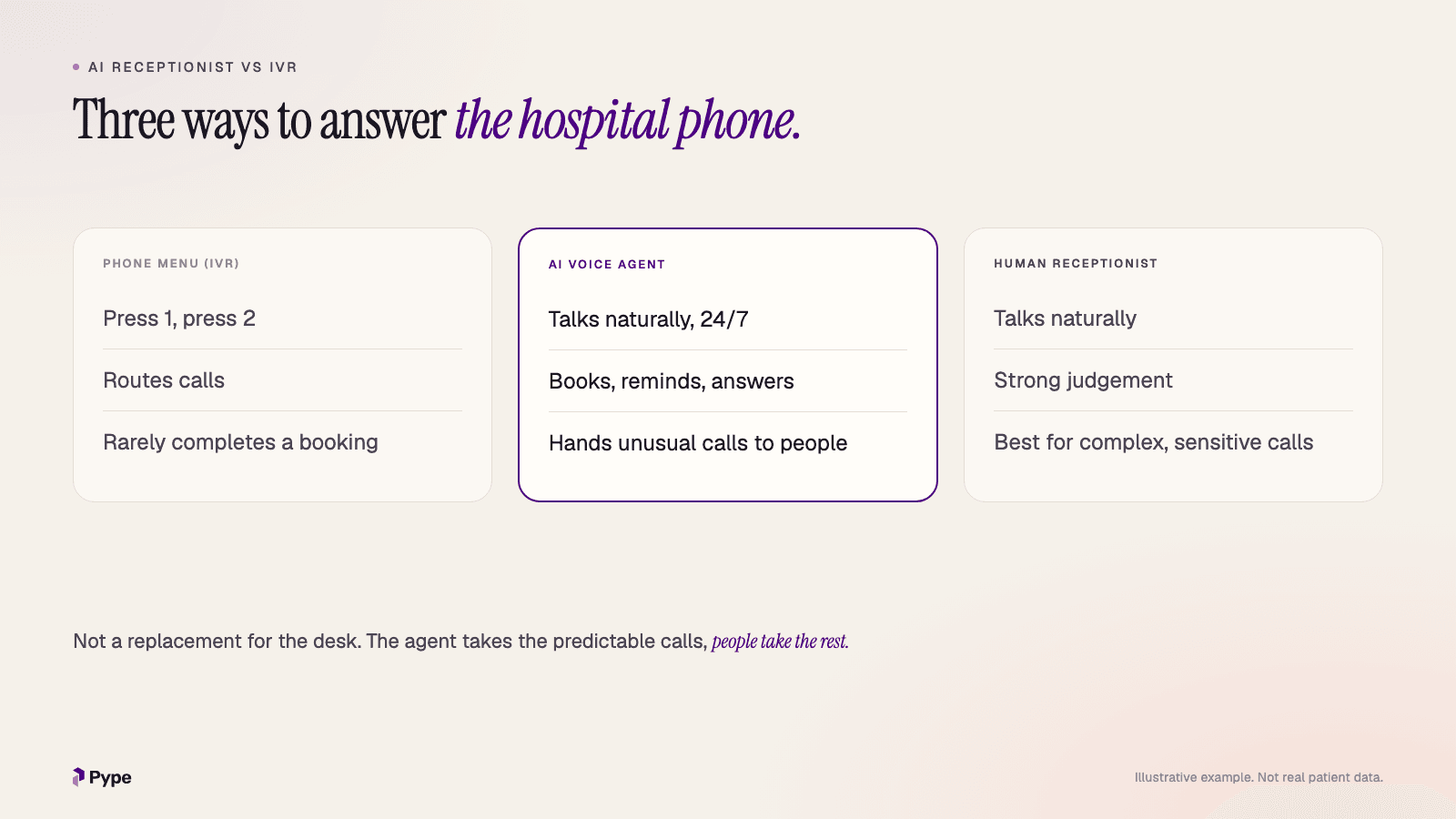 Each one has a job. The mistake is giving one of them all of them.
So is an AI receptionist for clinics and hospitals a replacement for your team? The right answer is almost never "replace the desk". It's letting the agent take the predictable calls so people have time for the ones that need a person.
What can go wrong with a healthcare voice agent?
This is the section I'd read twice. A generic voice agent, built for customer service and dropped into a hospital, can fail in ways that matter.
It finishes the task and misses the patient. An agent tuned only to book appointments might book Thursday at 11 for someone who just mentioned chest tightness. Task done. Patient at risk.
It mishears the important words. Drug names, doctor names and department names are exactly the words speech-to-text finds hardest. A clean-looking transcript can hide a wrong word, and the agent will act on it confidently.
It struggles with real callers. Patients may be elderly, unwell, anxious, on a bad line, in a noisy room, or switching between languages mid-sentence. These are the people least likely to correct the agent.
It says too much. A reminder left on voicemail shouldn't announce the reason for the visit. Privacy rules apply to calls just as they do to records.
None of these mean voice agents are unsafe. They mean a healthcare agent has to be built and tested for healthcare, with clear rules for when to hand over to a human, and with every call reviewable afterwards. We wrote more about that in How to Build Auditable AI Agents for Healthcare, and about watching agents once they're live in Beyond "It Works".
Is there a HIPAA-compliant AI voice agent for healthcare?
A voice agent isn't compliant or non-compliant on its own. A HIPAA-compliant AI voice agent is one that's built and contracted the right way.
In the US, a vendor that handles patient information on behalf of a hospital is a business associate under HIPAA, and needs a signed business associate agreement before it touches any patient data. Check that the agreement covers the AI product itself, not just an older phone platform. We go deeper on encryption, access and retention in Building Secure and Compliant Voice AI Systems for Healthcare.
In India, the DPDP Act sets its own rules on consent and data handling. We've covered that in DPDP Act 2025: What Every Indian Hospital Needs to Know.
This isn't legal advice. Bring your compliance team in early.
How to choose the best AI voice agent for healthcare
There's no single best AI voice agent for healthcare, or for hospital call centers. There's the one that holds up on your calls. A short checklist for your first vendor conversation, whether you run a single clinic or a large hospital call center:
- Ask for a live test call, on your hardest scenario. Not the demo script. Try an interruption, a language switch, and an emergency mentioned in the middle of a booking.
- Ask how it hands over to a human. When, to whom, and what happens if nobody answers.
- Ask what it connects to. Your HIS, EHR or CRM. If it can't read and write real slots, it can't really book.
- Ask what you can see after each call. A transcript is the minimum. You want to see why the agent did what it did.
- Ask how changes are tested. Every change to the agent should be tested before it goes live, and recorded.
- Ask about data. Where it's stored, who can see it, how long it's kept, and what agreements cover it.
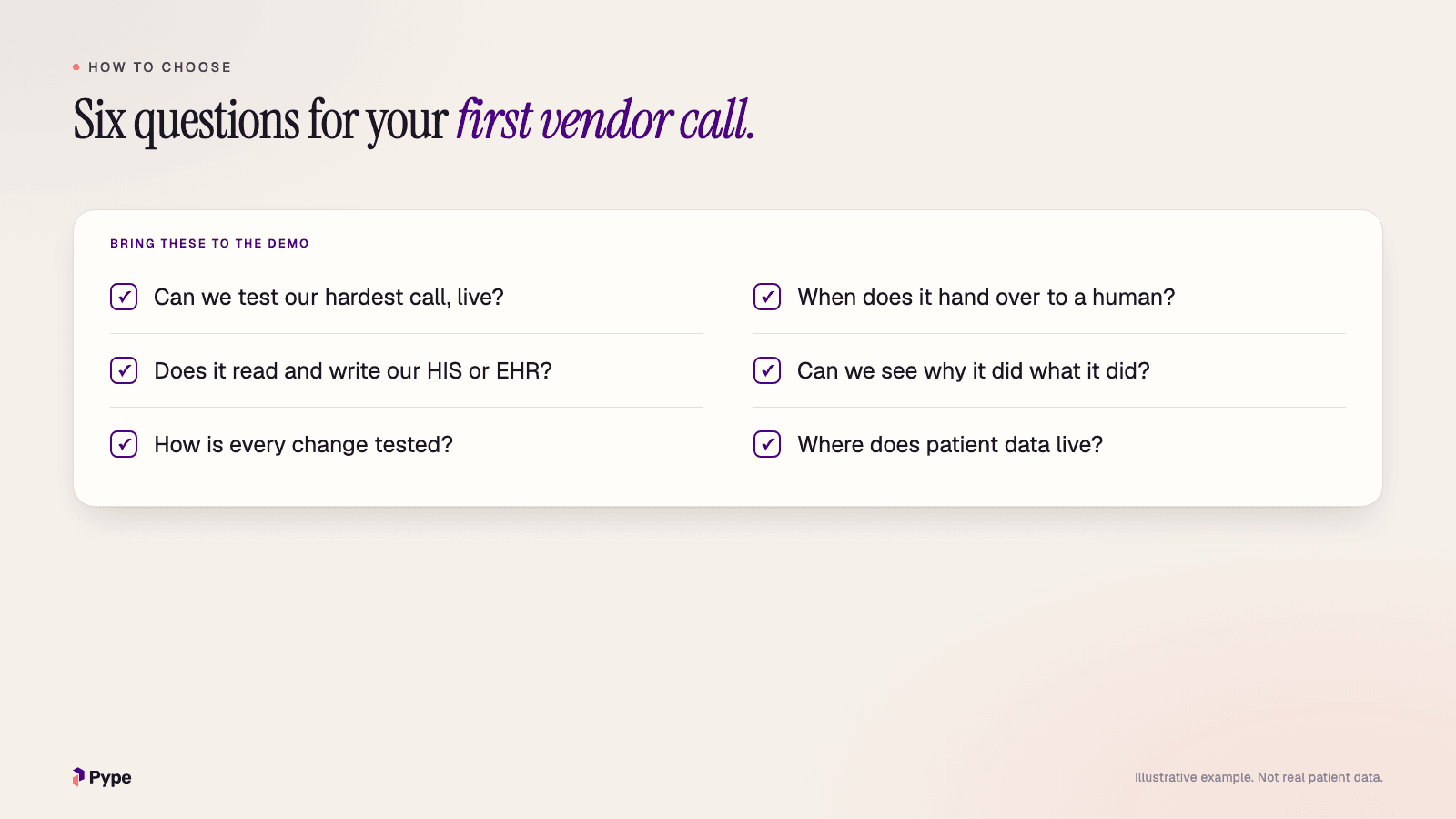 Print it, bring it, ask every vendor the same six.
How we approach it at Pype
Briefly, since you'll probably ask. We build healthcare voice agents for hospitals, covering reminders, inbound scheduling, enquiries, procedure prep, recall and consent. Every agent is scored on about two dozen metrics in testing and goes through two rounds of human QA and the hospital's own testing before it goes live. Once live, flagged calls are reviewed every day, and every fix ships as a new version. Our call tracing tool, Whispey, is open source.
Key takeaways
- An AI voice agent holds natural phone conversations with patients and connects to hospital systems to get things done.
- The best first uses are high-volume, predictable calls: scheduling, reminders, enquiries, recall.
- Reminders are well supported by research as a way to reduce no-shows.
- The biggest risks are missed warning signs, misheard words and difficult callers, so test for those first.
- Compliance depends on how the agent is built and contracted, not on a label.
If you're just starting, pick one call type, test it hard on your real patients' voices, and grow from there :)
Frequently asked questions
What are AI voice agents for healthcare?
Software that talks with patients on the phone in natural speech. It listens, understands, connects to the hospital's systems, and replies in a natural voice, so it can book appointments, send reminders and answer questions.
Can AI voice calls reduce patient no-shows?
Reminders by phone, text or mail are well supported by research as a way to reduce no-shows. A voice agent can call before every appointment and let the patient confirm or reschedule on the same call, if it's connected to the hospital's scheduling system.
Will an AI voice agent replace hospital receptionists?
In practice, no. It takes the repetitive, predictable calls so staff have more time for complex, sensitive or unusual ones.
What happens if a patient mentions an emergency to a healthcare voice agent?
A well-built healthcare agent follows a written rule set by clinicians: it hands the call to a nurse or gives urgent advice instead of carrying on with the booking. This is the most important behaviour to test.
Do AI voice agents work in more than one language?
Many do, including switching languages mid-call. Test it with real callers, because accents, background noise and mixed languages are where agents most often struggle.
What is the difference between an AI voice agent and an AI receptionist?
Mostly the name. An AI receptionist usually means a voice agent that answers inbound calls at the front desk. A healthcare voice agent can also make outbound calls, like reminders, recall and procedure prep.
About the author
Ashish Tripathy is the founder of Pype AI, which builds voice AI agents for hospitals and healthcare providers. Pype also maintains Whispey, an open-source, OpenTelemetry-based observability tool for voice AI agents.