
DPDP Act 2025: What Every Indian Hospital Needs to Know Before May 2027
The DPDP Act 2023: What Every Indian Hospital Needs to Know (And Do) Before May 2027
A comprehensive guide to DPDP compliance for healthcare leaders in India
Key Takeaways
- DPDP Rules notified November 2025; full compliance required by May 13, 2027
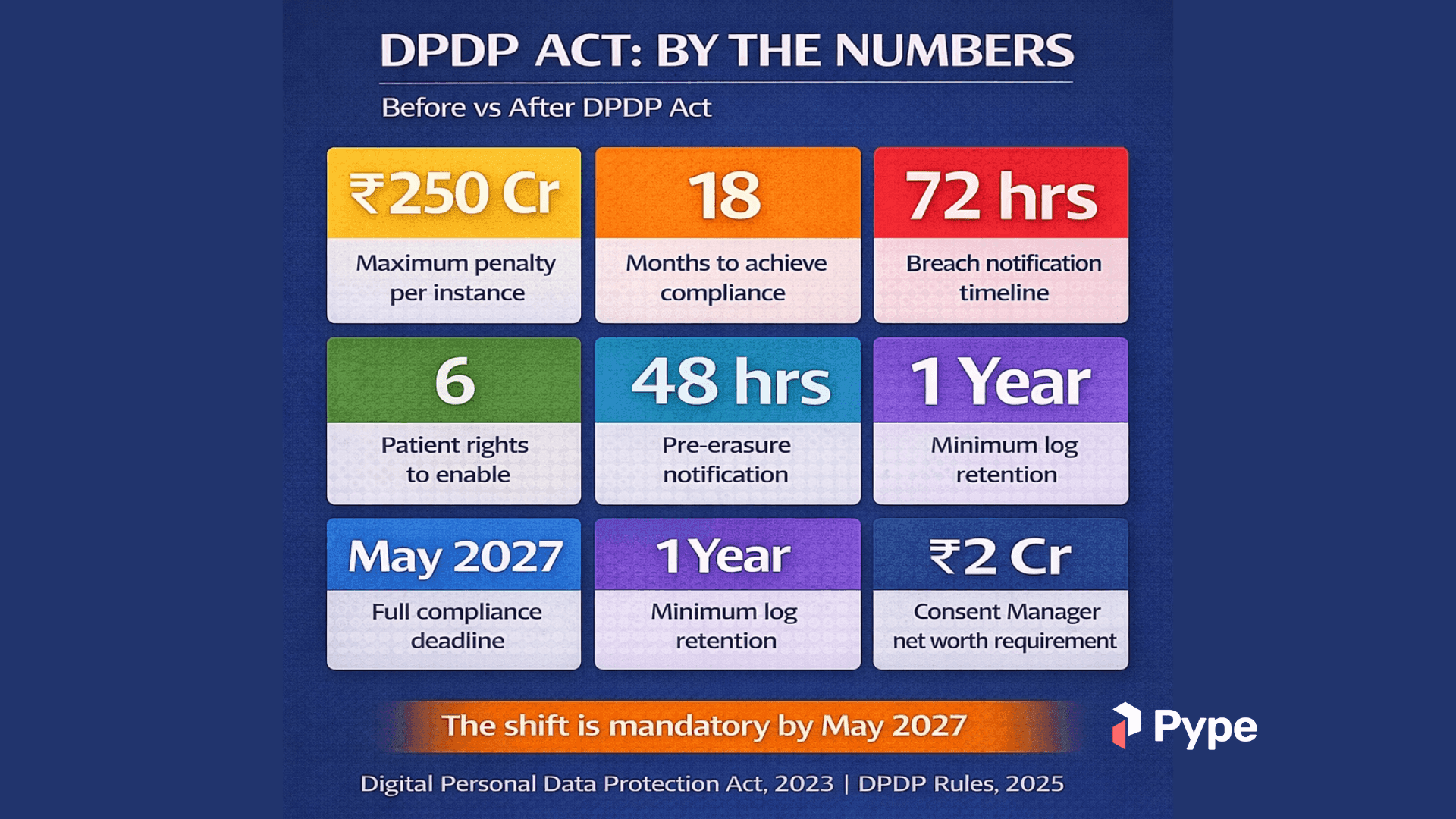
- Penalties up to Rs 250 crore per violation for security failures, applied per instance
- Healthcare faces unique challenges: legacy EHR systems, consent redesign, vendor compliance
- Hospitals must act now. 18 months is insufficient for most organizations with legacy infrastructure
- The Data Protection Board of India is already operational and will begin enforcement in 2027
Download Official Documents
Download DPDP Act 2023 (Official Gazette PDF)
Download DPDP Rules 2025 (Official Gazette PDF)
MeitY Data Protection Framework Page
Introduction: The Clock is Ticking
India's healthcare sector is facing its most significant regulatory transformation in decades. The Digital Personal Data Protection (DPDP) Act, combined with the DPDP Rules 2025, has created India's first comprehensive framework for healthcare data privacy. For hospitals, clinics, and healthtech companies, DPDP compliance is no longer optional. It's a legal mandate with penalties reaching Rs 250 crore per violation.
With the full compliance deadline of May 2027 approaching and the Data Protection Board of India already established, healthcare organizations can no longer treat patient data protection as an afterthought. This article breaks down what the DPDP Act means for Indian healthcare, why it matters more for hospitals than almost any other sector, and the practical steps organizations must take to achieve compliance.
Part 1: Understanding the DPDP Act
What is the DPDP Act?
The Digital Personal Data Protection Act, 2023, is India's first comprehensive digital privacy legislation. Passed on August 11, 2023, and operationalized through the DPDP Rules notified on November 13, 2025, it creates a rights-based framework governing how organizations collect, process, store, and protect personal data.
Unlike previous regulations under the IT Act that offered fragmented guidance, the DPDP Act establishes clear, enforceable standards with significant penalties for non-compliance. The framework mirrors global standards like GDPR while accounting for India's unique digital ecosystem.
Key Timelines and Rollout Phases
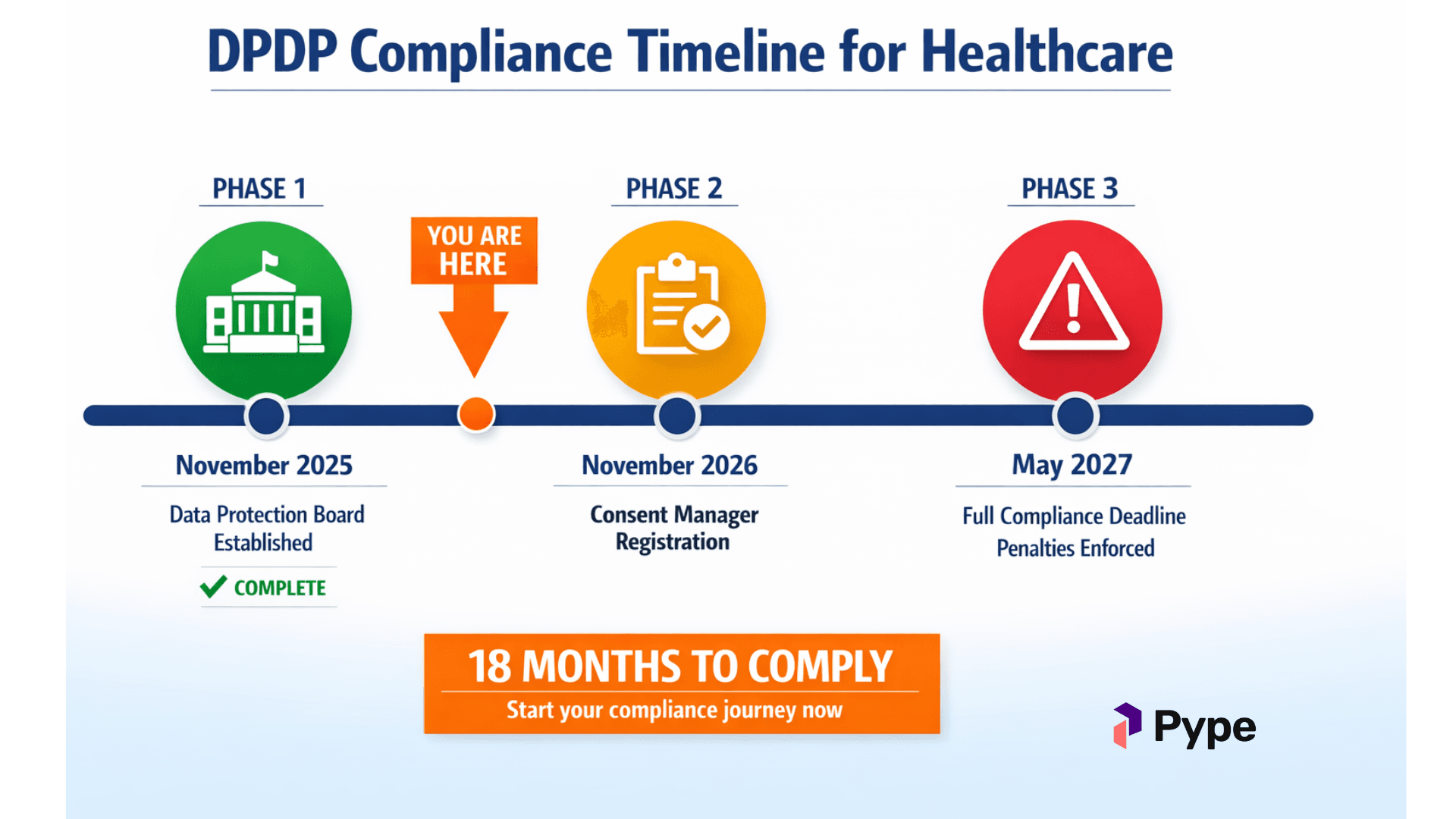
The implementation follows a three-phase approach:
Phase 1 (November 2025 - Immediate)
- Data Protection Board of India (DPB) established with four members
- Administrative provisions and definitions in effect
- Board's digital-first operating procedures activated
Phase 2 (November 2026 - 12 months)
- Consent Manager registration process activated
- Framework for consent management operationalized
- Eligibility criteria: Rs 2 crore net worth, India-incorporated company
Phase 3 (May 13, 2027 - 18 months)
- Full compliance required for all organizations
- All substantive provisions enforceable
- Penalties become applicable
- Patient rights fully enforceable
The Penalty Structure: Why This Matters
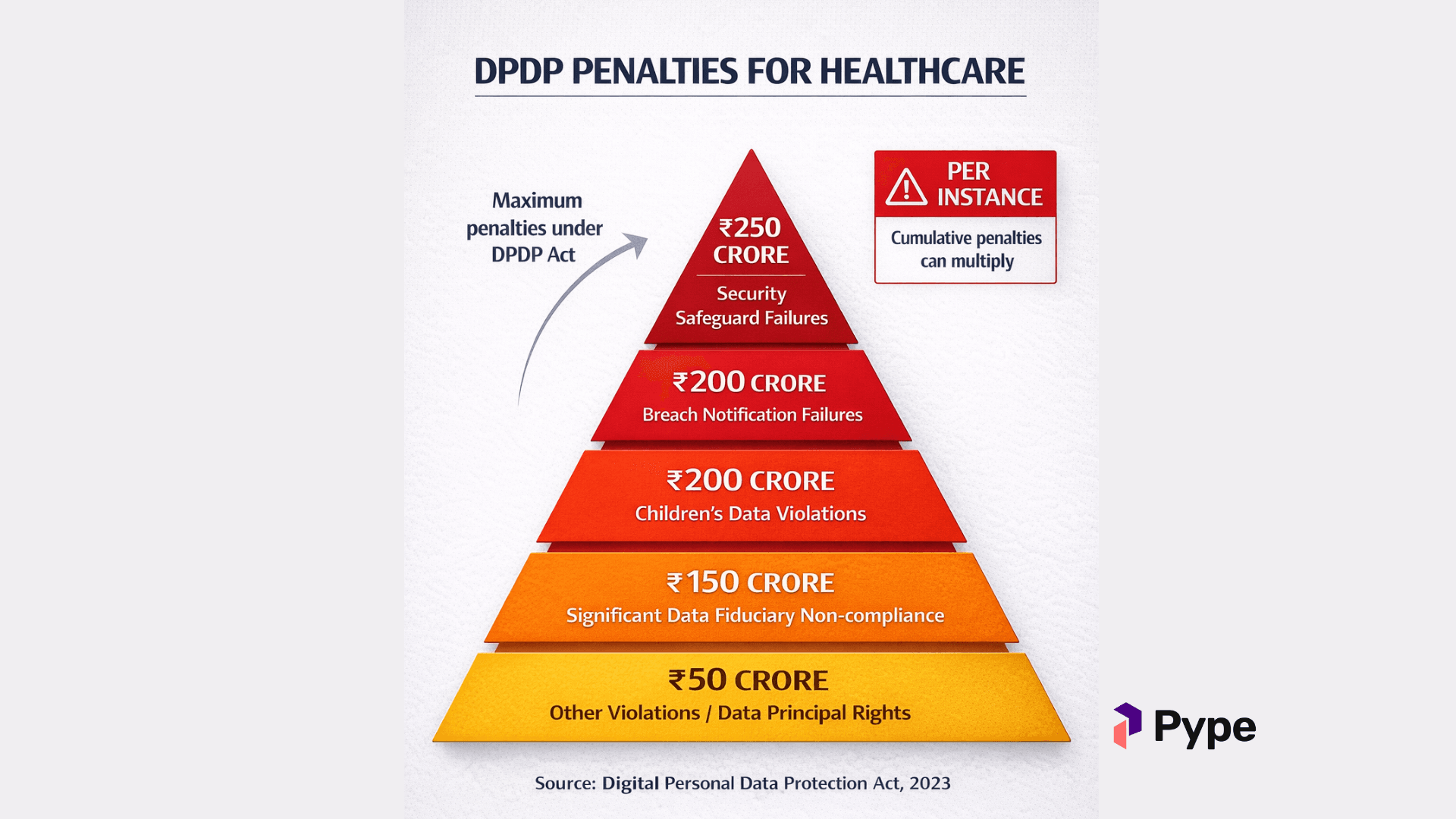
The DPDP Act introduces some of the highest administrative penalties in Indian law:
| Violation | Maximum Penalty |
|---|---|
| Failure to implement reasonable security safeguards | Rs 250 crore |
| Failure to notify data breach | Rs 200 crore |
| Violations related to children's data | Rs 200 crore |
| Non-compliance by Significant Data Fiduciaries | Rs150 crore |
| Failure to honor data principal rights | Rs 50 crore |
| Other violations | Rs 50 crore |
| Non-compliance with Board orders | Rs 20 crore |
Critical point: These penalties apply per instance of violation. A hospital with multiple compliance gaps across departments could face cumulative fines that threaten its very existence. The Data Protection Board has discretion to consider factors like breach severity, duration, and remediation efforts, but the caps are firm.
Who Does the DPDP Act Apply To?
The Act applies to all entities processing digital personal data in India. For healthcare, this includes:
- Hospitals and multi-specialty clinics
- Diagnostic laboratories and imaging centers
- Telemedicine platforms and digital health apps
- EMR/EHR software providers
- Health insurance companies and TPAs
- Pharmaceutical companies with patient data
- Clinical research organizations
- Wellness and fitness apps handling health data
- Ayurveda, homeopathy, and alternative medicine practitioners
Foreign companies processing data of Indian residents are also covered, making this a truly extraterritorial law similar to GDPR. Medical tourism facilities serving international patients while processing Indian staff or local patient data fall under DPDP jurisdiction.
Part 2: Why Healthcare is the Most Affected Sector
The Sensitivity of Health Data
While the DPDP Act does not create a separate category for "sensitive personal data" (unlike its earlier drafts), health data is inherently the most sensitive category of personal information. Medical records contain:
- Complete medical histories and treatment records
- Diagnostic reports and imaging data
- Prescription histories and medication records
- Mental health records and therapy notes
- HIV/AIDS status and STI records
- Genetic information and hereditary conditions
- Biometric data used for patient identification
A breach of health data can cause irreversible harm, from discrimination in employment and insurance to social stigma, psychological trauma, and even physical safety risks. The 1998 case of Mr. X v. Hospital Z, where non-consensual disclosure of HIV status led to cancellation of an engagement and severe emotional harm, remains a stark reminder of what's at stake.
The Scale of Digital Health Data in India
India's healthcare sector is undergoing rapid digitalization:
- The Ayushman Bharat Digital Mission (ABDM) is creating digital health IDs (ABHA) for crores of citizens
- Telemedicine consultations grew exponentially post-COVID and continue to rise
- EMR adoption is increasing across hospital chains, driven by accreditation requirements
- Health-tech startups are capturing unprecedented amounts of patient data
- Insurance claims processing has gone fully digital
- Government health schemes generate massive datasets
This digital transformation, while beneficial for care delivery and public health, has created massive repositories of sensitive data, often stored in systems never designed for modern data protection requirements.
Healthcare's Unique Compliance Challenges
Healthcare organizations face challenges that other sectors simply don't encounter:
1. Legacy Systems Everywhere Most Indian hospitals run on decades-old HIS (Hospital Information Systems) and EMR platforms that were never designed for data protection compliance. These systems often lack encryption, proper access controls, and audit capabilities.
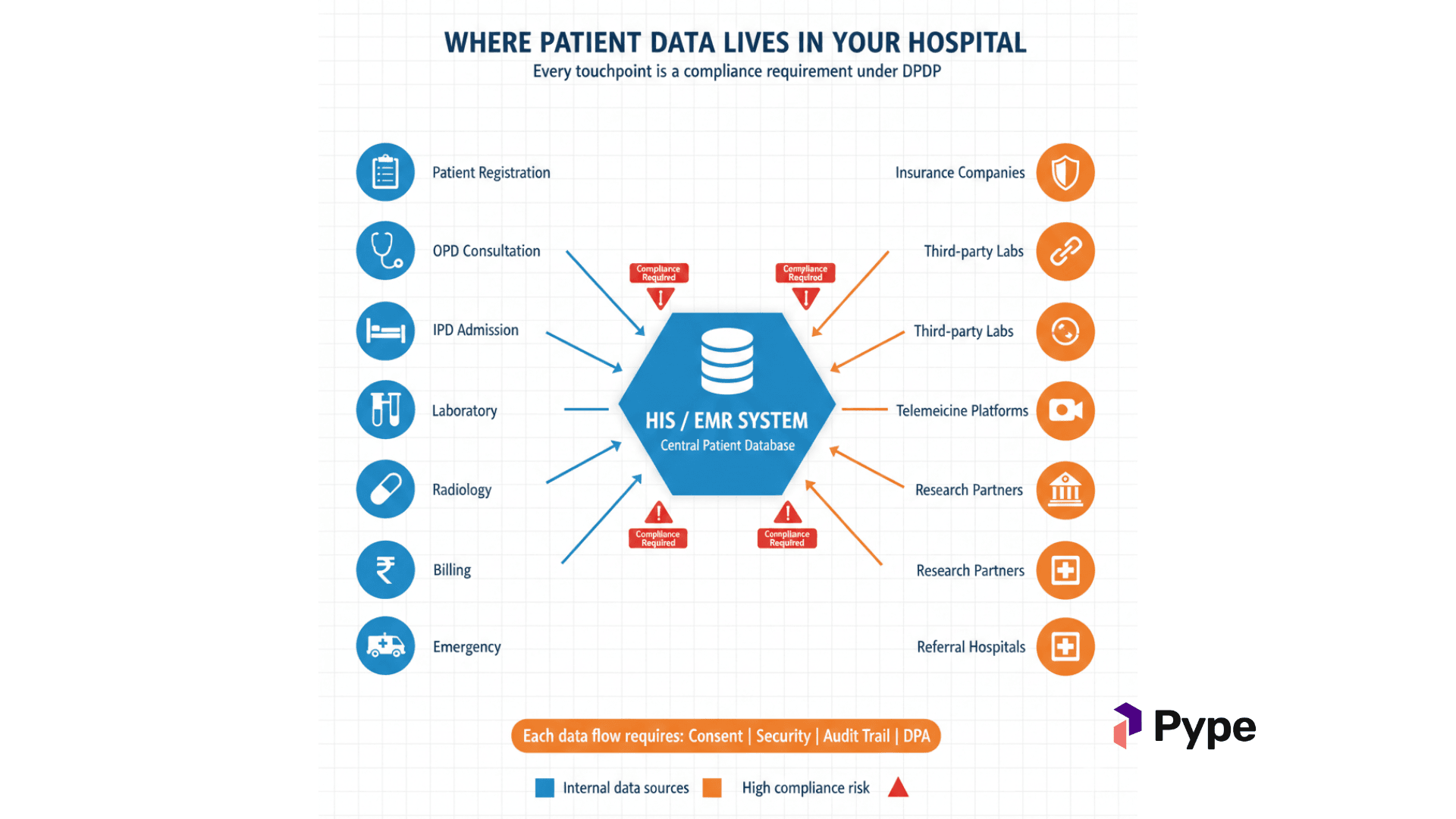
2. Multiple Data Touchpoints
A single patient interaction can create data across registration, consultation, laboratory, pharmacy, radiology, billing, and insurance systems, each potentially stored differently and each requiring compliance.
 3. Third-Party Dependencies
Hospitals share data with laboratories, insurance companies, pharmacies, equipment vendors, and research partners. Each relationship requires formal data processing agreements under DPDP.
3. Third-Party Dependencies
Hospitals share data with laboratories, insurance companies, pharmacies, equipment vendors, and research partners. Each relationship requires formal data processing agreements under DPDP.
4. Research and Analytics Requirements Hospitals use patient data for clinical research, quality improvement, and population health analytics. These activities require specific exemptions and safeguards under the Act.
5. Emergency Situations Healthcare requires provisions for processing data in emergencies when explicit consent cannot be obtained. The Act provides for "legitimate uses" but implementation requires careful documentation.
6. Diverse Patient Populations Consent must be obtained in languages patients understand, from populations with varying literacy levels, including provisions for children and incapacitated individuals.
Part 3: DPDP Compliance Requirements for Hospitals
Foundational Obligations
1. Consent Management Hospitals must obtain explicit, informed consent for all data processing. Under DPDP:
- Consent must be free, specific, informed, and unambiguous
- Purpose-bound and limited to stated uses only
- Revocable at any time by the patient
- Documented with verifiable proof of when, how, and for what purpose it was obtained
Traditional consent forms bundled with admission paperwork are no longer acceptable. Hospitals need digital consent management systems that can capture, track, and prove consent across all touchpoints.
2. Notice Requirements Before or at the time of data collection, hospitals must provide patients with a clear, plain-language notice explaining:
- What personal data is being collected (itemized)
- The specific purposes for collection
- How patients can exercise their rights
- How to file complaints with the Data Protection Board
- Contact details for the hospital's grievance redressal officer
- Data retention periods
This represents a significant shift from current practices where generic privacy policies are buried in admission documents.
3. Purpose Limitation Data can only be processed for the specified purpose. Using patient data collected for treatment purposes for marketing, research (without separate consent), or sharing with affiliates violates the Act.
4. Data Minimization Collect only what is necessary. If a consultation requires basic medical history, collecting complete family backgrounds, lifestyle details, or financial information may be considered excessive and non-compliant.
Security Safeguards
Hospitals must implement "reasonable security safeguards" including:
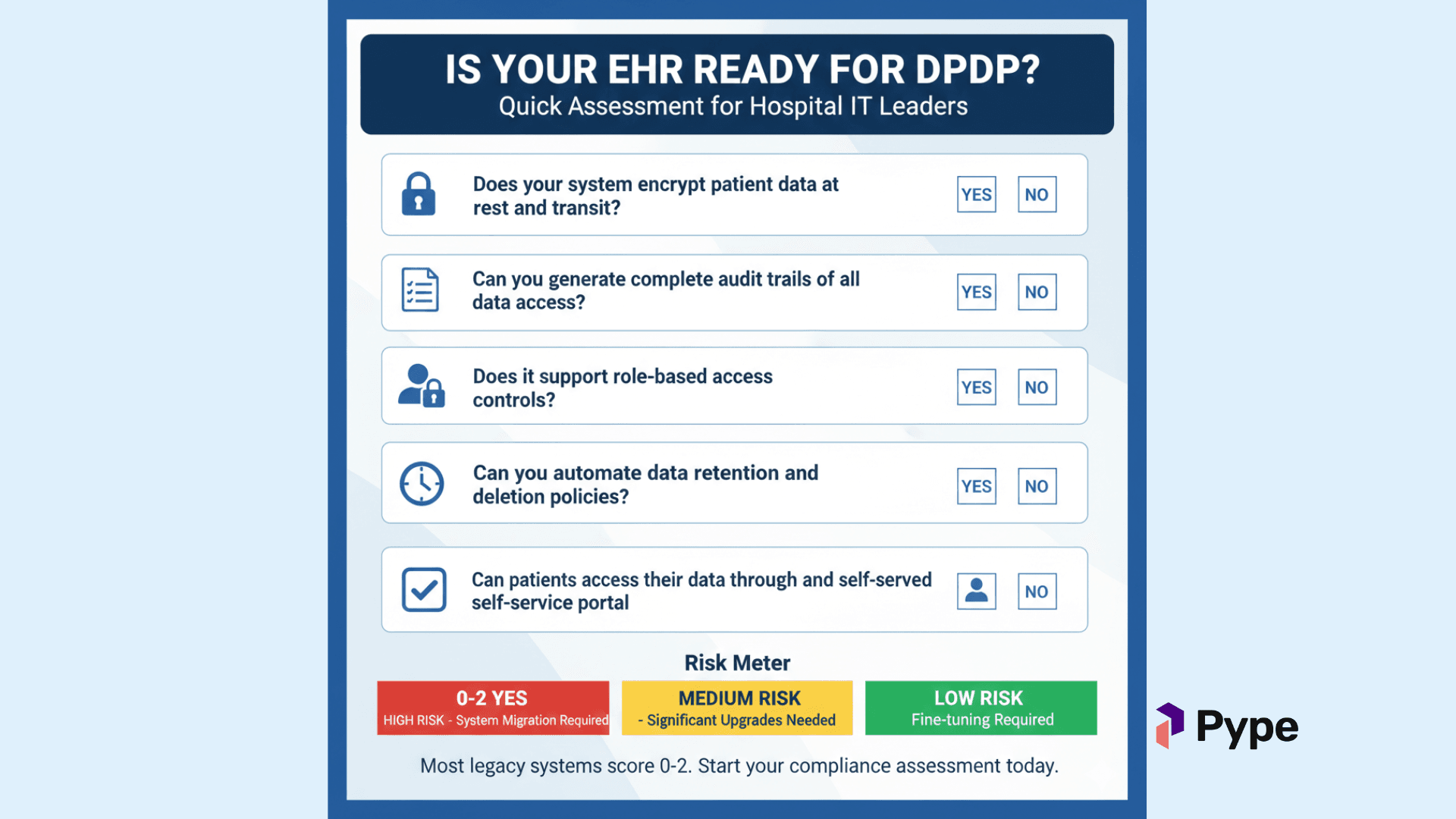
- Encryption: For all personal data in storage and transit
- Access Controls: Role-based access limiting who can view patient data
- Access Logging: Complete audit trails of all data access and modifications
- Data Backups: Ensuring continuity and recovery capability
- Intrusion Detection: Systems to detect unauthorized access attempts
- Incident Response: Documented procedures for breach handling
What constitutes "reasonable" will likely align with standards like ISO 27001, CERT-IN guidelines, and international frameworks like HIPAA (for reference). The Data Protection Board may issue specific guidance for healthcare.
Data Breach Notification
If a breach occurs, hospitals must:
- Notify the Data Protection Board immediately upon becoming aware
- Inform every affected patient about the nature of breach and its likely impact
- Provide details as specified in Rule 7 of the DPDP Rules
- Document all response actions for regulatory review
Unlike other jurisdictions with materiality thresholds, DPDP does not specify a minimum severity for reportability. Potentially any breach involving personal data requires notification. Hospitals should establish conservative breach response protocols.
Data Retention and Erasure
Patient data cannot be stored indefinitely. Hospitals must:
- Define clear retention periods for different data categories
- Implement automated erasure processes when retention periods expire
- Provide 48-hour pre-erasure notifications to patients (per Rule 8)
- Maintain processing logs for minimum one year after any data erasure
- Harmonize DPDP requirements with medical record retention rules under state clinical establishment acts
Patient Rights Under DPDP
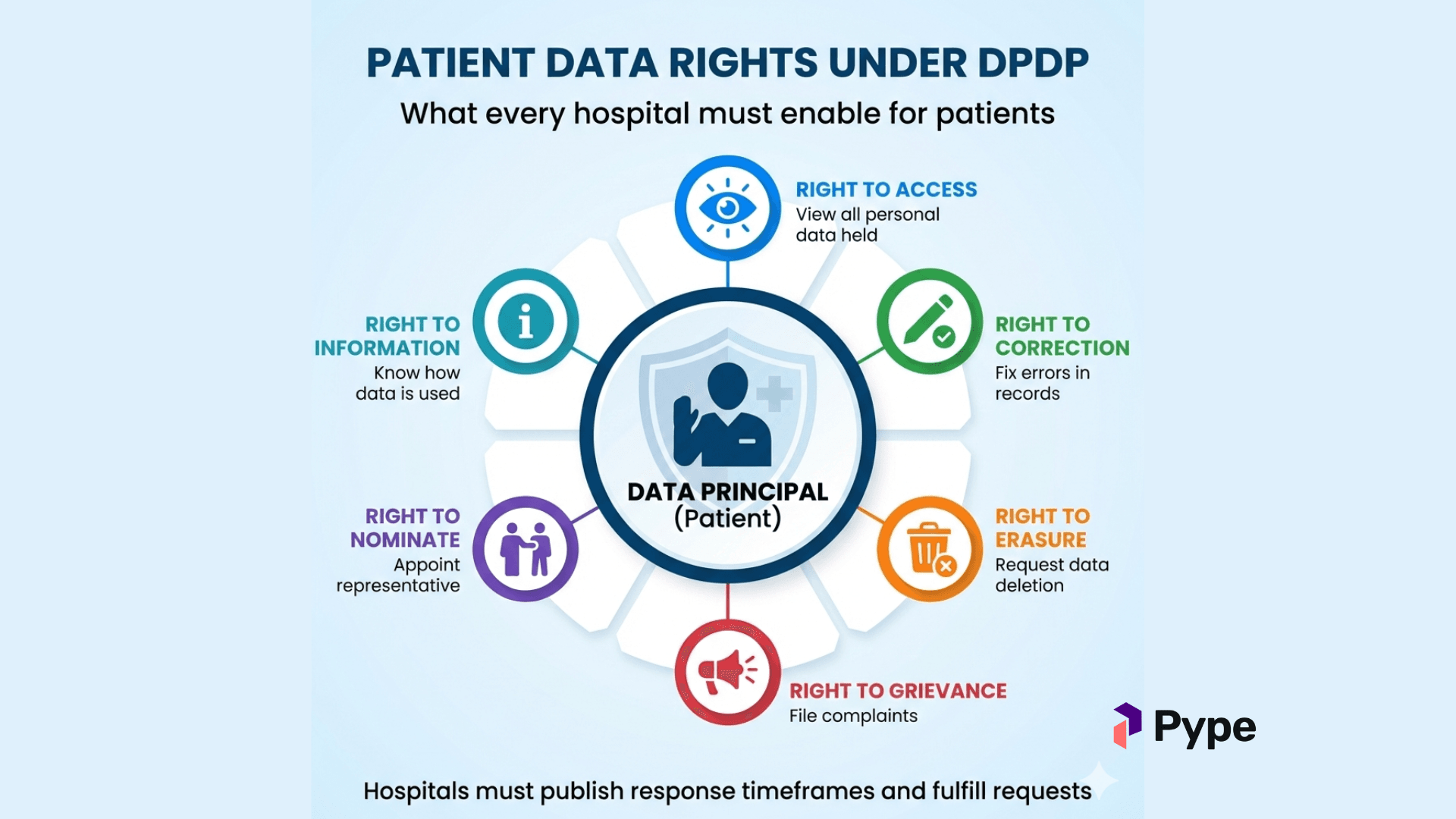
The Act grants patients comprehensive rights that hospitals must operationalize:
| Right | Hospital Obligation |
|---|---|
| Right to Access | Provide complete information about data held, purposes, and sharing |
| Right to Correction | Fix errors in medical records upon patient request |
| Right to Erasure | Delete data when retention period ends or purpose is fulfilled |
| Right to Grievance Redressal | Maintain accessible complaint mechanisms with designated officer |
| Right to Nominate | Allow patients to appoint representatives for data management |
Hospitals must publish response timeframes on their websites and ensure they can actually fulfill requests within stated periods.
Significant Data Fiduciary Requirements
Large hospital chains, health insurance companies, and healthtech platforms may be designated as Significant Data Fiduciaries (SDF) based on data volume and sensitivity. SDFs face additional obligations:
- Annual Data Protection Impact Assessments (DPIA) conducted independently
- Annual data protection audits with reports submitted to the Board
- Appointment of a Data Protection Officer based in India, reporting to the Board
- Enhanced algorithmic accountability for any AI/ML systems processing patient data
- Due diligence requirements for all technical systems deployed
Designation criteria will be notified by the government, but hospitals processing data of lakhs of patients should prepare proactively.
Part 4: The Legacy System Problem
Why Legacy Systems Are Your Biggest Risk
 Most Indian hospitals operate on software systems that are 10-20 years old. These legacy EHR/HIS platforms:
- Store data in proprietary, non-standardized formats
- Lack modern encryption capabilities
- Have no consent management features
- Cannot generate the audit trails DPDP requires
- Don't support automated data retention/erasure
- Have limited access control granularity
- May be running on unsupported operating systems
- Often have undocumented data flows to third parties
A system that worked adequately under previous regulatory ambiguity becomes a serious compliance liability under DPDP.
The True Cost of Non-Compliance
Beyond the headline Rs. 250 crore penalties, non-compliant legacy systems create:
Operational Risks
- Inability to respond to patient data requests within stated timeframes
- No audit trails to present during regulatory inspections
- Manual workarounds that increase error rates and staff burden
Clinical Risks
- Fragmented patient records across disconnected systems
- Inability to quickly retrieve complete medical histories
- Security vulnerabilities that could compromise patient safety
Business Risks
- Loss of patient trust and reputation damage
- Insurance empanelment challenges as payers demand compliance
- Competitive disadvantage against DPDP-compliant competitors
- Potential exclusion from government health schemes requiring data standards
The Migration Decision Framework
Hospitals face three strategic options:
Option 1: Upgrade Existing Systems
- Pros: Lower immediate cost, familiar interface for staff
- Cons: May not achieve full compliance, vendor dependency, technical debt
- Best for: Systems less than 5 years old with active vendor support and upgrade roadmap
Option 2: Implement New DPDP-Compliant Platform
- Pros: Built-for-compliance architecture, modern features, better long-term ROI
- Cons: Higher upfront cost, implementation disruption, staff retraining
- Best for: Hospitals on unsupported systems, planning expansion, or seeking digital transformation
Option 3: Hybrid Approach
- Migrate active patient records to new compliant system
- Archive legacy data in compliant, searchable data stores
- Maintain accessibility while reducing active system risk
- Best for: Large hospitals with decades of historical data and ongoing operations
Part 5: Where Hospitals Need External Help
Areas Requiring Specialized Expertise
1. Compliance Assessment and Gap Analysis
- Mapping current data flows against DPDP requirements
- Identifying gaps in systems, processes, and documentation
- Prioritizing remediation based on risk and effort
2. Consent Management Technology
- Digital consent capture across all patient touchpoints
- Consent lifecycle management (grant, modify, withdraw)
- Audit trail generation for regulatory evidence
3. Data Security Infrastructure
- Encryption implementation across legacy and modern systems
- Access control and identity management
- Security monitoring, logging, and incident response
4. Legal and Policy Framework
- Privacy policy development aligned with DPDP requirements
- Data processing agreements with all vendors
- Employee training programs and awareness campaigns
5. Technology Modernization
- EHR/HIS migration planning and execution
- Legacy data archival with continued accessibility
- Integration with ABDM and health information exchanges
The Role of DPDP-Compliant Technology Partners
Hospitals cannot achieve compliance alone. They need technology partners who:
Understand Healthcare Workflows Generic data protection solutions don't account for clinical workflows, emergency scenarios, research requirements, or the complex data sharing required in healthcare delivery.
Are Themselves DPDP-Compliant
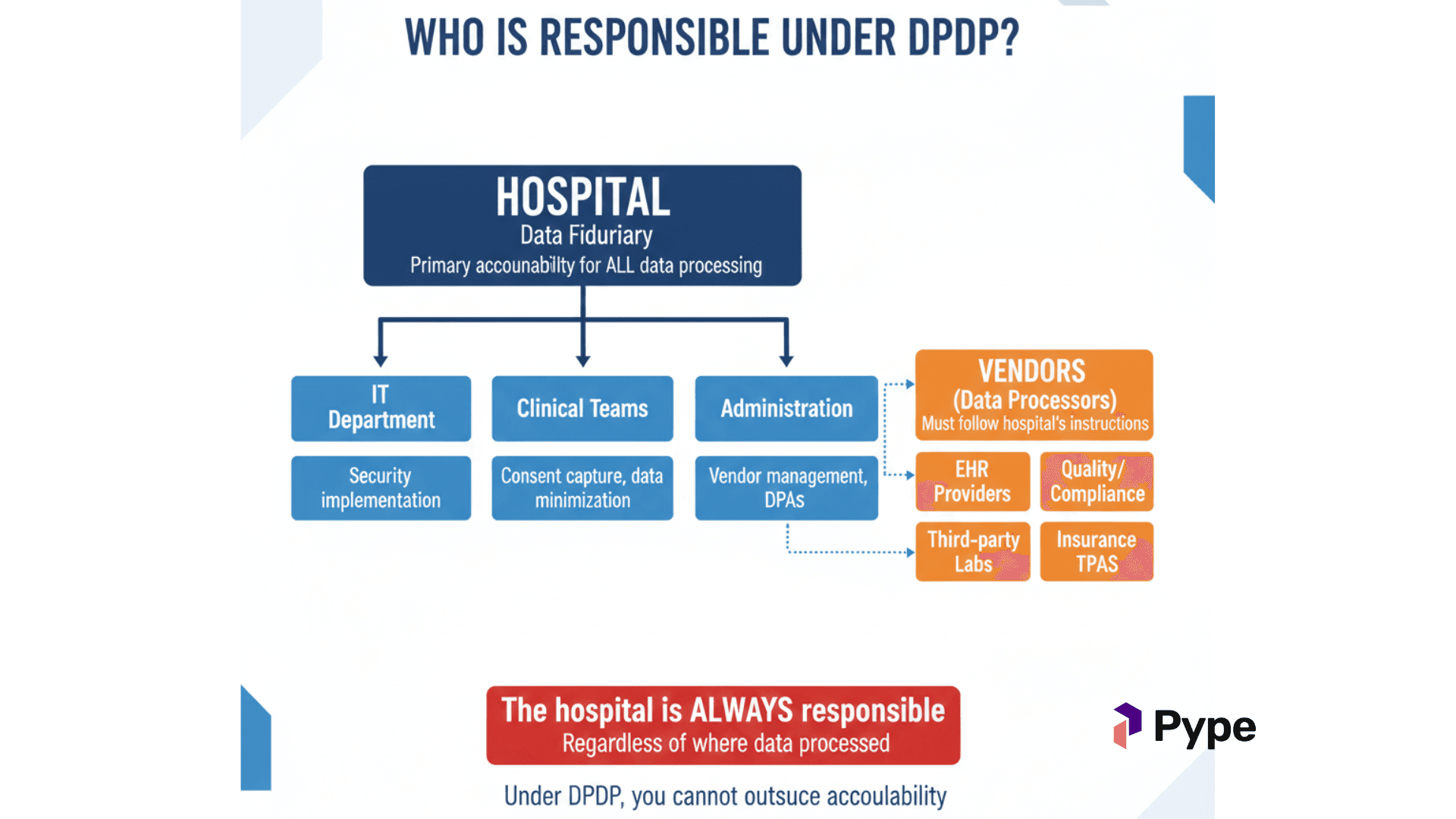
Under DPDP, the Data Fiduciary (hospital) remains responsible for their Data Processors (vendors). A vendor's non-compliance becomes your liability. Every technology partner must demonstrate their own compliance posture.
 Can Integrate with Existing Systems
Solutions that require complete replacement of all existing technology are impractical for most hospitals. Partners must work with your current infrastructure while enabling compliance.
Can Integrate with Existing Systems
Solutions that require complete replacement of all existing technology are impractical for most hospitals. Partners must work with your current infrastructure while enabling compliance.
Provide Ongoing Compliance Support DPDP compliance isn't a one-time project. It requires continuous monitoring, updates as regulations evolve, and adaptation as the Data Protection Board issues guidance.
Companies like Pype AI, which build DPDP-compliant voice AI solutions for patient communications, are helping hospitals automate consent capture during appointment scheduling, manage follow-up communications with proper data handling, and maintain audit trails for all patient interactions, while ensuring every touchpoint meets DPDP requirements.
What to Look for in a Technology Partner
When evaluating technology solutions for DPDP compliance, hospitals should verify:
- Built-in Consent Management: Can the system capture, track, and prove consent?
- Encryption Standards: Does it encrypt data at rest and in transit?
- Access Controls: Can it enforce role-based access with complete audit trails?
- Data Retention Features: Can it automate retention policies and erasure workflows?
- Patient Portal Capabilities: Can patients access and manage their data?
- Integration Capabilities: Can it connect with existing HIS/EMR systems?
- Compliance Documentation: Does the vendor provide DPA templates and compliance evidence?
- India-Based Support: Can they support compliance with India-specific requirements?
Part 6: Implementation Roadmap for Hospitals
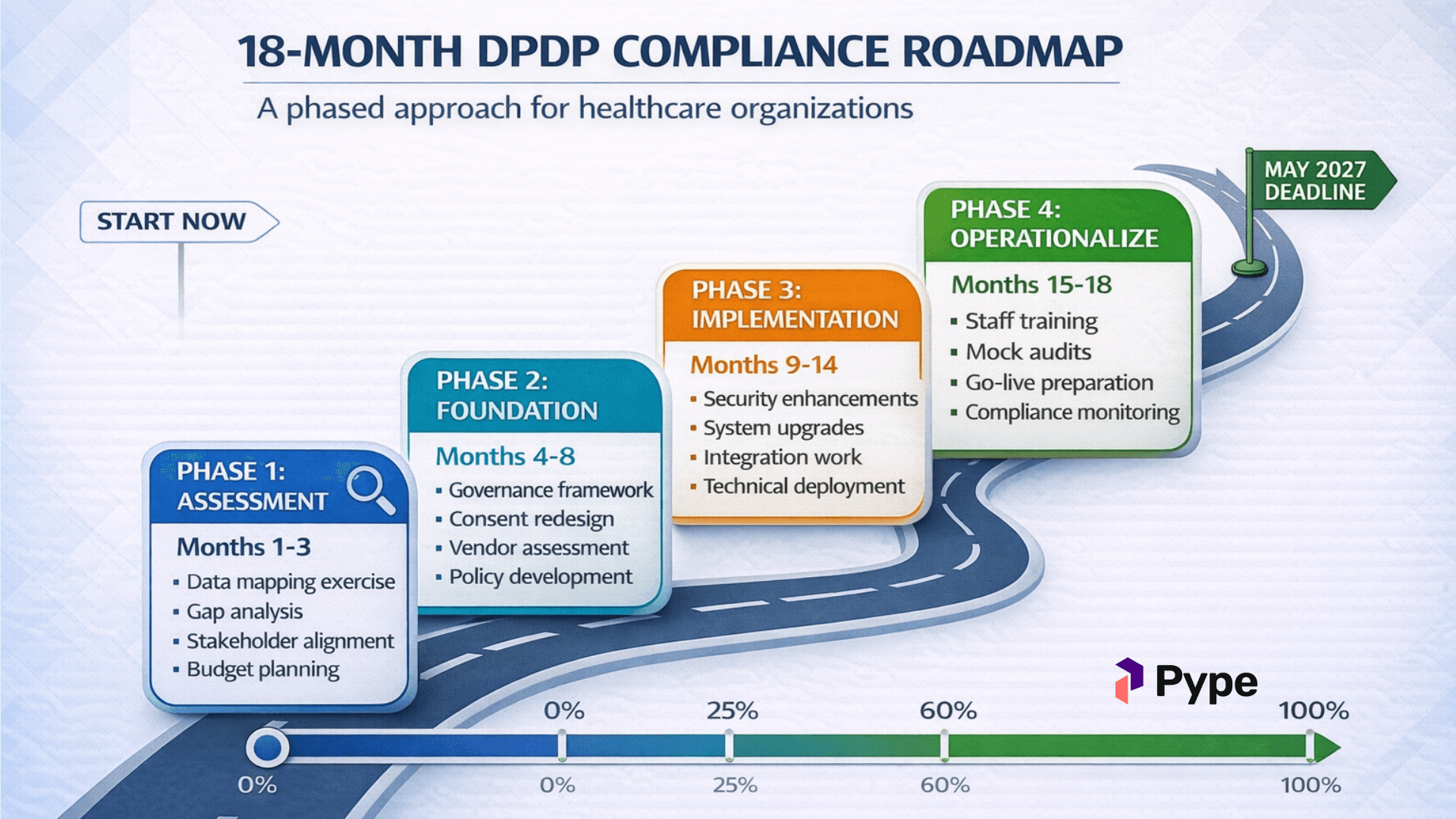
Phase 1: Assessment (Months 1-3)
Data Mapping Exercise
- Identify all personal data collected across every department
- Document data flows between internal systems and external parties
- Catalog existing consent mechanisms and their gaps
- Assess current security measures against DPDP requirements
Gap Analysis
- Compare current state against each DPDP requirement
- Identify non-compliant systems, processes, and documentation
- Estimate remediation effort, timeline, and costs
- Prioritize based on risk (penalties) and complexity
Stakeholder Alignment
- Brief hospital leadership and board on compliance requirements and risks
- Identify compliance ownership (CISO, Legal, IT, Quality, or dedicated DPO)
- Secure budget allocation for remediation activities
- Establish governance structure for compliance program
Phase 2: Foundation Building (Months 4-8)
Governance Framework
- Appoint Data Protection Officer (required if designated as SDF)
- Establish data governance committee with cross-functional representation
- Develop comprehensive privacy policies and procedures
- Create incident response and breach notification plans
Consent Redesign
- Redesign patient consent forms for DPDP compliance
- Implement digital consent capture systems at all touchpoints
- Train registration, nursing, and clinical staff on new procedures
- Test consent workflows across departments and patient scenarios
Vendor Assessment
- Audit all vendors currently handling patient data
- Update contracts with DPDP-compliant data processing agreements
- Address vendor compliance gaps or plan vendor transitions
- Establish ongoing vendor monitoring and audit procedures
Phase 3: Technical Implementation (Months 9-14)
Security Enhancements
- Implement encryption across all systems handling patient data
- Enhance access control mechanisms with role-based permissions
- Deploy monitoring, logging, and alerting tools
- Conduct penetration testing and security assessments
System Upgrades/Migration
- Execute EHR/HIS upgrades or migrations per chosen strategy
- Archive legacy data in compliant, accessible repositories
- Implement automated data retention and erasure workflows
- Build patient data request fulfillment processes
Integration
- Connect all systems with centralized consent management
- Ensure audit trail consistency across platforms
- Integrate with patient portals for self-service access
- Test end-to-end data flows for compliance
Phase 4: Operationalization (Months 15-18)
Training and Awareness
- Conduct comprehensive privacy training for all staff
- Deliver department-specific training (registration, clinical, IT, admin)
- Run breach response simulation exercises
- Establish ongoing education and awareness programs
Testing and Validation
- Conduct internal mock audits against DPDP requirements
- Test patient rights request handling end-to-end
- Verify breach notification procedures work as designed
- Validate retention/erasure automation accuracy
Go-Live and Monitoring
- Launch fully compliant operations before May 2027 deadline
- Establish compliance monitoring dashboards and metrics
- Address emerging issues and edge cases
- Prepare documentation for potential regulatory engagement
Part 7: Looking Ahead
The Competitive Advantage of Compliance
While DPDP compliance requires significant investment, it offers strategic benefits:
Patient Trust In an era of increasing privacy awareness, patients will actively choose hospitals that demonstrably protect their data. Trust becomes a differentiator.
Operational Efficiency Modern, compliant systems are typically more efficient than legacy alternatives. Compliance investment often delivers operational ROI.
Risk Mitigation Beyond avoiding penalties, compliance protects against reputational damage, legal costs, and business disruption from breaches.
Market Access As insurance companies, corporate health programs, and government schemes demand compliance, non-compliant hospitals will lose access to these revenue streams.
Talent Attraction Healthcare professionals increasingly prefer working with organizations that have modern, well-designed systems rather than legacy infrastructure.
The Global Context
The DPDP Act aligns India with global privacy norms. For hospitals pursuing:
- Medical tourism: International patients expect GDPR-equivalent protections
- Global accreditation: JCI and other bodies increasingly assess data practices
- Research collaborations: International partners require compliant data handling
- Health data exchange: Interoperability requires standardized, secure data practices
What Happens If You Don't Comply?
Starting May 2027:
- Patients can file online complaints directly with the Data Protection Board
- The Board can investigate, conduct inquiries, and issue binding directions
- Penalties up to Rs 250 crore per instance can be imposed
- Organizations can be required to implement specific remediation measures
- Appeals go to Appellate Tribunal (within 60 days) and then to higher courts
- While no criminal sanctions exist, reputational damage can be severe and lasting
- Insurance companies and empanelment bodies may require compliance certification
Conclusion: Start Now
The 18-month compliance window may seem generous, but it isn't. Healthcare organizations managing decades of legacy data, complex vendor relationships, ingrained clinical workflows, and resource constraints need every day of that runway.
The hospitals that start their DPDP compliance journey now will:
- Spread costs over a longer period, reducing budget shock
- Have time to test, iterate, and refine solutions
- Avoid the panic premium of last-minute implementation
- Train staff properly rather than rushing adoption
- Be ready for potential early enforcement on large organizations
The DPDP Act isn't just a compliance burden. It's an opportunity to modernize healthcare data management in India. The organizations that embrace this transformation will emerge stronger, more trusted, more efficient, and better positioned for the future of digital health.
The question isn't whether to comply. It's whether you'll be ready when May 2027 arrives.
Quick Reference: DPDP Compliance Checklist for Hospitals
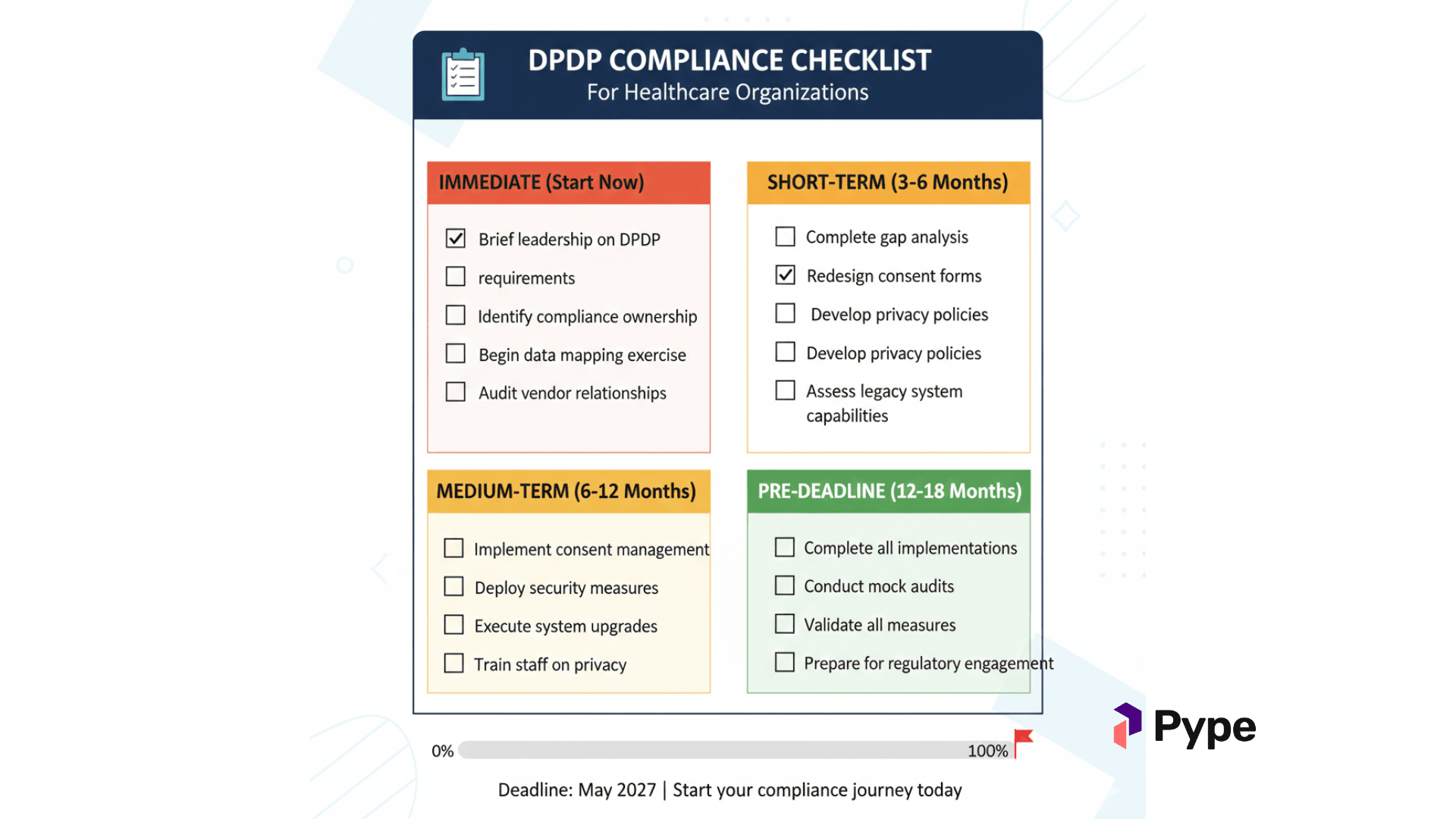
Immediate Actions (Start Now)
- Brief leadership on DPDP requirements, timeline, and penalty risks
- Identify compliance ownership within the organization
- Begin comprehensive data mapping across all departments
- Audit current vendor relationships for data sharing practices
Short-Term (3-6 Months)
- Complete gap analysis against DPDP requirements
- Redesign consent forms and capture processes
- Develop privacy policies and internal procedures
- Assess legacy system compliance capabilities
- Begin vendor contract renegotiations with DPA templates
Medium-Term (6-12 Months)
- Implement digital consent management systems
- Deploy enhanced security measures (encryption, access controls)
- Execute EHR/HIS upgrades or migration projects
- Establish patient rights request workflows
- Train all staff on privacy obligations
Pre-Deadline (12-18 Months)
- Complete all technical implementations
- Conduct mock audits and breach response drills
- Validate all compliance measures through testing
- Appoint DPO and complete SDF requirements (if applicable)
- Prepare documentation for regulatory engagement
Frequently Asked Questions
When does DPDP compliance become mandatory for hospitals? Full compliance is required by May 13, 2027, which is 18 months after the DPDP Rules were notified in November 2025. However, the Data Protection Board is already operational, and organizations should not wait until the deadline to begin preparations.
What is the maximum penalty under DPDP for healthcare organizations? Up to Rs 250 crore per instance for failure to implement reasonable security safeguards. Penalties for breach notification failures and children's data violations can reach Rs 200 crore. These apply per violation, meaning cumulative exposure can be substantial.
Does DPDP apply to paper medical records? DPDP applies specifically to digital personal data. However, once paper records are digitized (scanned, entered into EMR), they fall under DPDP. Organizations should ensure digitization processes include proper consent and security measures.
Are hospitals considered Significant Data Fiduciaries? Large hospital chains processing high volumes of sensitive health data may be designated as SDFs by the Central Government based on criteria including data volume, sensitivity, and risk. SDFs face additional obligations including mandatory DPIAs, annual audits, and DPO appointment.
How does DPDP interact with existing medical record retention requirements? Hospitals must harmonize DPDP data minimization and erasure requirements with medical record retention mandates under state clinical establishment acts and Medical Council guidelines. Generally, the longer retention period prevails, but organizations must document this clearly.
What consent is required for processing children's health data? Processing children's personal data requires verifiable parental consent. However, the government may notify exemptions for healthcare providers delivering essential health services in the child's best interest. This is not a blanket exemption and requires formal notification.
Can patient data be used for research under DPDP? Yes, but with conditions. Research, archiving, and statistical purposes can qualify for exemptions if processing complies with standards in the Second Schedule of DPDP Rules and if data is not used for decisions specific to individual patients. Separate consent may still be advisable.
What should hospitals do if they experience a data breach? Immediately notify the Data Protection Board and all affected patients about the breach nature and likely impact. Document all response actions. Unlike some jurisdictions, DPDP does not specify a materiality threshold, so any breach involving personal data potentially requires notification.
This article is for informational purposes only and does not constitute legal advice. Healthcare organizations should consult qualified legal and compliance professionals for specific guidance on DPDP compliance.