
AI receptionist for hospitals in India: a practical setup guide (Hindi, Hinglish, HIS and DPDP)
AI receptionist for hospitals in India: a practical setup guide (Hindi, Hinglish, HIS and DPDP)
How to set up an AI receptionist for a hospital in India: which calls to give it, how to handle Hindi and Hinglish, how deep to connect your HIS, and what the DPDP Act means for the setup.
Ashish Tripathy, Founder, Pype AI | 19 October 2026 | 8 minute read
An AI receptionist for a hospital in India is a voice agent that answers the hospital's phone line in Hindi, English, a regional language or a mix of them, and does the front desk's repeat work on the call: booking OPD appointments, answering timing and doctor questions, sending reminders, and passing anything urgent or sensitive to a person. Set up well, it books straight into your HIS and follows the DPDP Act from the first "hello".
Last week we answered the 15 questions Indian hospitals ask about AI voice agents. This post is the follow-on: how to actually set one up for a multi-specialty hospital.
Quick context. At Pype AI we build voice agents that talk to patients for hospitals in India and the US. After millions of minutes of these calls, the setup decisions below are the ones that make the biggest difference, and they're mostly made before a single call goes live.
What does an AI receptionist for a hospital actually do?
It takes the calls that sound the same every day, so your team can take the ones that don't.
In most multi-specialty hospitals, a large share of front desk calls are some version of "Is Dr. Sharma in on Thursday?", "What time does the OPD open?" or "I need to move my appointment." An AI receptionist answers those instantly, in the caller's language, at 9 AM rush hour and at 9 PM.
What it should not do is anything that needs clinical judgement. It doesn't give medical advice, and it doesn't try to handle an emergency on its own. Those calls go to a person, fast.
Which calls should the AI receptionist take first?
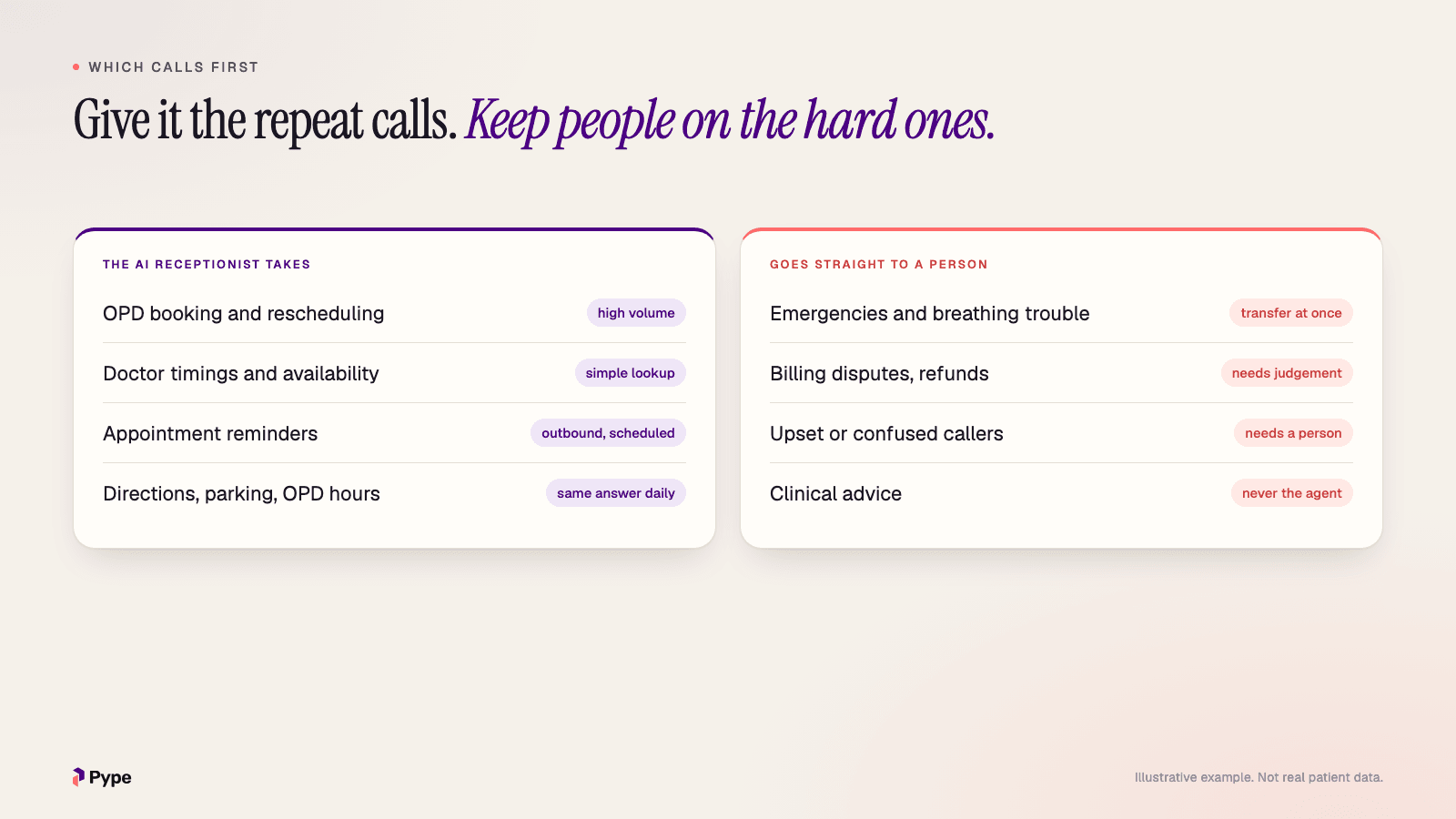
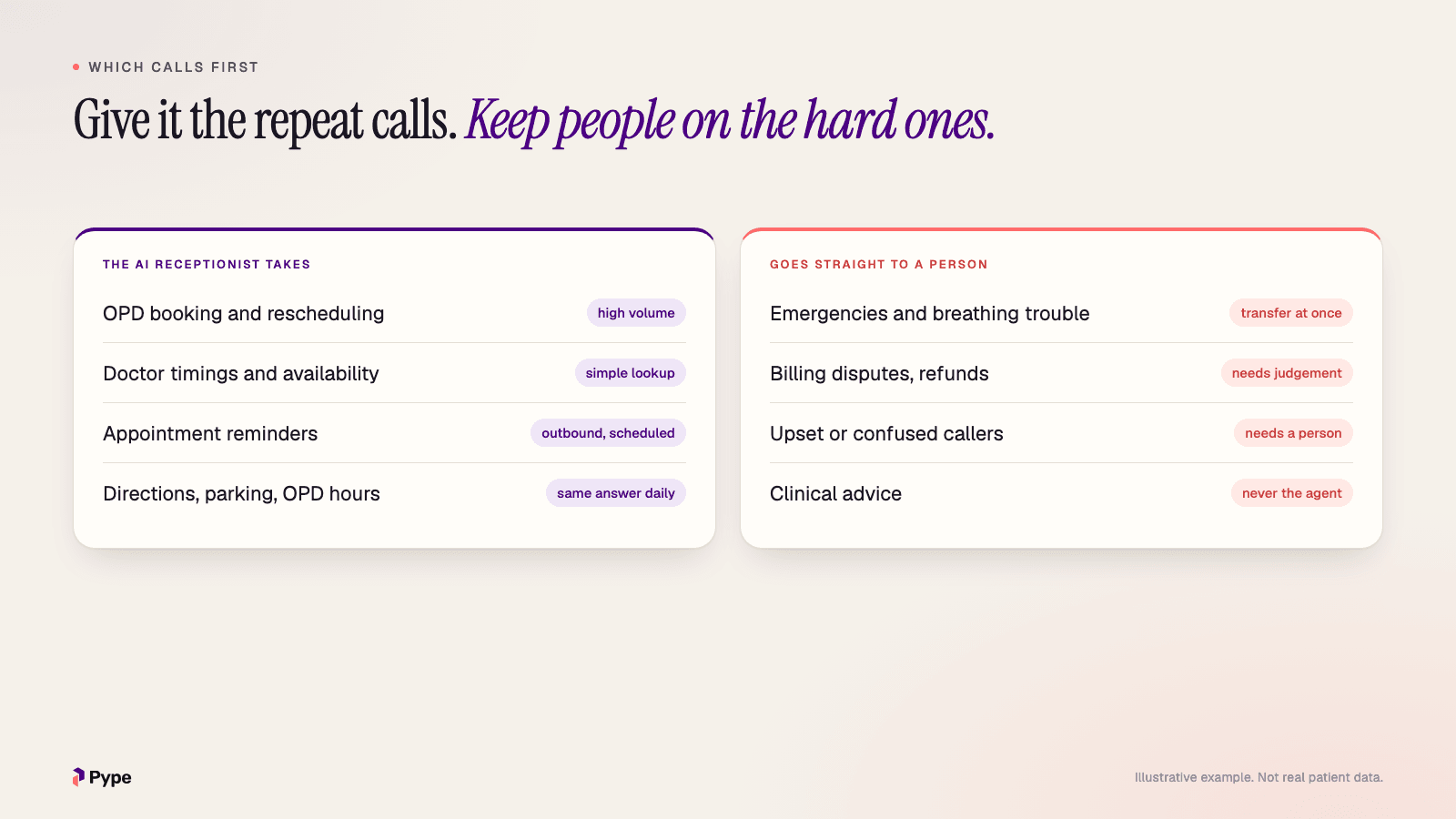
Start with high-volume, low-risk calls, and write down which calls always go to a human.
 Give it the repeat calls. Keep people on the hard ones.
Here's how I'd sort them for a first launch:
| Call type | Who handles it | Why |
|---|---|---|
| OPD booking and rescheduling | AI receptionist | Highest volume, clear rules, easy to measure |
| Doctor timings and availability | AI receptionist | A simple lookup in the doctor schedule |
| Appointment reminders (outbound) | AI receptionist | Scheduled, predictable, cuts no-shows |
| Directions, parking, visiting hours | AI receptionist | Same answer every day |
| Report status | AI receptionist, once connected | Needs the lab system, so phase two |
| Billing disputes and refunds | Person | Needs judgement and authority |
| Emergencies, breathing trouble, chest pain | Person, transferred at once | Never wait on a bot |
| Clinical questions | Person | The agent never gives medical advice |
The second column matters as much as the first. A good setup is defined by what the agent hands over, not just what it handles.
Hindi and Hinglish: how should an AI receptionist handle language?
Follow the caller. Whatever language they start in, and wherever they switch, the agent goes with them.
India doesn't have one phone language. In the 2011 Census, about 44% of Indians reported Hindi as their mother tongue, and many more speak it as a second or third language. On a real hospital line, most callers in the north mix Hindi and English in the same sentence. In Chennai or Kolkata, you'll hear Tamil or Bengali mixed with English instead.
Three habits make an AI receptionist work in this mix:
- Don't ask the caller to pick a language. "Press 1 for Hindi" is an IVR habit. Detect the language from the first sentence and reply in kind.
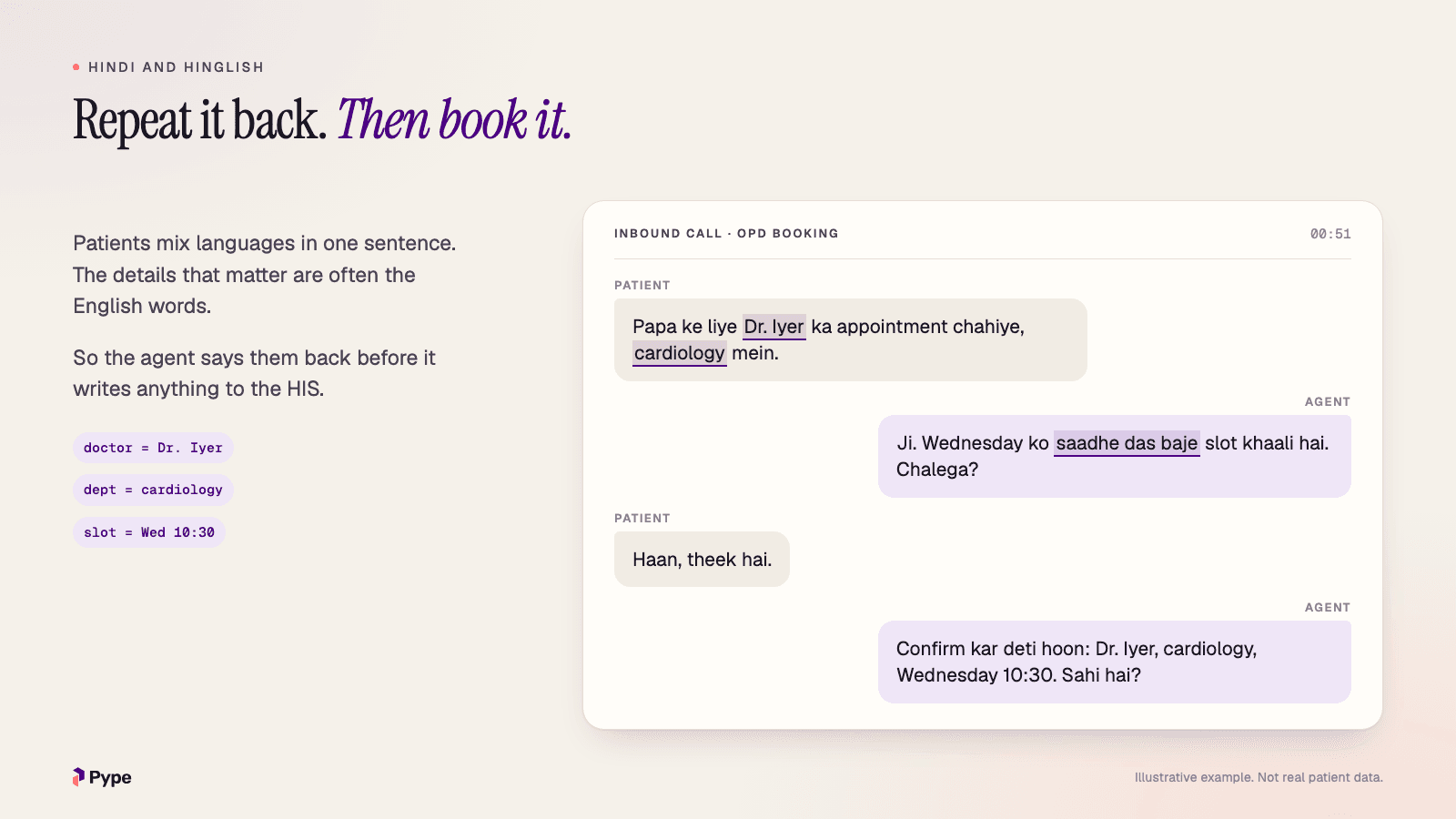
- Expect the important words in English. Doctor names, departments, dates and drug names often come in English inside a Hindi sentence.
- Read the details back before booking. Names and times are where speech recognition slips most. A five-second read-back catches it.
Let's take one call. A son calls to book for his father:
"Papa ke liye Dr. Iyer ka appointment chahiye, cardiology mein."
 Repeat it back. Then book it.
Notice the time. "Saadhe das baje" is 10:30, and the agent has to understand it, say it naturally, and still write 10:30 into the HIS. Numbers and times in Hindi are a test every vendor should pass on your own calls, not just in a demo.
HIS integration for an AI receptionist: how deep should you go?
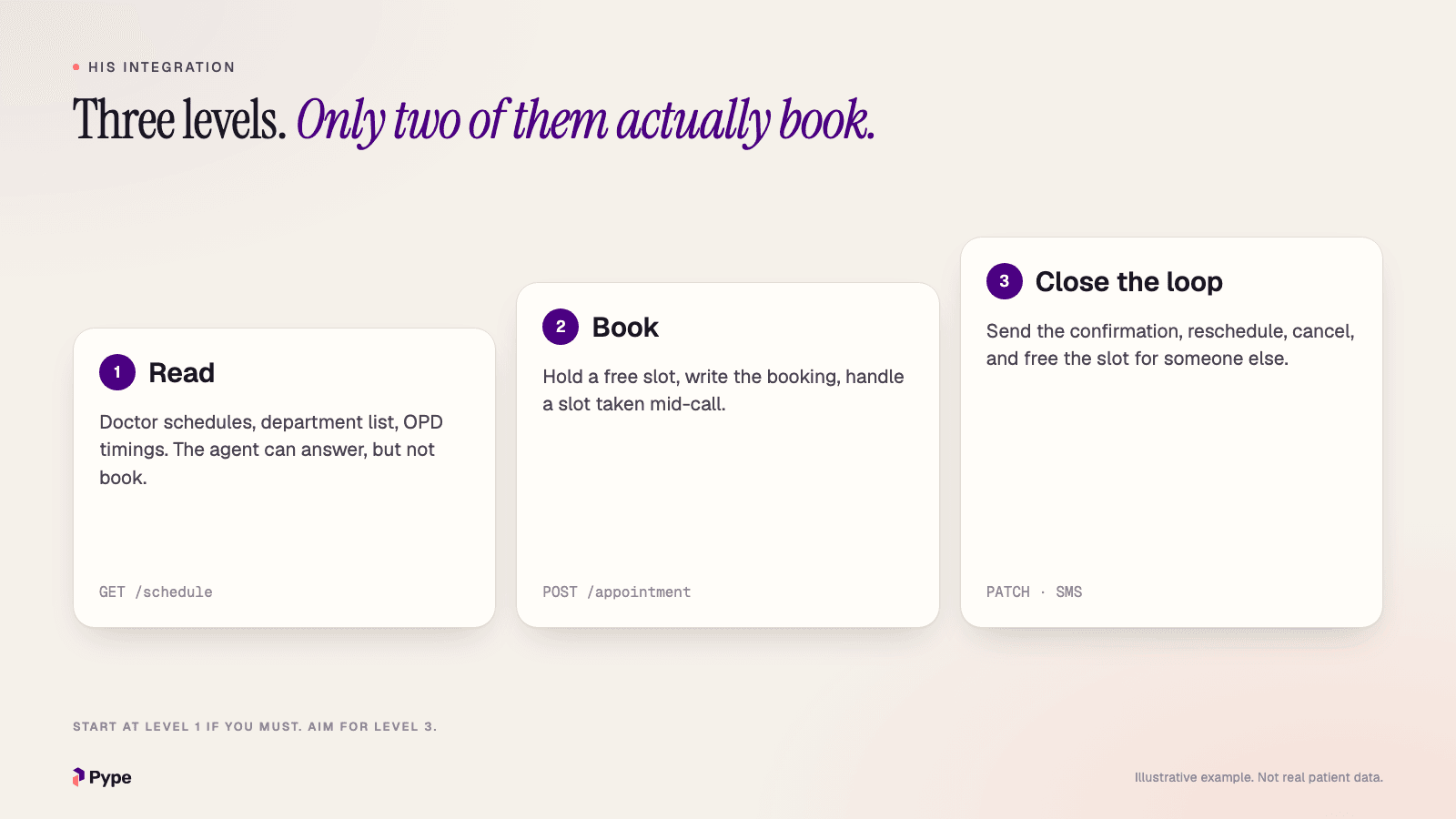
Deep enough that the agent can book, not just take messages. Think of it in three levels.
 Three levels. Only two of them actually book.
| Level | What the agent can do | What it needs from the HIS |
|---|---|---|
| 1. Read | Answer timings and availability | Doctor master, department list, OPD schedule |
| 2. Book | Hold and book a real slot during the call | Write access for appointments, slot locking |
| 3. Close the loop | Confirm, reschedule, cancel and free slots | Updates and cancellations, plus SMS or WhatsApp |
Level 1 is a fine place to start if your HIS has no booking API yet. But until you reach level 2, every "booking" is really a message for someone to type in later, and patients can tell.
Two practical tips. First, ask how the agent handles a slot taken by the front desk while the caller is still on the line. Second, keep the doctor master clean. If the HIS lists "Dr. R. Iyer" and patients say "Iyer sir", the agent needs both in its vocabulary.
When should an AI receptionist hand over to a person?
Immediately, whenever the call stops being routine. Emergencies first.
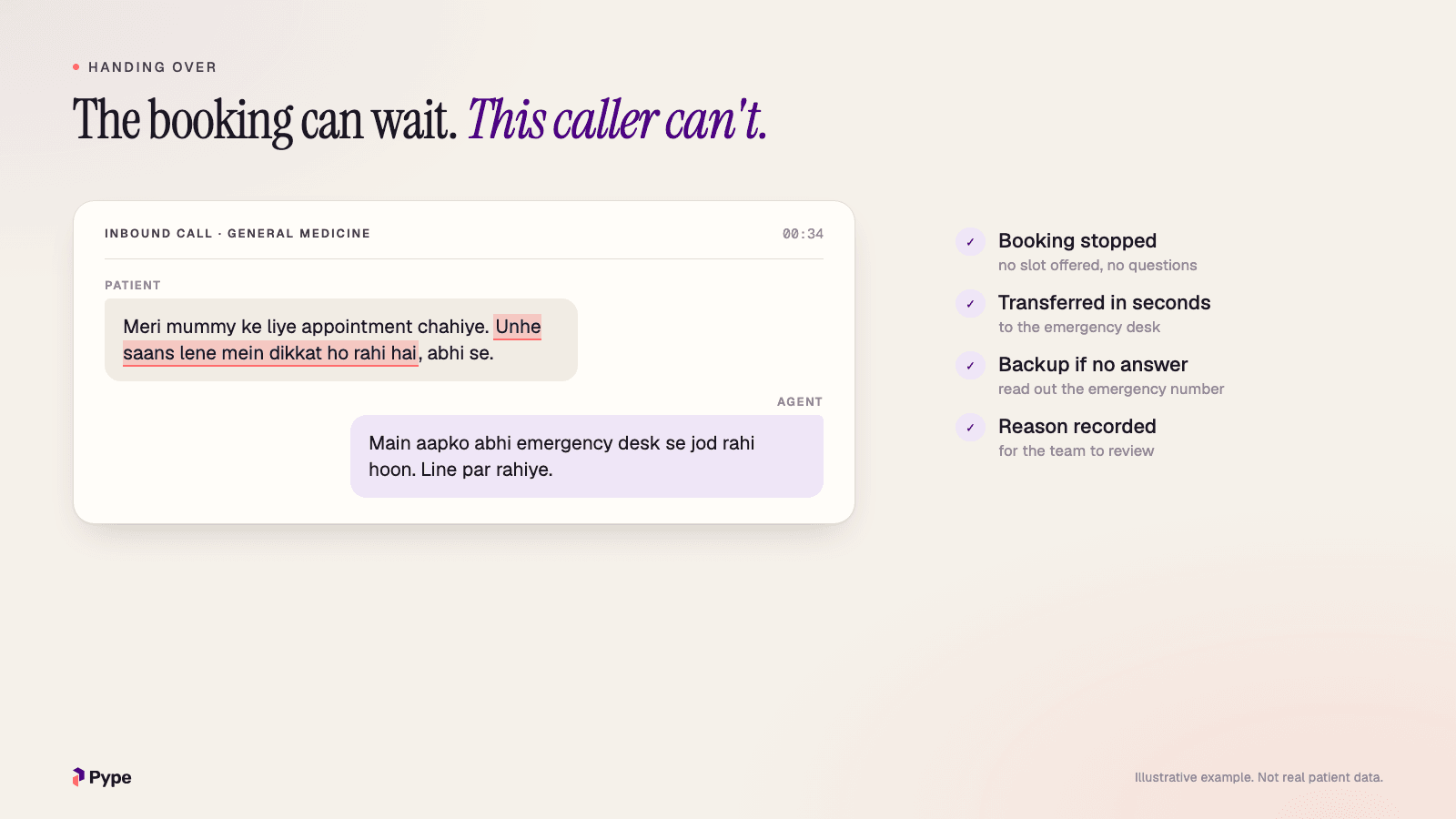 The booking can wait. This caller can't.
Write the handover rules down before go-live, and get your medical team to sign them off:
- Emergency words (breathing trouble, chest pain, unconscious, heavy bleeding) stop the booking and transfer to the emergency desk at once.
- If nobody picks up, the agent reads out the hospital's emergency number and India's national emergency number, 112, and stays on the line.
- Upset or confused callers go to a person, even if the request itself is simple.
- Every transfer records a reason, so your team can review it later.
Then test these paths as pass or fail, in Hindi and English, with bad audio. One missed emergency matters more than a hundred perfect bookings.
What does the DPDP Act mean for an AI receptionist?
Build for it now. The Digital Personal Data Protection Act, 2023 applies to call recordings, transcripts and booking records, and most core duties under the Rules apply from May 2027.
The hospital is the data fiduciary. The AI receptionist vendor is usually a data processor working on your behalf. In practice, that means:
- Notice at the start of the call. A short line that the call is handled by an AI assistant and may be recorded, in the caller's language.
- Only the data the task needs. A booking needs a name, a number and a slot, not a full history.
- Clear retention. Decide how long recordings and transcripts are kept, and delete on schedule.
- A processor contract that covers security, breach notice and deletion.
The government's published Rules also set specifics like breach reporting timelines. Our DPDP guide for Indian hospitals covers the details. Confirm your own setup with your legal team.
A six-week setup plan
Here's a realistic first rollout for one multi-specialty hospital:
| Week | What happens |
|---|---|
| 1 | Pick the call types, record sample calls, write the handover rules |
| 2 | Connect the HIS at level 1 or 2, clean up the doctor master |
| 3 | Build and test against hard calls: Hinglish, bad lines, emergencies mid-booking |
| 4 | Staff test it on real numbers. Fix, retest |
| 5 | Go live on one line or one shift, with people listening in |
| 6 | Review real calls, then widen to more lines or departments |
If you're comparing vendors at this stage, our 10 questions to ask AI voice agent vendors is a good checklist.
How we approach this at Pype
A short note, since people ask. Our agents handle inbound scheduling, enquiries, reminders and patient recall for hospitals in the languages their patients actually speak. Every agent is tested against hard scenarios before go-live, every change ships as a new version, and we watch live calls with Whispey, our open-source observability tool for voice agents.
Key takeaways
- An AI receptionist for a hospital in India should take repeat calls (OPD booking, timings, reminders) and hand everything sensitive to a person.
- Follow the caller's language. Expect key details in English inside Hindi sentences, and read them back.
- HIS integration decides whether the agent books or just takes messages. Aim for level 2 or 3.
- Write emergency handover rules first, and test them as pass or fail.
- The DPDP Act applies. Build in notice, minimal data and clear retention now.
None of this is glamorous. Most of it is careful setup and a lot of listening to real calls. But the first morning the phone lines don't ring out at 9 AM, it feels worth it :)
Frequently asked questions
What is an AI receptionist for a hospital in India?
A voice agent that answers the hospital phone line in Hindi, English, regional languages or a mix, and handles repeat calls like OPD booking, doctor timings and reminders. It hands emergencies and sensitive calls to staff.
Can an AI voice receptionist for clinics and hospitals handle Hinglish?
Yes, if it's built for it. Good agents follow the caller's language, including switches mid-sentence, and read back names and times before booking. Test it on real calls from your city.
Does an AI receptionist need HIS integration?
To book real appointments, yes. Without it, the agent can only answer questions or take messages for staff to type in later.
What happens if a patient calls the AI receptionist with an emergency?
A well-built agent stops the booking and transfers the caller to the emergency desk at once. If nobody answers, it gives the emergency number and records the reason for review.
Is an AI receptionist compliant with the DPDP Act?
It can be. The setup needs a clear notice at the start of the call, only the data the task needs, sensible retention and a processor contract. The hospital stays responsible as the data fiduciary.
How long does it take to set up an AI receptionist for a hospital?
A first rollout for one hospital usually takes around six weeks, from choosing call types to going live on one line. Deeper HIS integration or more languages can add time.
About the author
Ashish Tripathy is the founder of Pype AI, which builds voice AI agents for hospitals and healthcare providers. Pype also maintains Whispey, an open-source, OpenTelemetry-based observability tool for voice AI agents.