
Post-discharge follow-up call script: what to say, when to call, and when to escalate
Post-discharge follow-up call script: what to say, when to call, and when to escalate
A free post discharge follow up call script you can copy, plus the timing, the warning signs that should stop the script, and what to write down after every call.
Ashish Tripathy, Founder, Pype AI | 15 October 2026 | 8 minute read
A post discharge follow up call script is a short, structured set of questions a hospital uses to call patients in the first few days after they go home. It checks how they feel, whether they have and are taking their medicines, whether their next appointment is booked, and whether anything at home is missing. Most importantly, it tells the caller exactly when to stop and escalate.
Good post discharge follow up calls take about five minutes. They catch the small problems (a skipped pill, a missing appointment, a ride that fell through) before they turn into a trip back to the emergency room.
Quick context. At Pype AI we build voice agents that talk to patients for hospitals: booking, reminders, follow-ups. After millions of minutes of these calls, follow-up is the call type I think most hospitals underrate. So here's the script we'd hand any team, human or AI, along with the parts people usually get wrong.
Why post discharge follow up calls matter
The first days at home are when discharge plans quietly fall apart. The patient was told five things on the way out. They remember two.
That's why the US Agency for Healthcare Research and Quality made a follow-up phone call part of its Re-Engineered Discharge (RED) toolkit. AHRQ's guidance is that patients are called two to three days after discharge, by clinical staff, to review health status, medicines, appointments and home services. RED was tested at Boston University Medical Center and was shown to reduce readmissions and post-hospital emergency visits.
There's money attached too. Under Medicare's Hospital Readmissions Reduction Program, hospitals with higher than expected 30-day readmissions for conditions like heart failure, heart attack, COPD, pneumonia, bypass surgery and hip or knee replacement get paid less.
Here's what a follow-up call is really for. Let's take one patient (an illustrative example, not a real one).
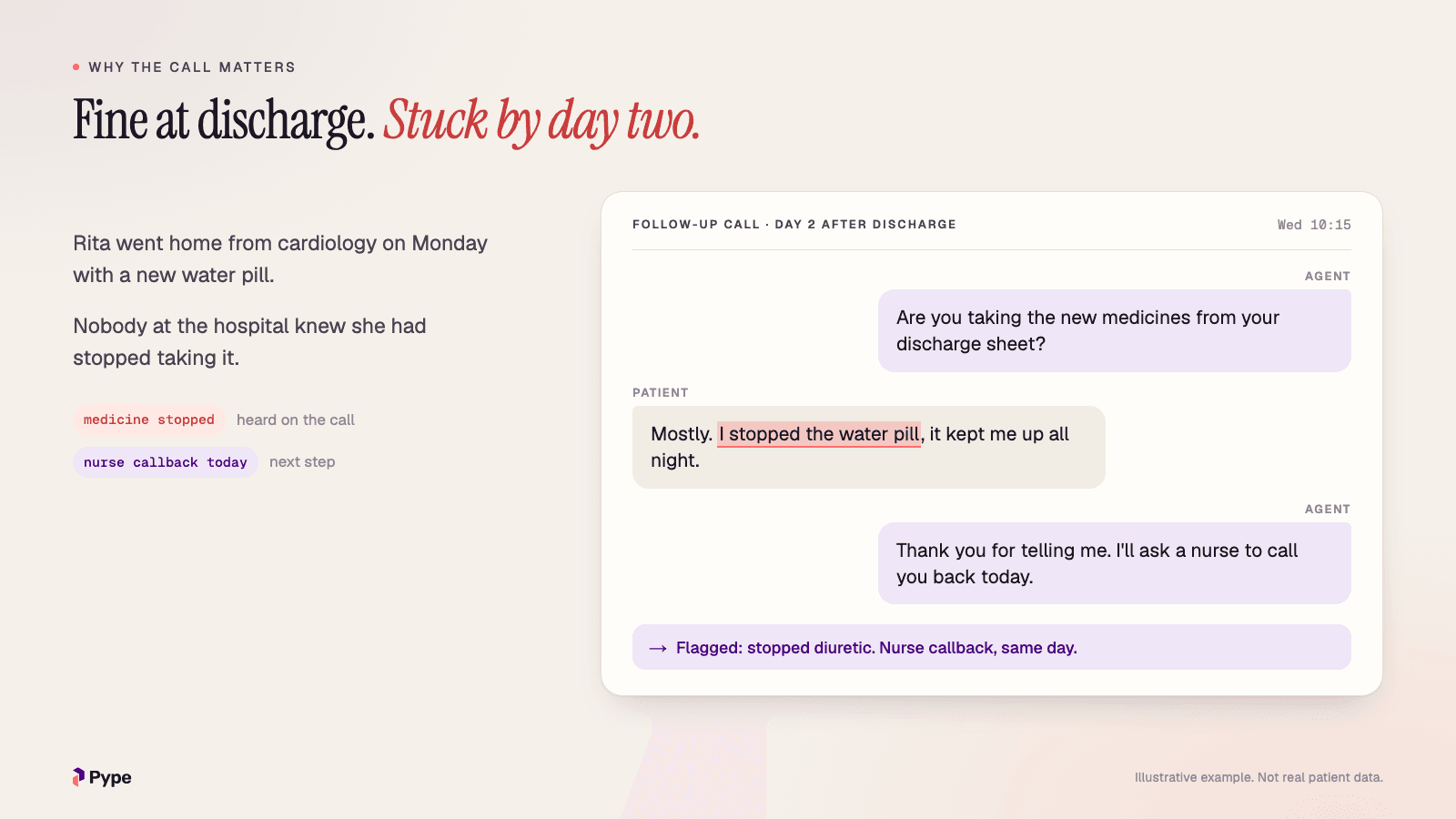
Rita, 71, goes home from cardiology on Monday with a new water pill. On Wednesday morning she gets her follow-up call. Asked about her medicines, she says: "Mostly. I stopped the water pill, it kept me up all night."
Nobody at the hospital knew. Without the call, the first sign of trouble might have been swollen ankles and a breathless night on Saturday.
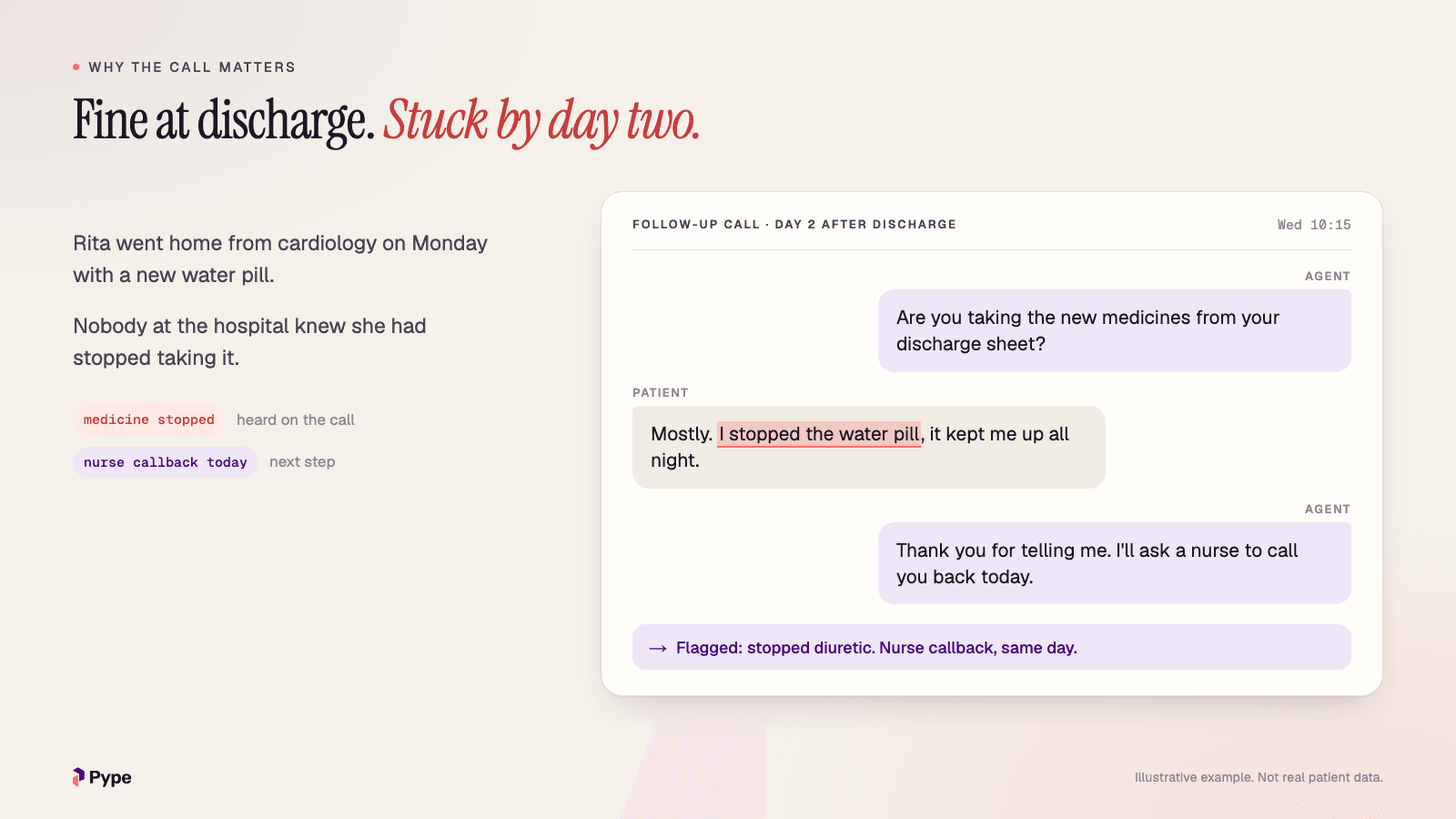 One honest answer, caught on day two instead of in the ER on day six.
The call isn't a courtesy. It's the first check that the discharge plan actually works at home.
When to make post discharge follow up phone calls
Timing matters more than most teams think. Here's the schedule we'd suggest as a starting point.
| When | What | Why |
|---|---|---|
| Day 0, at discharge | Confirm the best number, the best time, and who else can answer (a carer, a son or daughter) | Most failed follow-ups are just wrong numbers |
| Days 1 to 3 | The main follow-up call | Matches AHRQ's RED guidance, and catches medicine problems early |
| Days 7 to 10 | A second, shorter check for higher-risk patients | Heart failure, COPD, complex medicine changes, people living alone |
| By day 14 | Confirm the first clinic visit happened, or is booked | Closes the loop on the discharge plan |
If you bill Medicare for transitional care management (TCM), there's a tighter rule. Noridian's TCM guidance says the interactive contact must happen within two business days of discharge, and that it must address the patient's status and needs, not just scheduling.
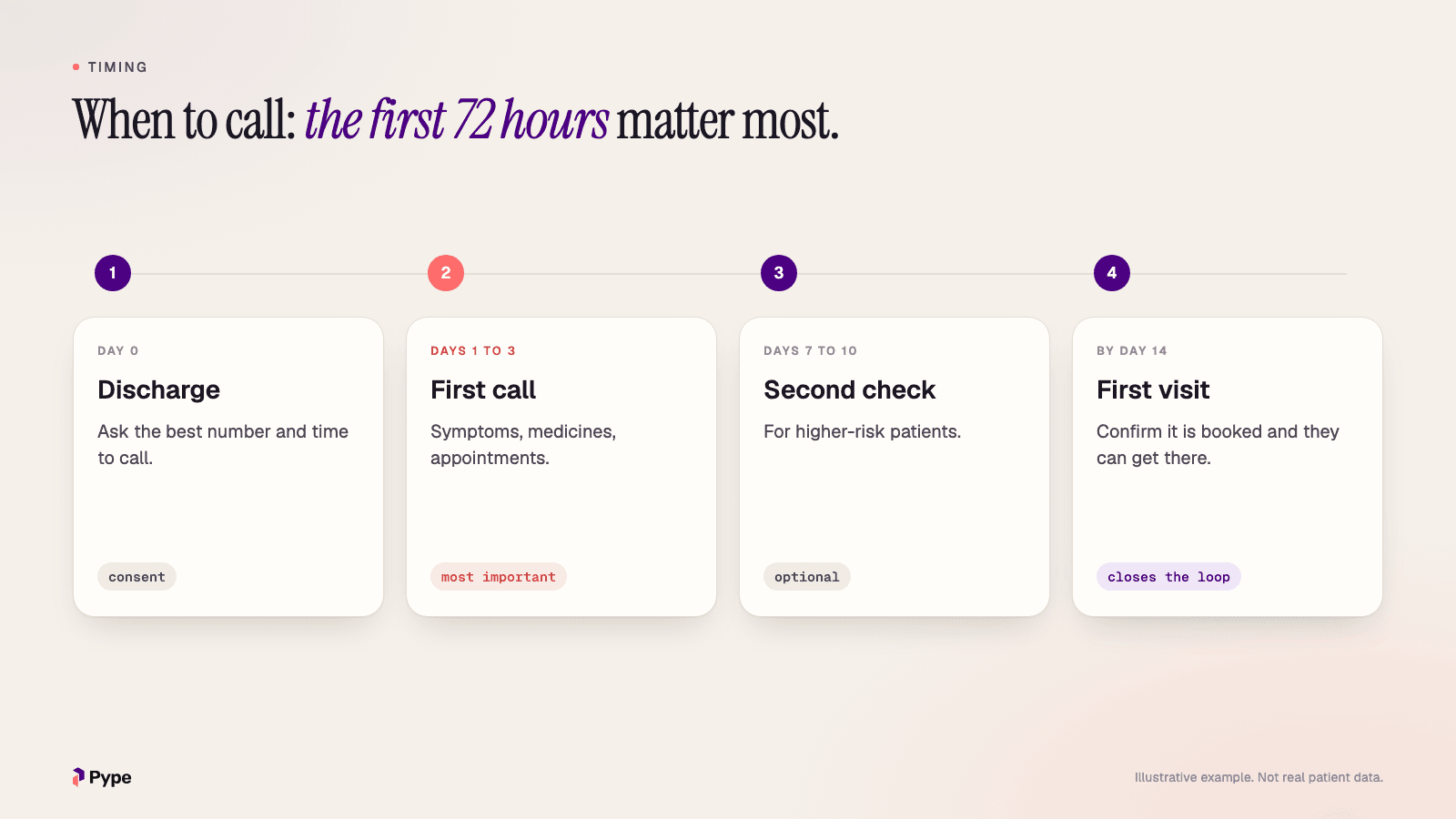 Most of the value sits in the first 72 hours.
Call early, try more than once, and write down every attempt.
The post discharge follow up call script (free template)
Here's the script. Copy it, change the wording to fit your hospital, and get your clinical lead to sign it off. The order matters: warning signs come before any admin questions.
1. Open and verify
"Hi, this is [name] calling from [hospital] about [patient name]'s recent stay. Is this [patient name]? Before we start, can you confirm your date of birth? Is now a good time for about five minutes?"
If the patient can't talk, book a time. If a carer answers, check you're allowed to speak with them.
2. How are you feeling? (warning signs first)
"How are you feeling today compared with when you left the hospital?" "Since you got home, have you had any of these: chest pain, trouble breathing, a new fever, bleeding, new confusion, or pain that's getting worse?"
Add the warning signs for the condition. Heart failure: weight up by more than your clinic's limit, swollen ankles, can't lie flat. Surgery: wound redness, discharge, fever.
3. Medicines
"Were you able to pick up all your new medicines?" "Can you read me the names on the bottles you're taking now?" "Have you stopped or changed any of them? Any side effects?"
Asking them to read the bottles beats "are you taking your medicines?" every time. People say yes to yes-or-no questions.
4. Appointments
"Do you know when your follow-up appointment is? Do you have a way to get there?"
If it isn't booked, book it on the call.
5. Help at home
"Did the equipment or home care you were promised arrive? Is there someone helping you at home?"
6. Close with teach-back
"Just so I know I explained it well, can you tell me which symptoms mean you should call us straight away? Here's the number to call. We'll check in again on [date]."
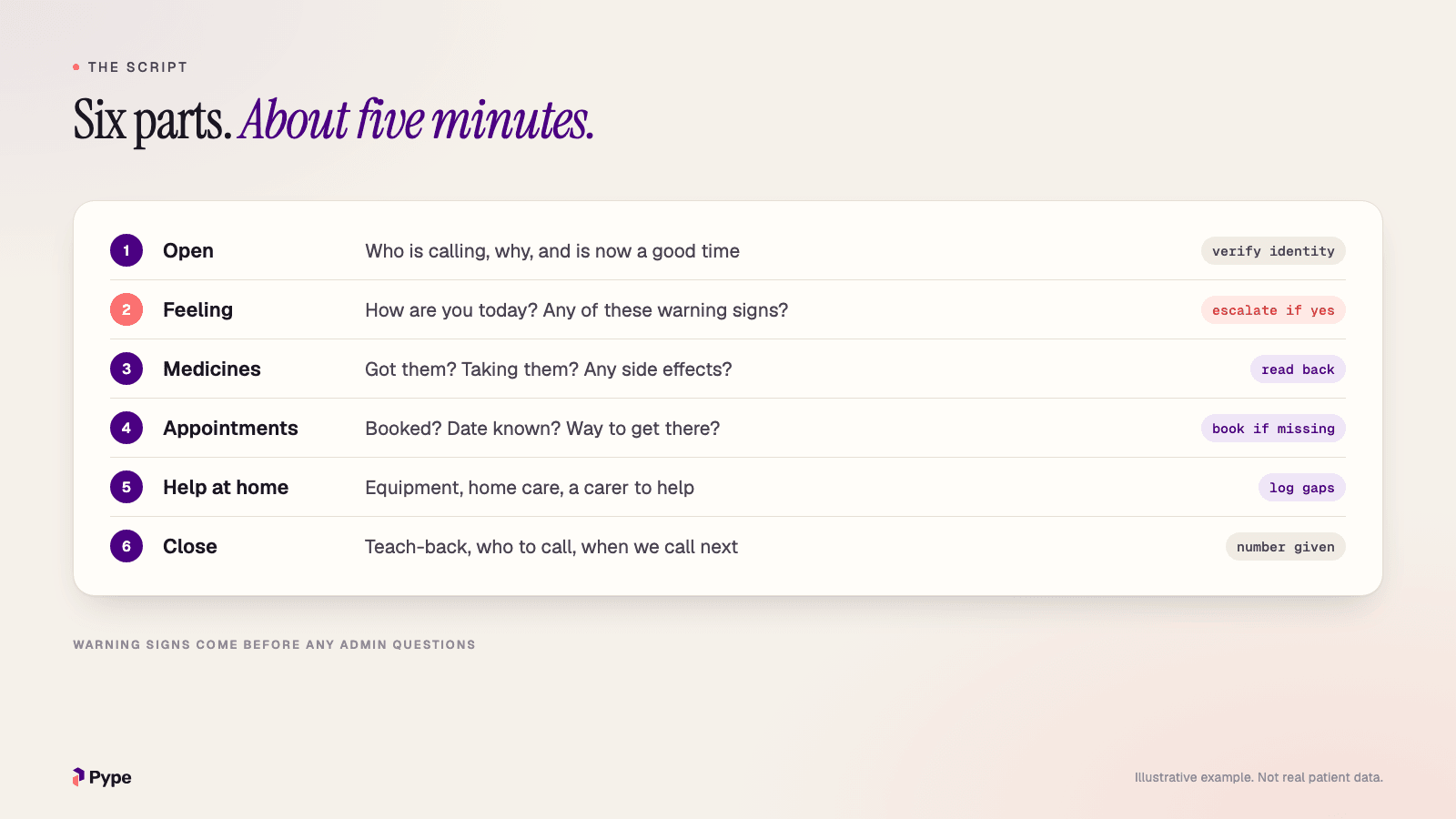 Six parts, about five minutes. Warning signs always come first.
When to escalate a follow-up call
This is the part most scripts skip, and it's the part that matters most. Every answer should land in one of three buckets, and each bucket has a fixed next step.
| What you hear | Bucket | What happens next |
|---|---|---|
| Chest pain, can't breathe, fainting, signs of stroke, heavy bleeding | Emergency now | Stop the script. Tell them to call emergency services (911 in the US, 112 in India). Alert the care team. |
| Stopped a medicine, new fever, wound looks red, weight gain, can't get medicines | Nurse today | Warm transfer to a nurse, or a nurse callback the same day. Note the reason. |
| Appointment unclear, transport, equipment questions | Routine | Sort it on the call or log a task with an owner. |
Two rules make this work. First, the warning sign list is written and signed by a clinician, not improvised by the caller. Second, the caller never talks a patient out of a symptom. If in doubt, move it up a bucket.
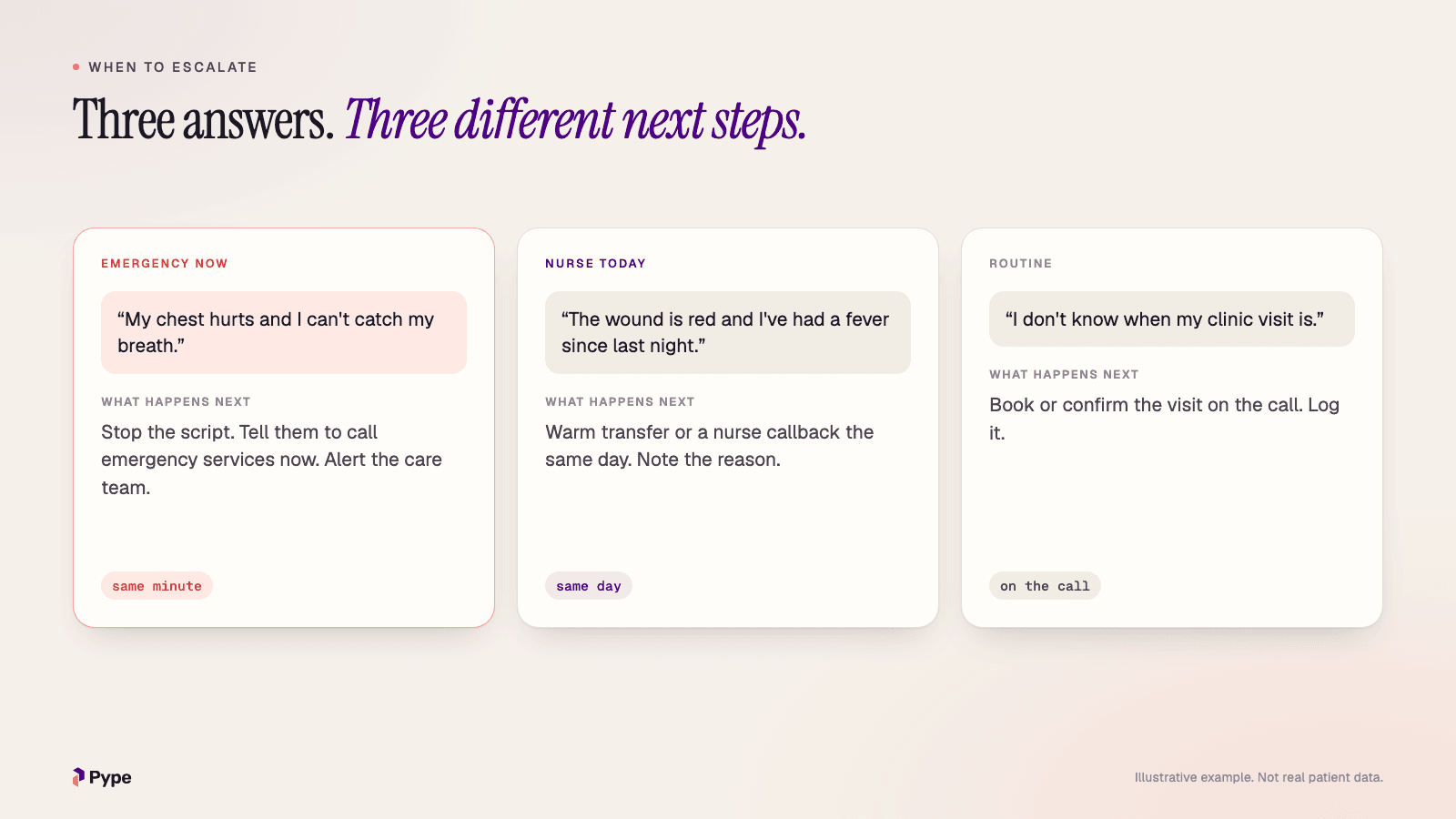 Every answer lands in a bucket. Every bucket has a fixed next step.
A script without an escalation ladder is just a survey.
Post discharge follow up phone call documentation form
Whoever makes the call, write the same things down every time. A simple documentation form looks like this:
- Patient name, ID, discharge date, discharging department
- Date and time of each attempt, and the outcome (reached, no answer, wrong number, voicemail)
- Who answered (patient or carer) and how identity was checked
- Symptoms asked about, and the answers in the patient's own words
- Medicines confirmed, stopped or changed, and any side effects
- Follow-up appointment: date, booked on this call or already booked
- Home services and equipment: arrived or missing
- Escalation bucket, the reason, and who it went to
- Teach-back done (yes or no), and the date of the next call
If the call is made by software, the record should also say which script version ran and why each escalation decision was made. We wrote about that in more detail in how to build auditable AI agents for healthcare.
Can voice AI make post-discharge follow-up calls?
Yes, for a lot of the work, with clear limits. The hardest part of follow-up is usually reach: calling every patient, at the right time, more than once, and writing it all down. That's exactly where voice AI for post-discharge follow-up calls helps. It can run the routine questions, call back at the time the patient picked, speak the patient's language, and route anything worrying to a nurse straight away.
Two honest caveats. A voice agent should never handle the emergency bucket on its own. It should hand over immediately. And for Medicare TCM billing, Noridian's direct contact guidance says digital assistants such as chatbots don't count as the interactive contact, so plan for clinical staff to make or complete that contact. Check the current rules with your billing team.
At Pype we approach follow-up the same way as every other call: the escalation rules are written and signed off by the hospital's clinicians, every call leaves a trail you can review, and hard calls go to a person. If you're comparing options, our guide to choosing an AI voice agent for your hospital lists the questions to ask, and what are AI voice agents for healthcare? covers the basics.
Key takeaways
- A post discharge follow up call script checks symptoms, medicines, appointments and help at home, in that order.
- Call within one to three days of discharge, and within two business days if you bill TCM.
- Ask patients to read their medicine bottles. Don't ask yes-or-no questions.
- Every answer goes into one of three buckets: emergency now, nurse today, or routine.
- Document every attempt, every answer and every escalation the same way.
- AI can carry the routine calls. Emergencies and TCM contact need a person.
Start with one department and one script. Run it for two weeks, read the calls, and fix the questions patients keep misunderstanding. It's not glamorous work, but it's some of the most useful work a hospital can do :)
Frequently asked questions
What should a post discharge follow up call script include?
An identity check, questions about symptoms and warning signs, a medicine review, a check that the follow-up appointment is booked, a check on help at home, and a teach-back close. It should also include a written escalation ladder that tells the caller exactly what to do with worrying answers.
When should post discharge follow up calls be made?
AHRQ's RED toolkit recommends calling two to three days after discharge. For Medicare transitional care management, the interactive contact must happen within two business days. Higher-risk patients benefit from a second, shorter call around day seven to ten.
Who should make post discharge follow up phone calls?
AHRQ's guidance is that clinical staff make the call. Many hospitals use nurses or care coordinators, and some use voice AI for the routine questions and outreach, with anything worrying handed to a nurse.
What should happen if the patient reports a warning sign?
Stop the script. For emergency symptoms such as chest pain or trouble breathing, tell the patient to call emergency services and alert the care team. For urgent but not emergency symptoms, arrange a nurse callback the same day and record the reason.
Can an AI voice agent make post-discharge follow-up calls?
Yes, for routine check-ins, reminders and outreach, as long as escalation rules are signed off by clinicians and every call can be reviewed. Emergencies should go straight to people, and AI calls may not count as the direct contact for Medicare TCM billing.
What goes on a post discharge follow up phone call documentation form?
Every call attempt and its outcome, who answered, the patient's answers on symptoms, medicines, appointments and home services, the escalation bucket and reason, and the date of the next call.
About the author
Ashish Tripathy is the founder of Pype AI, which builds voice AI agents for hospitals and healthcare providers. Pype also maintains Whispey, an open-source, OpenTelemetry-based observability tool for voice AI agents.