
When a caller says "emergency": how a hospital emergency contact AI agent should hand off
When a caller says "emergency": how a hospital emergency contact AI agent should hand off
What a hospital emergency contact AI agent should do the moment a call turns urgent: the phrases to listen for, the three lanes, the warm handoff, and an escalation checklist.
Ashish Tripathy, Founder, Pype AI | 21 October 2026 | 8 minute read
A hospital emergency contact AI agent is a voice agent that answers patient calls and, the moment a call sounds like an emergency, stops whatever it was doing and gets the caller to the right help: emergency services, an on-call nurse or doctor, or a crisis line.
It does not diagnose. It listens for warning signs, follows rules a clinician signed, and hands off fast, with the context, so nobody has to start over.
Quick context. At Pype AI we build voice agents that talk to patients for hospitals: booking, reminders, follow-ups. After millions of minutes of these calls, the emergency handoff is the first thing safety-minded buyers ask about. They're right to. So here's how I'd design it, whoever builds your agent.
Why the emergency handoff matters more than anything else the agent does
Most calls to a hospital are routine. A booking, a reschedule, a question about parking. Healthcare voice agents handle these well.
But a small share of calls are not routine, and the caller often doesn't know it. They ring to book a visit and mention, almost in passing, the one sentence that changes everything.
That's the hard part. Callers rarely say "emergency". They describe symptoms.
This isn't a new problem, and it isn't unique to AI. A study of after-hours phone handling in 91 primary care practices, published in the Journal of Family Practice (2003), found that most answering services asked patients to decide for themselves whether their problem was serious enough to reach the on-call physician. Physicians reviewing the calls that weren't forwarded said they'd have wanted to speak to the patient in about half of them.
AI adds its own twist. ECRI, the patient safety organisation, named the misuse of AI chatbots the top health technology hazard for 2026, warning that fluent, confident answers can mislead people (Fierce Healthcare, January 2026). A voice agent that sounds calm and sure is exactly the kind of thing people trust without question.
So the agent's job is not to sound reassuring. It's to notice, and to hand off.
What an emergency sounds like on a hospital call
Let's take one call (an illustrative example, not a real one).
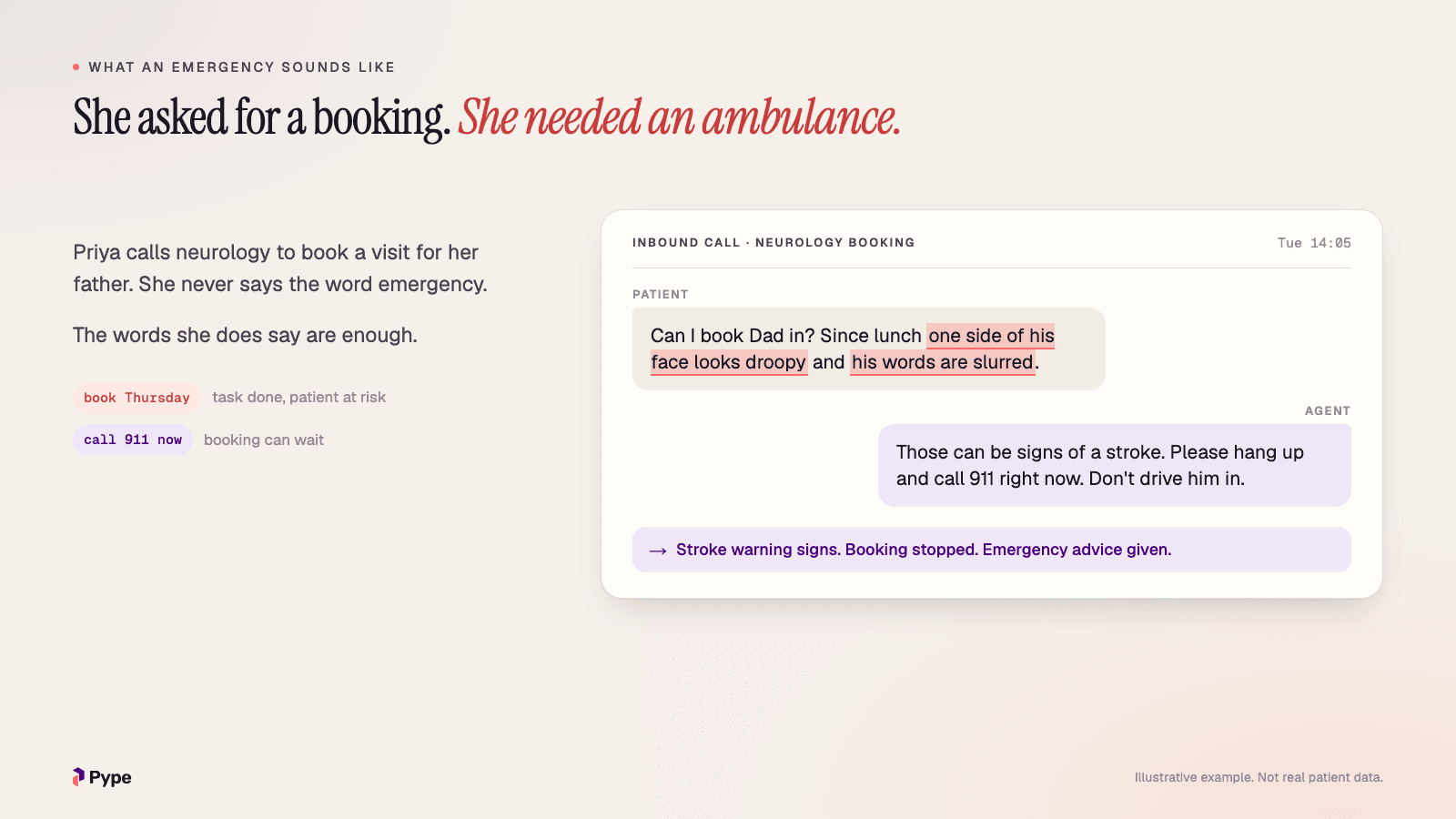
Priya calls the neurology desk on a Tuesday afternoon. "Can I book Dad in? Since lunch one side of his face looks droopy and his words are slurred."
She asked for a booking. A generic agent tuned only for booking would find her the next free slot and call it a success.
But a drooping face and slurred speech are classic stroke warning signs. The American Heart Association is clear: call 911 right away, and don't drive the person in yourself. The booking can wait.
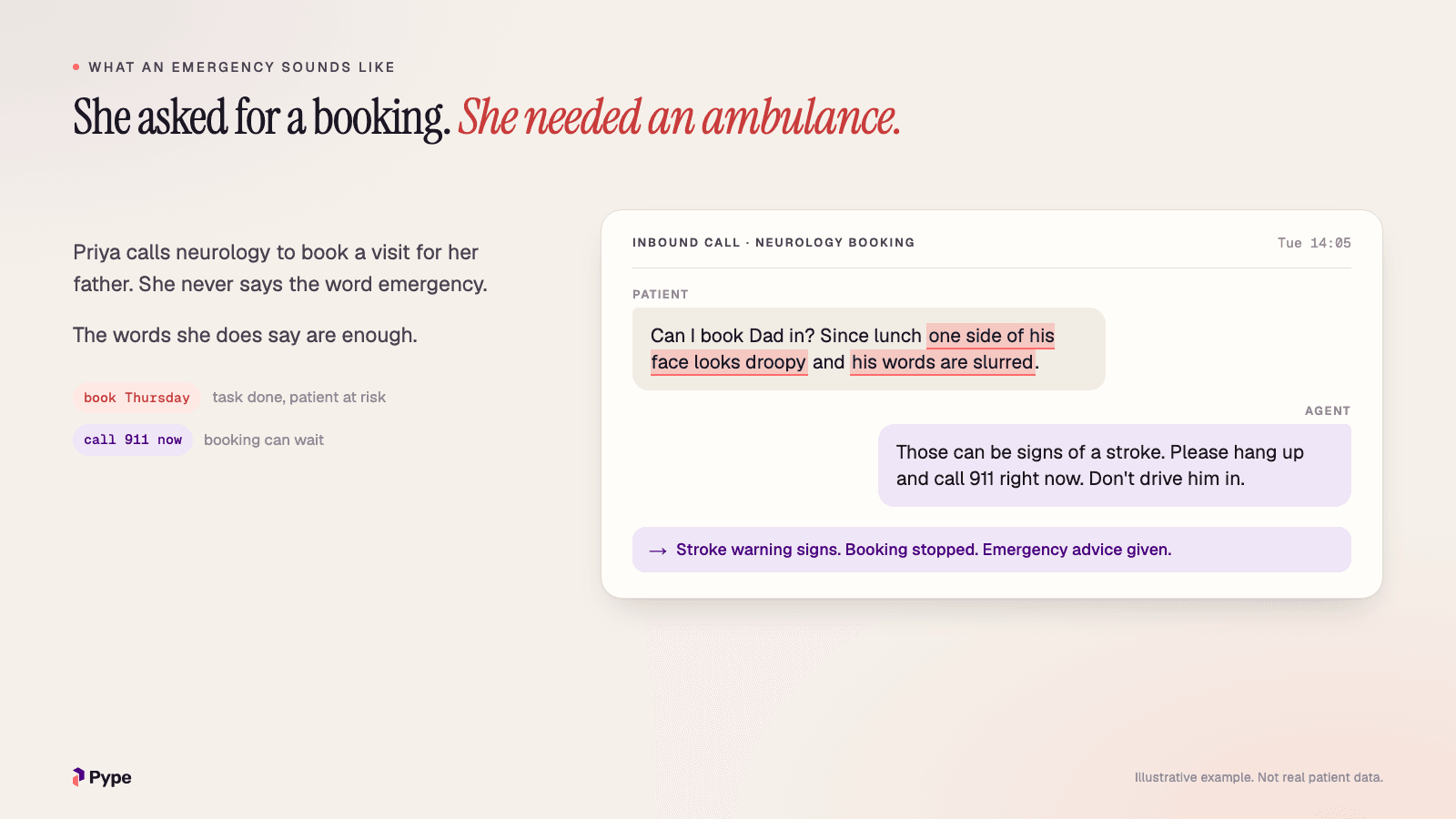 She never said "emergency". The words she did say were enough.
Here's what should happen, step by step:
| Step | What the agent does | Why |
|---|---|---|
| 1. Hears | Picks up "face looks droopy" and "words are slurred" | Both are on the clinician-signed red-flag list |
| 2. Stops | Drops the booking flow mid-call | No booking question should come before safety |
| 3. Says | "Those can be signs of a stroke. Please call 911 right now. Don't drive him in." | Short, plain, read word for word from an approved script |
| 4. Offers | Stays on the line if she has questions, and offers the nurse line | The caller shouldn't feel hung up on |
| 5. Logs | Records the phrases heard, the rule that fired, and what was said | So someone can review the call the same day |
The phrases, scripts and steps above are an illustration, not clinical guidance. Your clinicians set your own.
Escalate on the words the caller uses, never on their own guess of how serious it is.
The three lanes every call can fall into
The simplest design I know is three lanes. Every call lands in one of them, and the agent decides which before it does anything else.
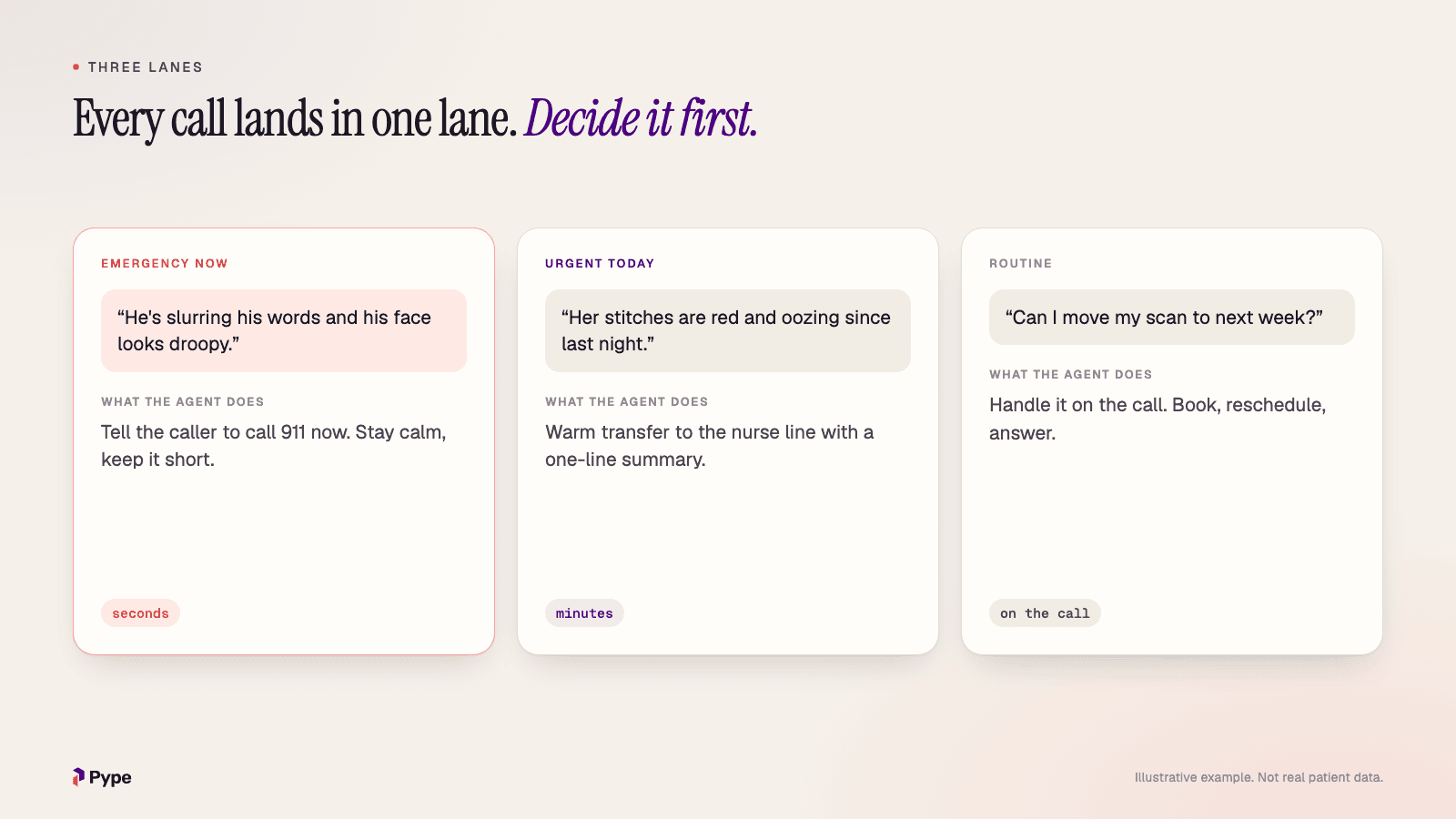 Every call lands in one lane. Decide it first.
- Emergency now. Signs of stroke, heart attack, severe bleeding, trouble breathing, or someone at risk of harming themselves. The agent tells the caller to contact emergency services immediately (911 in the US, 112 in India), in a few calm sentences.
- Urgent today. Worrying but not life-threatening right this minute. A wound that looks infected, a fever after surgery, a medication question that can't wait. The agent warm-transfers to a nurse or on-call doctor.
- Routine. Everything else. The agent books, reschedules, or answers from the hospital's own information.
Mental health crises need their own path. In the US, the 988 Suicide and Crisis Lifeline handles most contacts directly, and SAMHSA notes that only a small share need 911, usually with the caller's agreement. In India, the national Tele-MANAS helpline (14416) handles mental health calls, and in Bengaluru it has been linked with the 112 emergency system for psychiatric emergencies (ThePrint). Your agent should know which line to offer, and should never end the call abruptly.
The lanes and the red-flag phrases belong to your clinicians, not your engineers.
How AI voice agents for healthcare should hand off: warm, not cold
Once the agent decides a call is urgent, how it hands off matters as much as the decision.
A cold transfer just moves the call. The caller hears hold music. A nurse picks up with no context and asks "how can I help?", and the caller has to start over, often more anxious than before. If nobody answers, the line rings out.
A warm handoff does three things differently:
- Tells the caller what's happening. "I'm connecting you to the nurse now. Please stay on the line."
- Sends the summary first. The nurse hears or sees one line before the caller is connected: "Meena, day 3 after knee surgery, wound red and oozing since last night."
- Has a fallback. If nobody answers within a set time (say 30 seconds), the agent tries the next person on the rota, and if that fails, gives emergency advice and logs it.
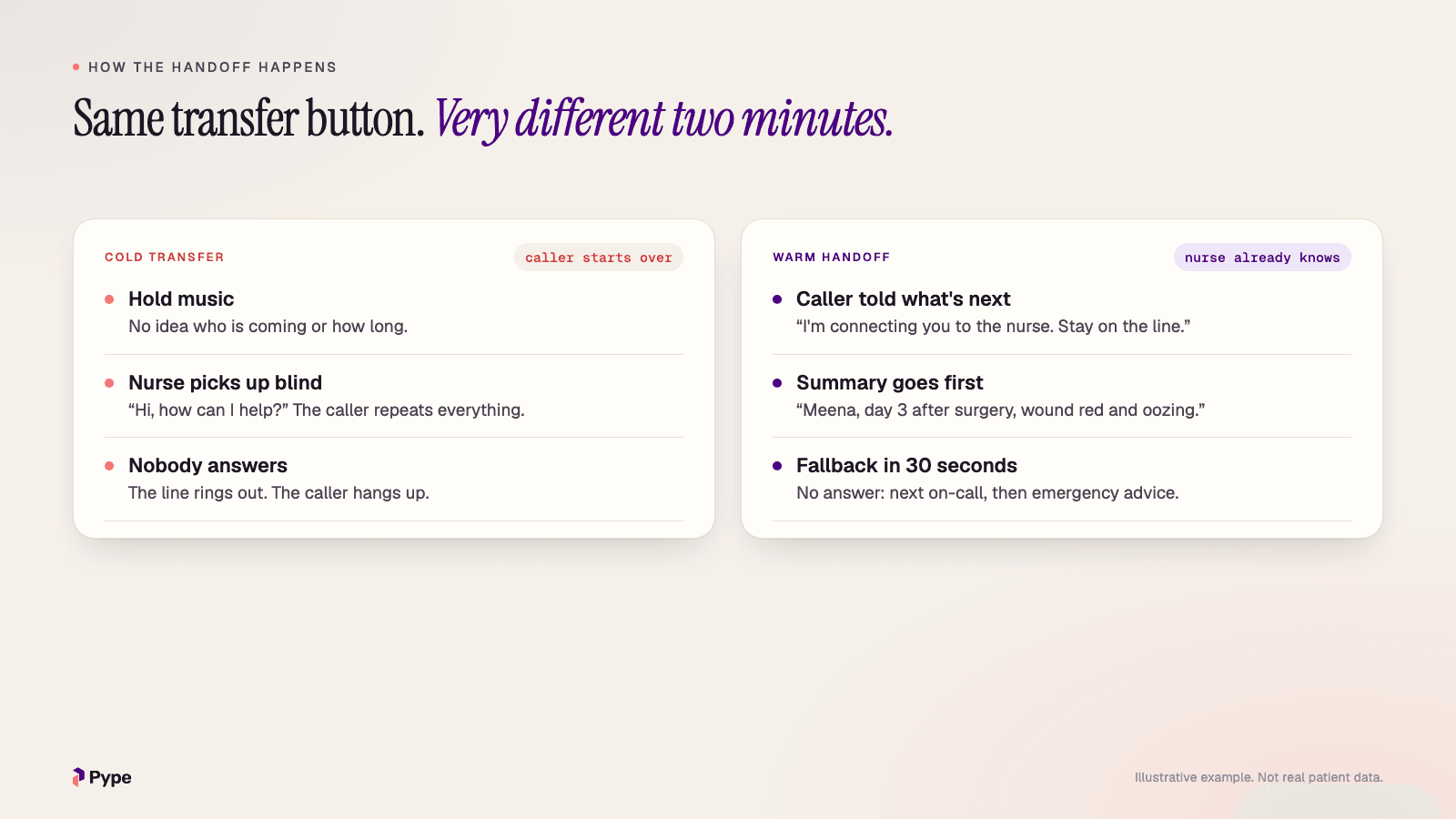 Same transfer button. Very different two minutes.
The fallback is the part most teams forget. Your nurse line at 3 am on a public holiday is not your nurse line at 11 am on a Tuesday. Test both.
A handoff isn't finished when the call is transferred. It's finished when a person has it.
Logging every escalation: the decision trail
Every escalation should leave a record anyone can read later: the phrases the agent heard, how sure it was it heard them right, the rule that fired, what it said, who picked up, and how long it took.
This is how you find the near misses. It's also how you answer the question every hospital eventually asks: "why did your agent do that?" I wrote more about this in how to build auditable AI agents for healthcare.
If the escalation record contains patient details (it usually does), it's protected health information. That means it has to be covered by the same agreements as the rest of the call. If you're in the US, check that every vendor in the chain has signed a BAA, which I walked through in HIPAA-compliant AI voice agent: the BAA chain behind every call.
Hospital emergency contact AI agent: escalation checklist
Before your agent takes its first real call, check these eight things.
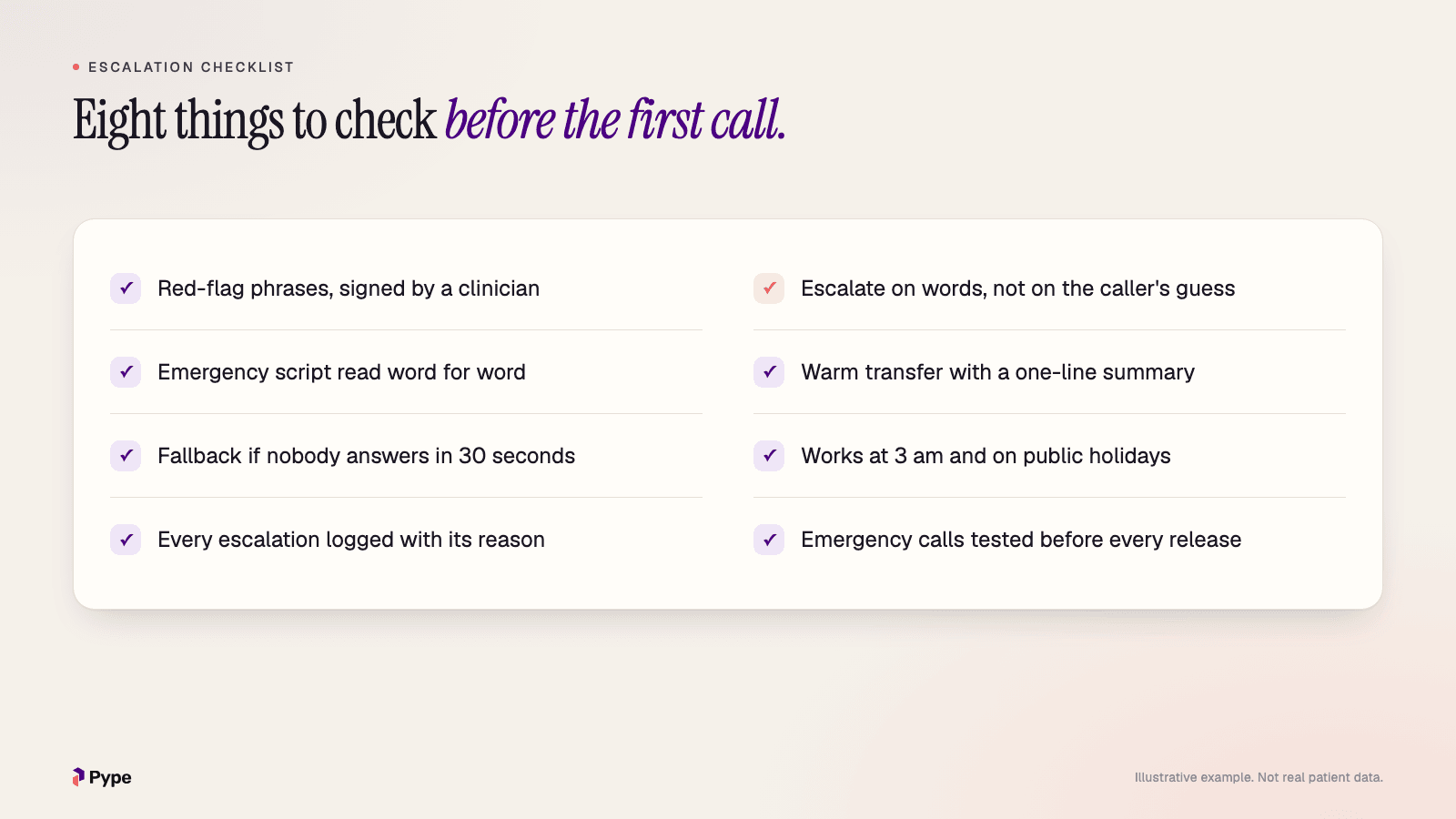 Eight things to check before the first call.
- A list of red-flag phrases per specialty, written and signed by a clinician
- The agent escalates on what the caller describes, not on whether they say it's serious
- An emergency script, short and plain, read word for word
- Warm transfer to a nurse or on-call doctor, with a one-line summary sent first
- A fallback if nobody answers within a set time
- The same coverage at 3 am, on weekends and on public holidays
- Every escalation logged with the phrases heard, the rule applied and the outcome
- Emergency scenarios tested as pass or fail before every new version goes live
If you're comparing vendors, ask each one to walk you through this list on a live demo call. It tells you more than any slide. I listed more questions like this in how to choose an AI voice agent for your hospital.
How we think about it at Pype
At Pype, emergency escalation is one of the things we test on every version of an agent before it goes live, and every fix ships as a new version that goes through the same tests again. The red-flag lists and handoff paths come from each hospital's own clinicians. That's it. The rest of this post applies whoever builds your agent.
Key takeaways
- Callers rarely say "emergency". They describe symptoms, often in the middle of a routine request.
- Sort every call into three lanes first: emergency now, urgent today, routine.
- For emergencies, the agent's job is short, plain direction to emergency services, not reassurance.
- Hand off warm: tell the caller, send the summary, and have a fallback if nobody answers.
- Clinicians own the red-flag phrases and the scripts. Engineers make sure they run every time.
- Log every escalation, and test emergency scenarios before every release.
Nobody demos the emergency path in a sales meeting. But it's the one call you'll be glad you got right :)
Frequently asked questions
What is a hospital emergency contact AI agent?
A voice agent that answers hospital calls and, when a call sounds like an emergency, stops its normal task and directs the caller to the right help: emergency services, an on-call nurse or doctor, or a crisis line. It follows clinician-signed rules and does not diagnose.
How do AI voice agents for healthcare know when a call is an emergency?
They listen for red-flag phrases that clinicians define, such as slurred speech, chest pain or trouble breathing, rather than waiting for the caller to say "emergency". When one is heard, a written rule decides what happens next, so the same words always lead to the same action.
Should an AI voice agent tell callers to dial 911?
For signs of a life-threatening emergency, yes. The agent should tell the caller, in short plain words, to call 911 in the US or 112 in India right away, using a script your clinicians approved. For urgent but not life-threatening calls, a warm transfer to a nurse is usually the better path.
What is a warm handoff in a healthcare voice agent?
A transfer where the agent tells the caller what is happening, passes a short summary to the nurse or doctor before connecting them, and has a fallback if nobody answers. The caller never has to repeat their story from the start.
Can voice AI handle escalation on post-discharge follow-up calls?
Yes, and it should be designed in from the start. Post-discharge calls often surface warning signs like fever, wound changes or breathlessness, so the call script needs clear escalation rules. Our post-discharge follow-up call script shows one way to set it up.
Does a HIPAA compliant AI voice agent for healthcare need to log escalations?
HIPAA's Security Rule requires audit controls for systems that handle electronic patient data, and an escalation log usually contains patient details. Keeping a clear, access-controlled record of every escalation is good practice either way. Confirm the specifics with your compliance team.
About the author
Ashish Tripathy is the founder of Pype AI, which builds voice AI agents for hospitals and healthcare providers. Pype also maintains Whispey, an open-source, OpenTelemetry-based observability tool for voice AI agents.