
Automated insurance verification AI: what hospitals can automate today
Automated insurance verification AI: what hospitals can automate today
A plain guide to automated insurance verification AI: which eligibility and benefits checks software can do today, where voice AI helps with payer calls, and what to keep with people.
Ashish Tripathy, Founder, Pype AI | 19 October 2026 | 8 minute read
Automated insurance verification AI is software that checks a patient's coverage before a visit: whether the plan is active, what the patient will owe, whether the service needs prior authorization. It does this by sending electronic checks to the health plan, reading plan portals, and, where needed, making the phone call to the plan itself.
The electronic part is mostly solved. The hard part is the leftovers: the questions an electronic check doesn't answer, which still end with someone on hold.
Quick context. At Pype AI we build voice agents that talk to patients for hospitals: booking, reminders, follow-ups. After millions of minutes of these calls, the insurance questions keep coming up, from both hospitals and patients. So here's a plain map of what can be automated today, and what shouldn't be.
Why insurance verification is still a big job
Insurance verification is the most common admin task in US healthcare, and most of it is already electronic. The leftovers are still expensive.
The numbers from the 2024 CAQH Index, which covers 2023:
- Medical plans and providers ran 31.5 billion eligibility and benefit verifications, up 5% on the year. That's 51% of all medical admin transactions CAQH tracks.
- For a provider, a fully manual check (phone, fax, email) cost an average of $8.57. A portal check cost $4.46. A fully electronic check cost $2.00.
- CAQH estimates providers would save about 12 minutes per transaction by moving from manual to electronic.
Prior authorization sits right next to it. In the AMA's 2025 prior authorization survey, physicians reported about 40 prior authorizations a week, taking around 13 hours of physician and staff time.
Most checks are already automatic. The cost lives in the ones that aren't.
Why the phone still rings
An electronic check tells you a plan is active. It doesn't always tell you the detail you need for this patient, this service, this place.
Let's take one example (illustrative, not a real patient).
Priya is booked for a lumbar MRI on Tuesday. On Friday, the electronic check comes back: coverage active. On Monday, a call to the plan asks the specific question. "It's covered at 80% after deductible, but it needs prior authorization first."
Without that call, Priya arrives on Tuesday, the scan is postponed or done without approval, and somebody spends next month on a denied claim.
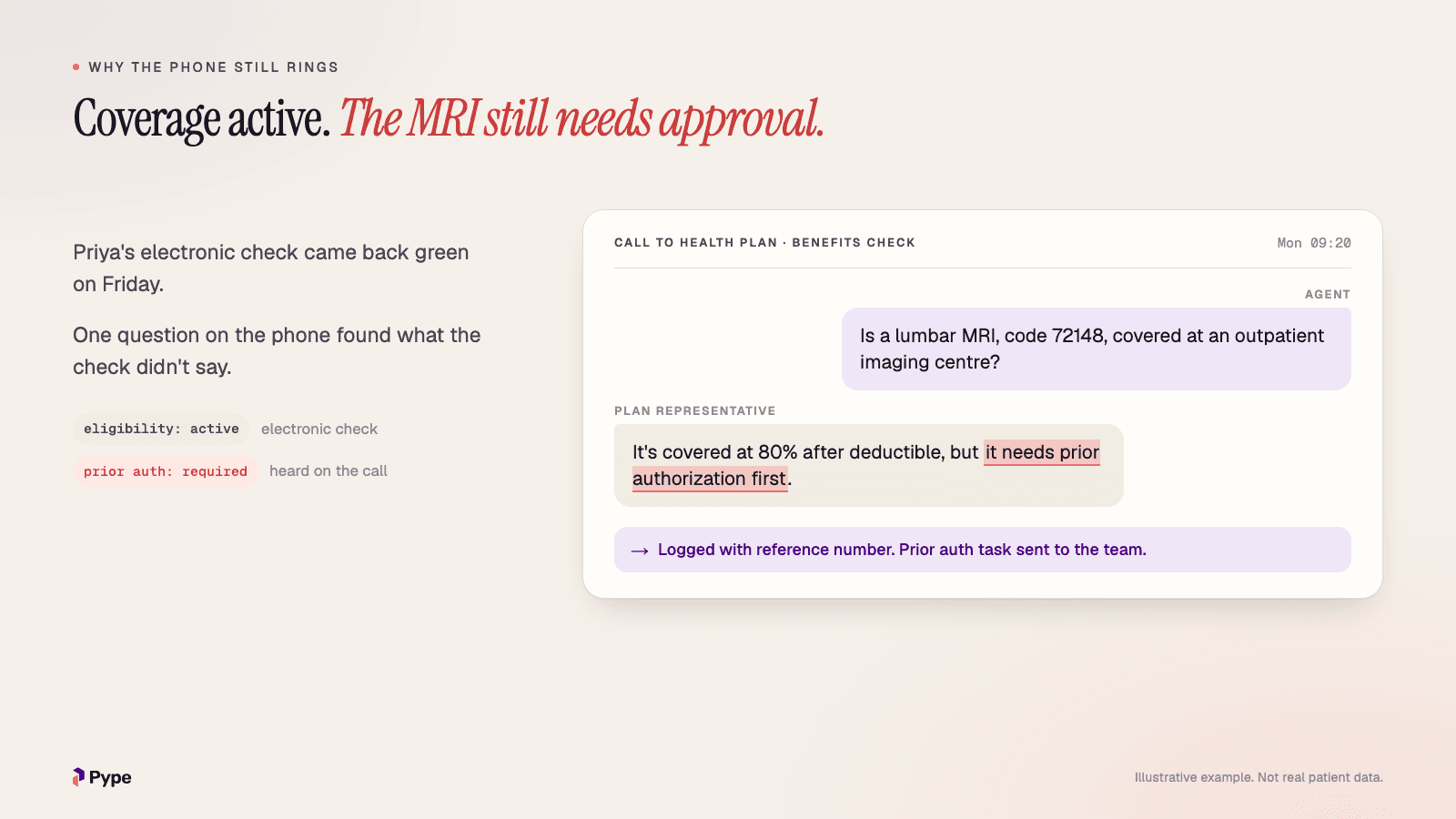 Coverage active. The MRI still needs approval.
Typical reasons a check ends in a phone call:
- Benefits for a specific procedure, place of service or specialist aren't in the electronic answer.
- The plan's prior authorization or referral rules aren't clear.
- The electronic answer conflicts with what the patient says.
- The plan is new, small, or a secondary payer.
Phone calls are where automated insurance verification AI earns its keep.
Where automated insurance verification AI fits
The right order is simple: electronic first, portal second, phone call only for the gaps. AI helps at every step, but differently.
| Step | What it is | What AI does |
|---|---|---|
| 1. Electronic check | A standard eligibility request (the X12 270/271 transaction) sent to the plan | Runs it automatically for every visit, reads the answer, flags anything missing |
| 2. Plan portal | The plan's website for providers | Fills in details the electronic answer left out, where the plan allows automated access |
| 3. Phone call | A call to the plan's provider line | A voice agent waits on hold, asks the specific questions, and records the answers and a reference number |
| 4. Patient call | A call or text to the patient | Confirms the plan is current, captures a new card, explains what to expect |
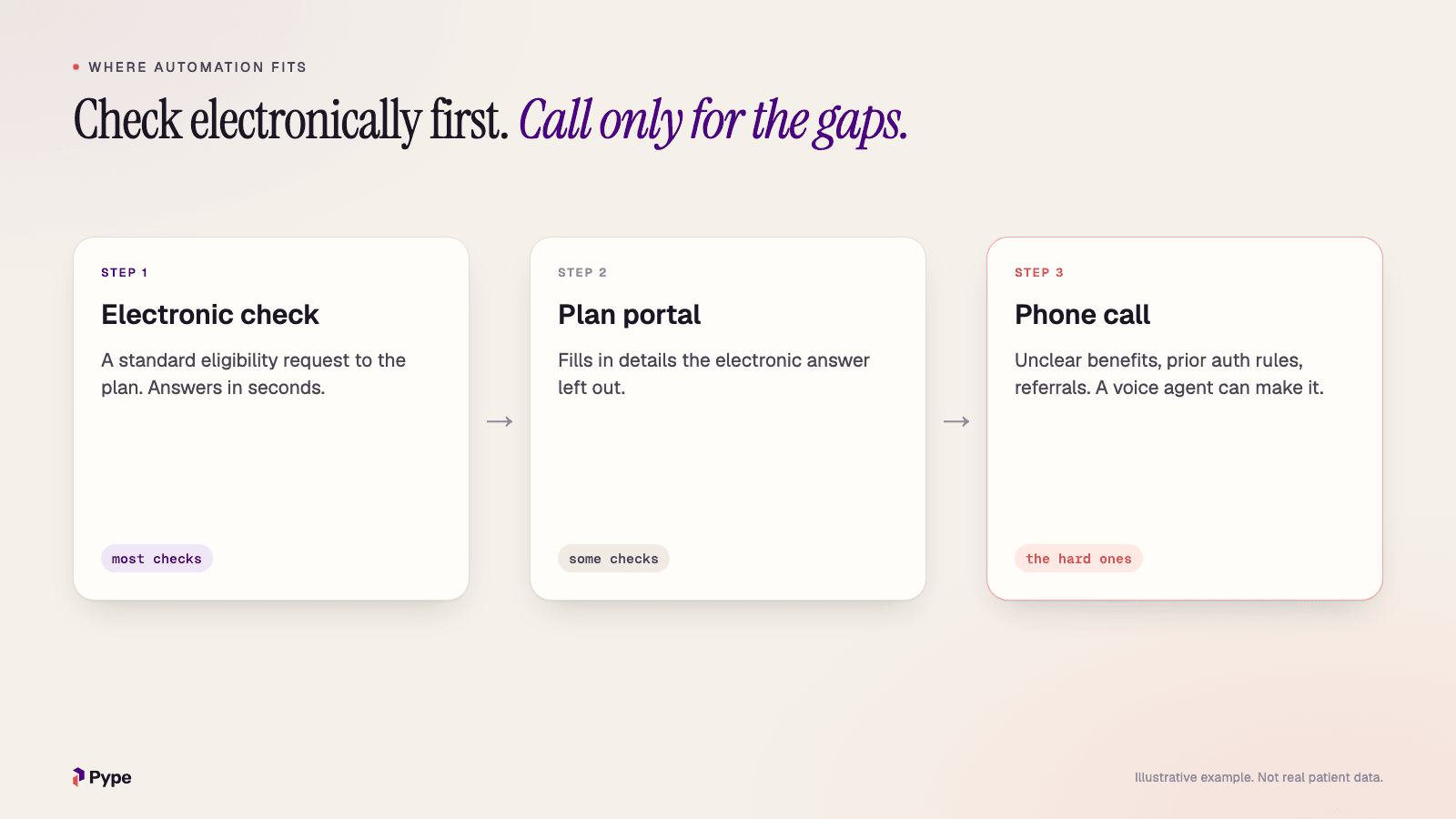 Check electronically first. Call only for the gaps.
The voice part is newer, and it's where the hidden hours are. A person waiting on hold for a plan's provider line can't do anything else. An AI voice agent for healthcare can wait, ask the same structured questions every time, and write the answers straight into the record.
Electronic checks cover volume. Voice agents cover the leftovers.
What hospitals can automate today, and what to keep with people
Not everything should be automated, even when it can be. Here's how I'd split it.
| Automate today | Automate, then review | Keep with people |
|---|---|---|
| Active coverage and plan dates | Payer calls for unclear benefits | Clinical arguments for approval |
| Copay, deductible, out-of-pocket left | "Is prior authorization needed?" | Appeals and peer-to-peer calls |
| In or out of network | Referral rules | Financial hardship conversations |
| Re-checks before every visit | Explaining costs to patients | Anything the plan disputes |
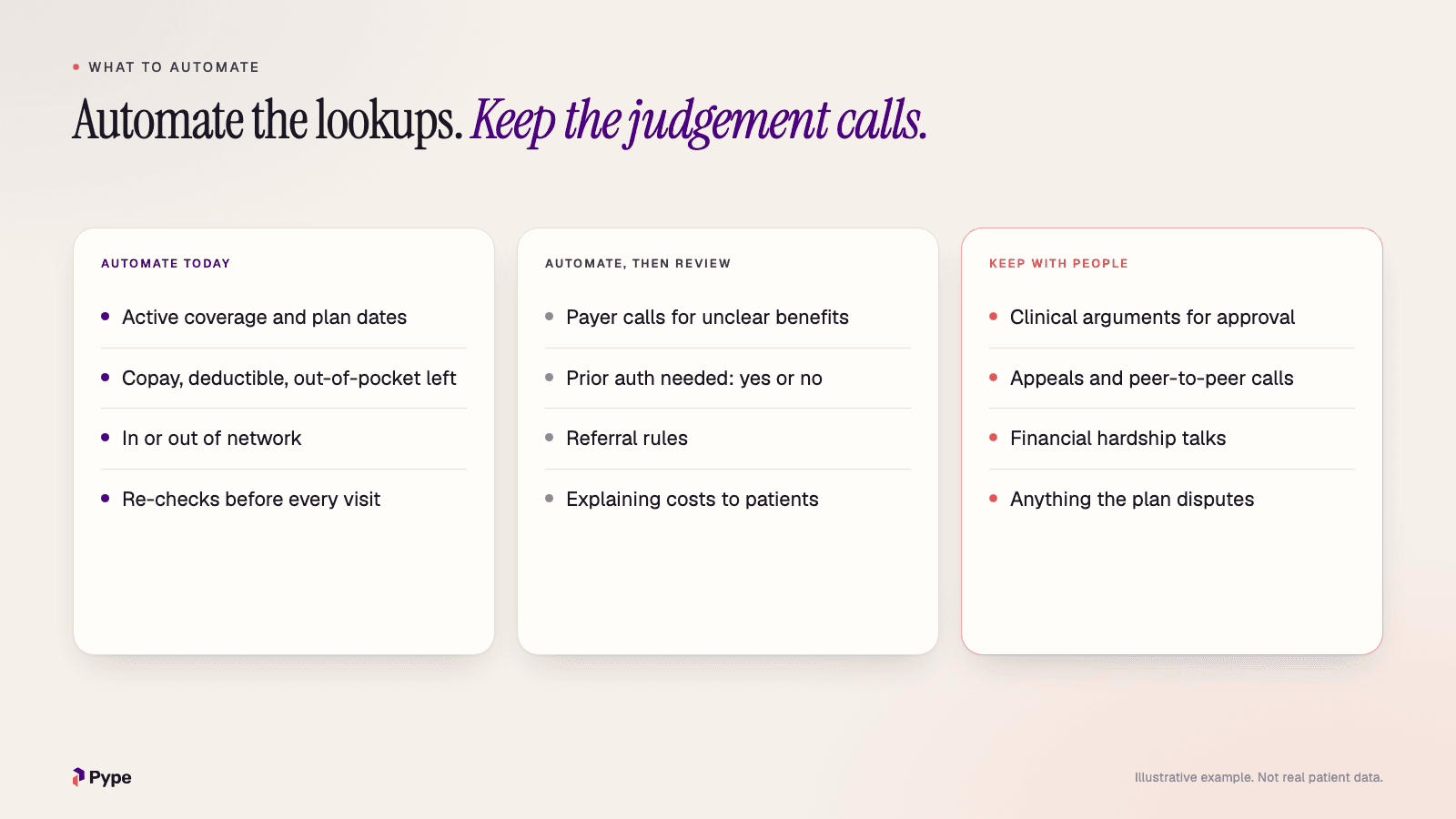 Automate the lookups. Keep the judgement calls.
The middle column is where most teams should start. The work is repetitive, but the answers matter, so a person reviews them before anything goes to the patient or the claim.
A note on rules. CMS's Interoperability and Prior Authorization Final Rule requires many government-program payers (including Medicare Advantage, Medicaid and CHIP) to decide urgent prior authorization requests within 72 hours and standard ones within 7 calendar days from 2026, and to build prior authorization APIs. Over time that should mean fewer calls for those plans. It won't remove them all, so plan for both.
Don't forget the patient side
Verification is only half the job. The other half is the patient knowing what to expect.
The most common cause of a failed check is simple: the patient's insurance changed and nobody told the clinic. A short pre-visit call catches it.
Daniel's cardiology visit is on Thursday. On Tuesday the agent asks if his insurance is still the plan on file. "Oh, my work switched plans in January. I have a new card."
A link to upload the new card, a same-day re-check, and Thursday goes smoothly.
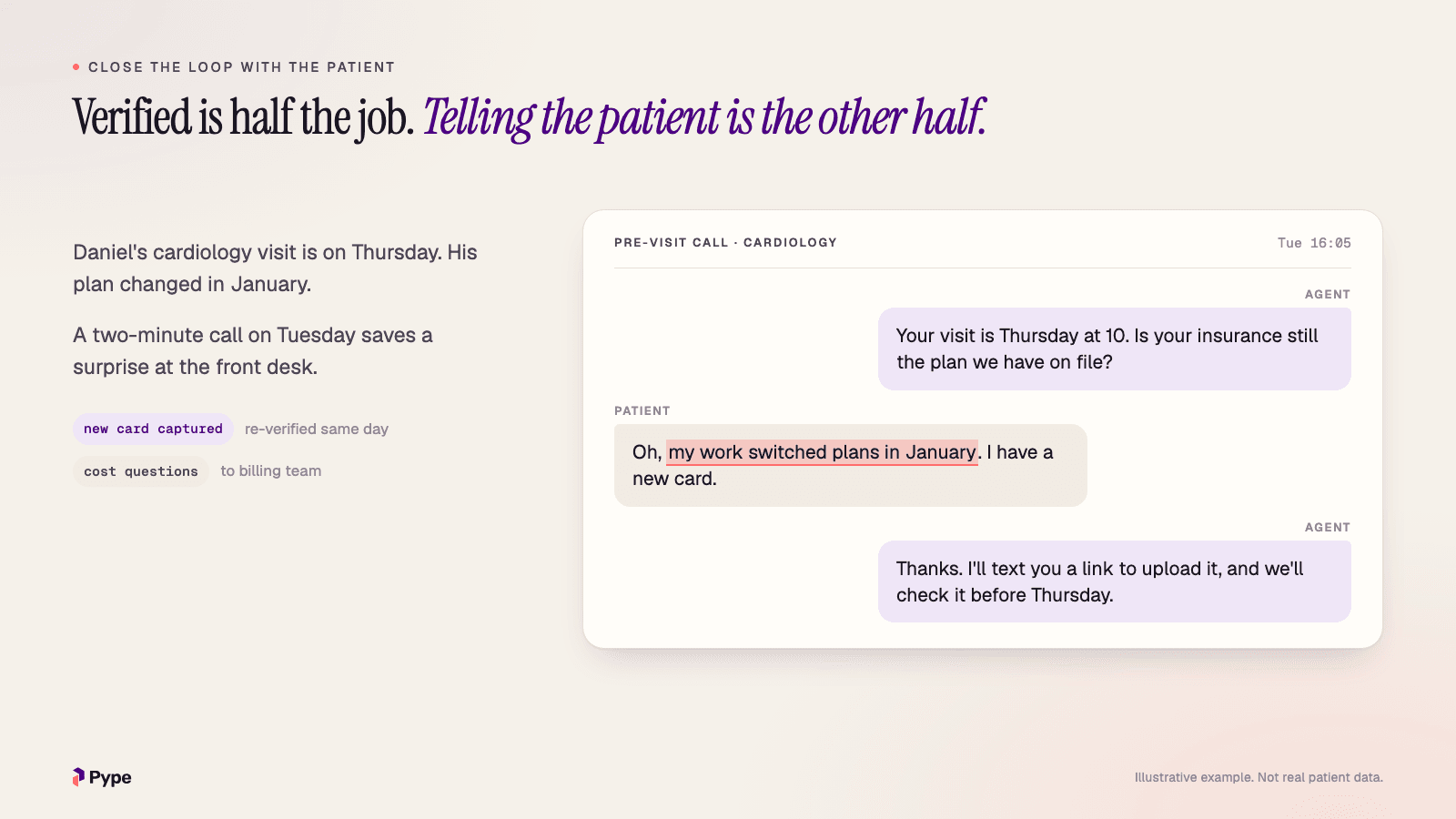 Verified is half the job. Telling the patient is the other half.
This is the part of an AI call center for healthcare that patients actually notice. Cost questions beyond the basics should go to the billing team, not be guessed by an agent.
If you run hospitals in India, the shape is similar: cashless pre-authorization with insurers and TPAs is another phone-heavy queue. Our India FAQ on AI voice agents in hospitals covers language, DPDP and HIS questions.
How to start
- Measure your leftovers. For two weeks, count which checks end in a portal visit or phone call, and why.
- Automate electronic checks for every visit, including a re-check a few days before.
- Pick one call type (say, imaging benefits) and write the exact questions and the fields to record, including the reference number.
- Run the voice agent on that one call type with a person reviewing every answer for the first few weeks.
- Add the patient call for plan changes and new cards.
Any vendor that touches these calls handles patient information, so check the Business Associate Agreement chain. Our post on what makes an AI voice agent HIPAA compliant lists the questions to ask, and how to choose an AI voice agent for your hospital covers the rest.
At Pype, we approach these calls the same way as any patient call: structured questions agreed with the hospital's team, every answer recorded with where it came from, and anything unclear handed to a person.
Key takeaways
- Automated insurance verification AI checks coverage, costs and prior authorization needs before a visit.
- Most eligibility checks are already electronic. The cost sits in the manual leftovers ($8.57 vs $2.00 per check for providers, per CAQH).
- Order matters: electronic first, portal second, phone only for the gaps.
- Voice agents are a good fit for payer calls and patient pre-visit calls, with a person reviewing answers at first.
- Keep appeals, clinical arguments and hardship conversations with people.
Start with one call type and two weeks of counting. It's not exciting work, but your front desk will notice on day one :)
Frequently asked questions
What is automated insurance verification AI?
It's software that checks a patient's insurance before a visit: whether coverage is active, what they'll owe, and whether prior authorization is needed. It uses electronic checks, plan portals and, increasingly, AI voice agents that call the plan.
Can AI voice agents call insurance companies for hospitals?
Yes. A voice agent can call a plan's provider line, wait on hold, ask structured benefit questions, and record the answers and a reference number. A person should review the answers at first, especially for prior authorization.
What can't be automated in insurance verification?
Clinical arguments for approval, appeals, peer-to-peer reviews and financial hardship conversations should stay with people. So should anything the plan disputes.
How much does manual insurance verification cost?
According to the 2024 CAQH Index, a fully manual eligibility and benefit verification cost providers an average of $8.57, against $2.00 for a fully electronic check, with about 12 minutes of staff time saved per transaction.
Is AI insurance verification HIPAA compliant?
It can be, if every vendor that handles patient information signs a Business Associate Agreement and the data is protected end to end. Ask the vendor to show the full chain.
Will the CMS prior authorization rule remove the need for payer calls?
Not entirely. It speeds up decisions and requires APIs for many government-program payers, but not for every plan or every question. Most hospitals will still need some calls for a while.
About the author
Ashish Tripathy is the founder of Pype AI, which builds voice AI agents for hospitals and healthcare providers. Pype also maintains Whispey, an open-source, OpenTelemetry-based observability tool for voice AI agents.