
How to reduce patient no-shows: the reminder cadence that works (SMS, voice call, then same-day backfill)
How to reduce patient no-shows: the reminder cadence that works (SMS, voice call, then same-day backfill)
How to reduce patient no-shows with a simple reminder cadence: a text at booking, a two-way call two days out, a text on the morning, and same-day backfill for every slot that frees up.
Ashish Tripathy, Founder, Pype AI | 19 October 2026 | 8 minute read
The most dependable way to reduce patient no-shows is a reminder cadence, not a single reminder: a text when the appointment is booked, a two-way voice call about two days before, a short text on the morning of the visit, and same-day backfill so any slot that frees up goes to someone on the waitlist. The texts keep the visit top of mind. The call is where the clinic finds out who isn't coming, while there's still time to use the slot.
Quick context. At Pype AI we build voice agents that talk to patients for hospitals and clinics, and reminders are usually the first thing teams ask us for. Last week I wrote about how AI voice reminder calls cut one provider's no-shows by 60%. This post is the playbook underneath it: what to send, when, and what to do with the slots you get back.
Why one reminder isn't enough
One reminder helps. Two help more. That's not a vendor claim, it's what a large trial found.
In a 2018 randomised trial at Kaiser Permanente Colorado, about 54,000 primary care patients got a reminder 3 days before, 1 day before, or both. Missed appointments were 5.8% with the 3-day reminder alone, 5.3% with the 1-day reminder alone, and 4.4% with both. For patients at the highest risk of missing, the gap was bigger: 24.2% with one reminder at best, 20.5% with two.
The channel matters too. A 2025 meta-analysis of trials in hospital outpatient clinics found phone reminders clearly improved attendance, while the effect of SMS alone was smaller and not statistically significant.
So the answer isn't "text or call". It's both, in the right order.
The reminder cadence: how to reduce patient no-shows step by step
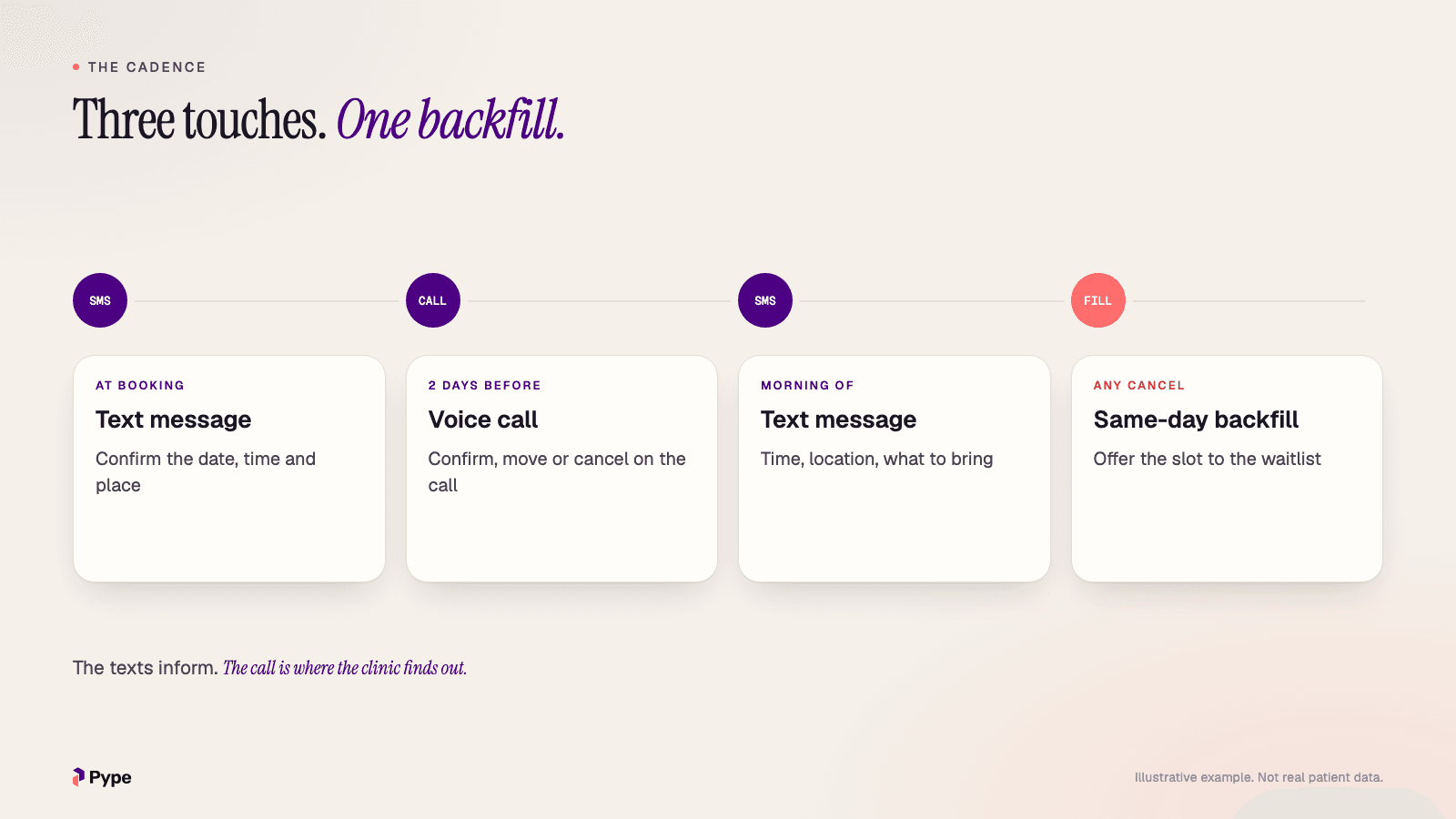
Here's the cadence I'd start with for most hospitals and clinics.
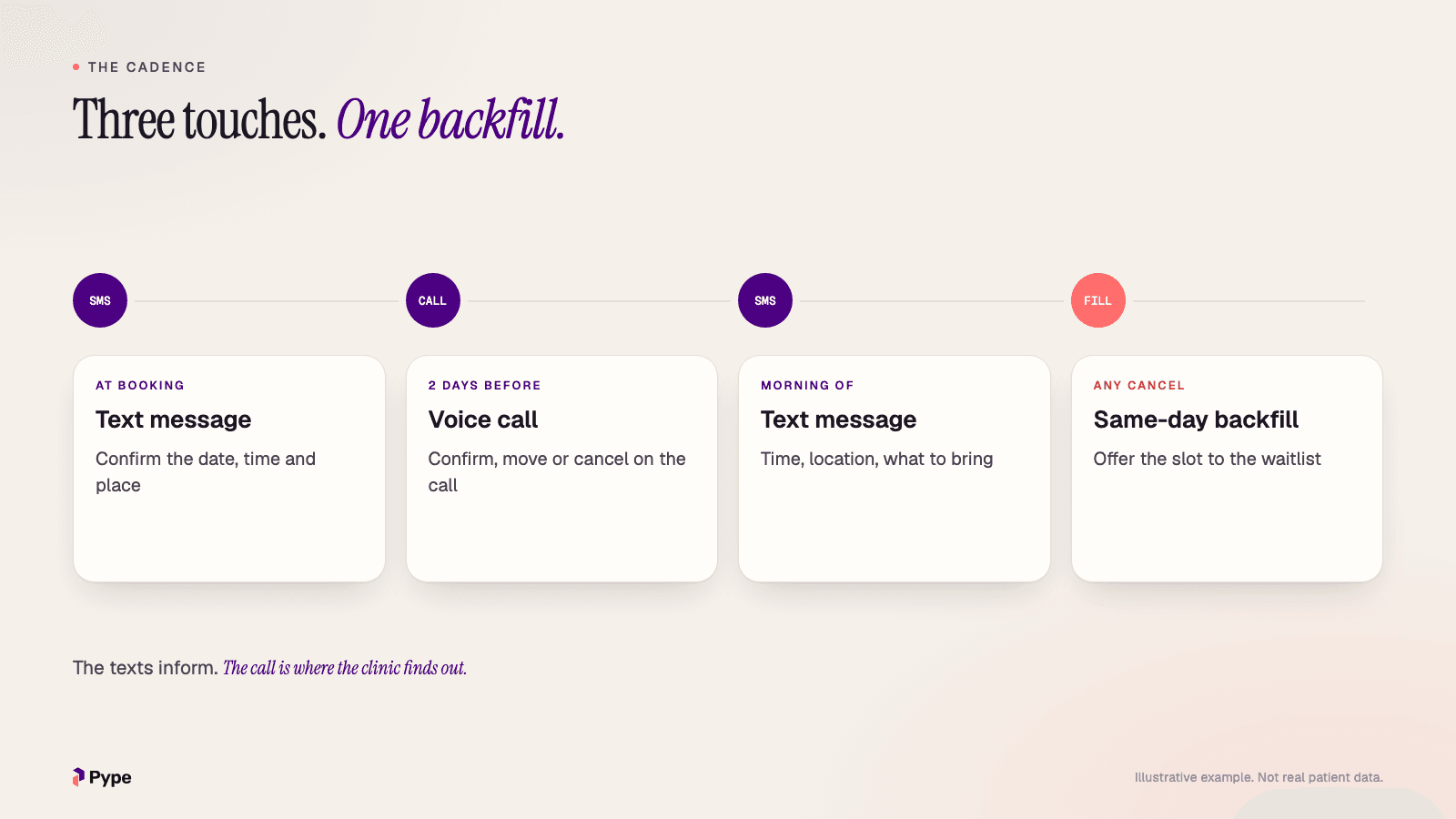 Three touches. One backfill.
| When | Channel | What it says | What it's for |
|---|---|---|---|
| At booking | SMS or WhatsApp | Date, time, doctor, address | A record the patient can find later |
| 2 days before | Two-way voice call | "Still good for Thursday at 11?" | Confirm, move or cancel while the slot is still usable |
| No answer | Retry, then SMS | Two more tries, spaced out | Most missed calls are just bad timing |
| Morning of | SMS | Time, location, what to bring | A last nudge, plus fasting or paperwork notes |
| Any cancellation | Waitlist calls | "A slot opened today at 11. Want it?" | Turn a lost slot into a seen patient |
Three details make this work.
The call is two-way. A reminder that can't take an answer only informs the patient. A call that can take an answer informs the clinic. That's the half that moves the number.
The reschedule happens on the same call. "Call us back to rebook" loses half the people who say it. Offer two real slots, book one, done.
The morning text is short. Time, place, one practical detail. No links to read, no forms to fill.
What happens on the two-day call
Let's take one call. It's Tuesday evening, and Daniel has a dermatology visit on Thursday at 11.
"Ah, I can't make Thursday, I have a work trip."
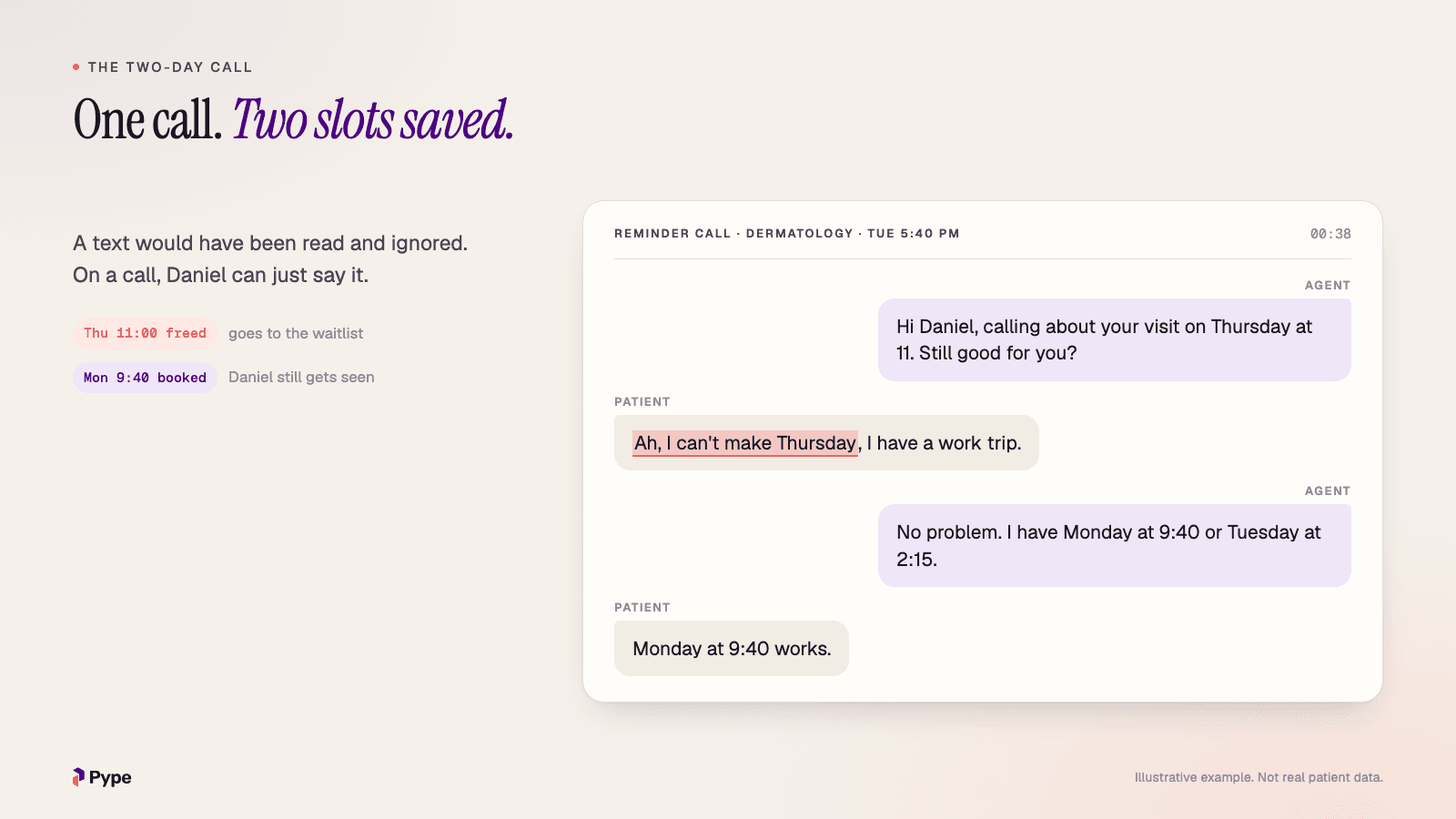 One call. Two slots saved.
Here's what happens in the next 30 seconds:
| Step | What happens | Result |
|---|---|---|
| 1. Asked | "Still good for Thursday at 11?" | Daniel says he can't make it |
| 2. Offered | Two real slots from the schedule | Monday 9:40 or Tuesday 2:15 |
| 3. Booked | Daniel picks Monday | New slot written to the schedule |
| 4. Freed | Thursday 11:00 released | Goes straight to the waitlist |
| 5. Confirmed | SMS with the new time | Daniel has it in writing |
An illustrative example, not real patient data.
Without the call, Daniel probably just doesn't turn up. The clinic finds out on Thursday at 11:10, and the slot is gone. With the call, Daniel still gets seen, and someone else gets his Thursday slot.
Same-day backfill: what to do with a cancelled slot
A cancelled slot isn't a loss yet. It only becomes one if nobody fills it.
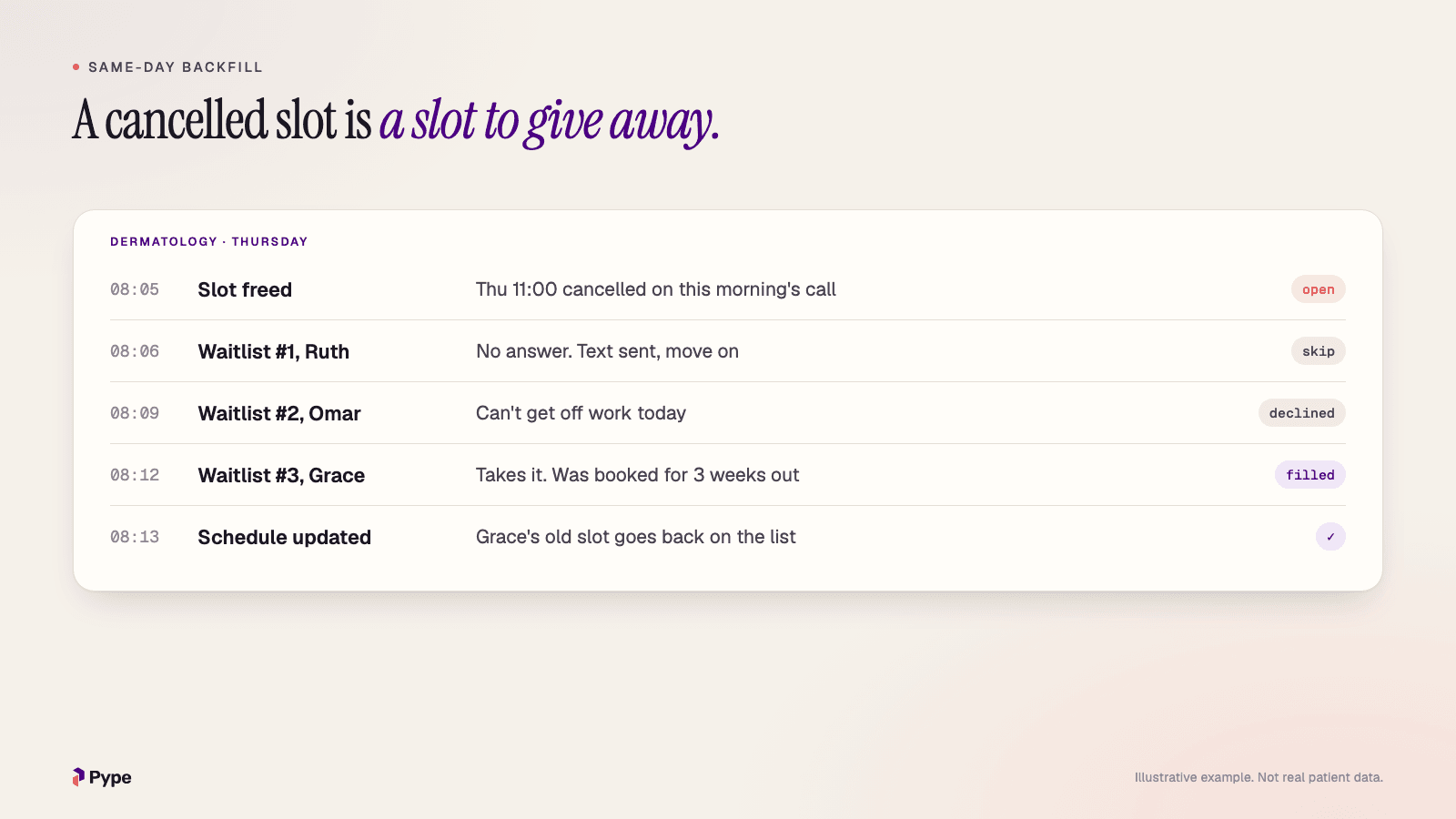 A cancelled slot is a slot to give away.
The simplest backfill works like this:
- Keep a real waitlist. Patients booked weeks out who said they'd take something sooner.
- Offer the slot in order, by call or text, the moment it frees up.
- Move on fast. No answer in a few minutes, try the next person.
- Release the old slot of whoever takes it, so it can be offered too.
There's good evidence patients want this. At UCSF Health, an automated tool that offered earlier slots to patients saw 30.5% of offers accepted, and patients who accepted were seen a median of 14 days sooner. That study used text and portal offers. A short call often works even better for same-day slots, because "today at 11" needs an answer now.
Patient no-show reduction strategies: match the cadence to the risk
Not every patient needs the same number of touches. Spending more effort where the risk is gets you more for the same calls.
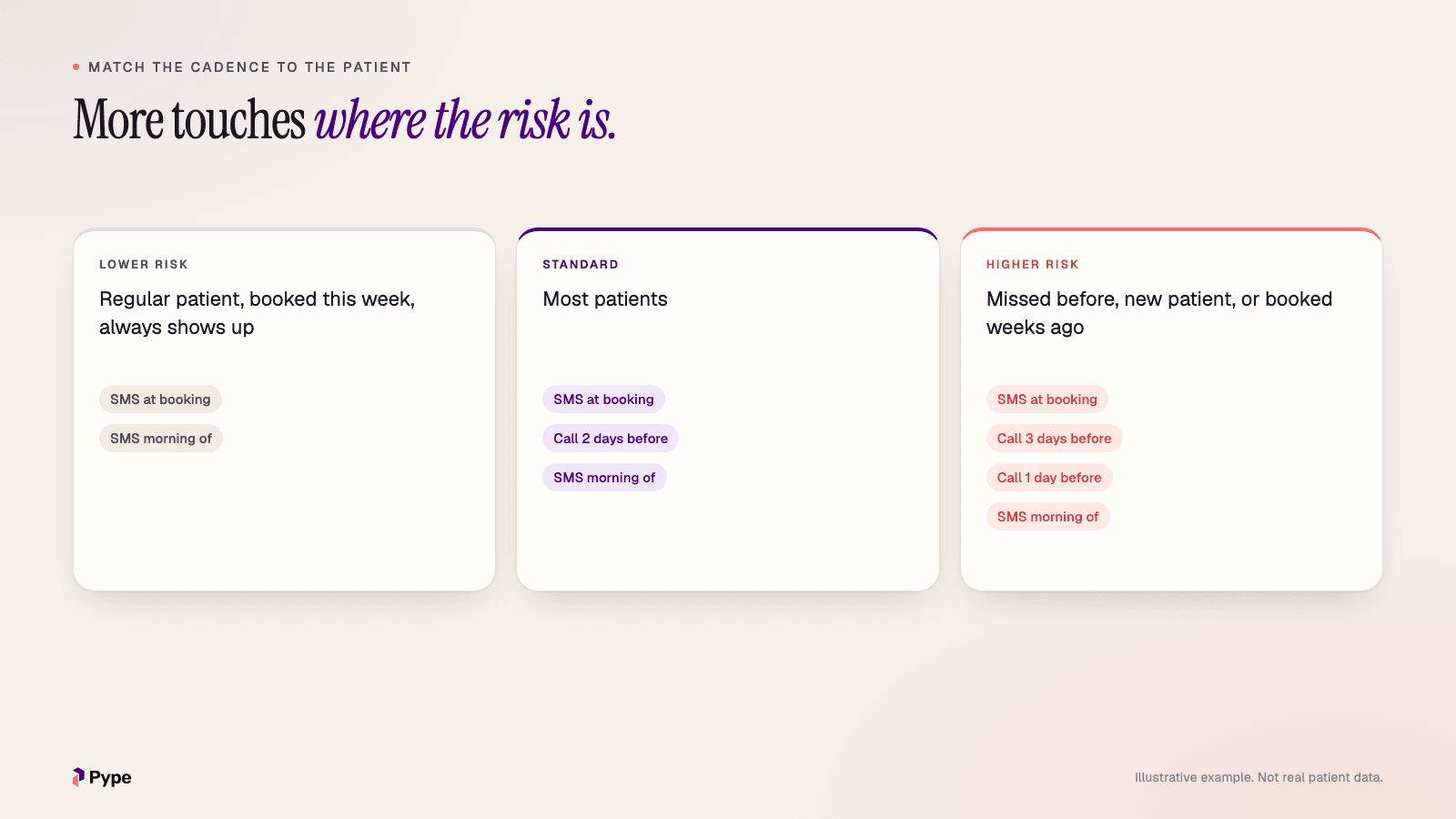 More touches where the risk is.
Simple signals that a patient is more likely to miss:
- They've missed before. The single most useful signal most clinics already have.
- It's their first visit. New patients haven't built the habit yet.
- It was booked a long time ago. Plans change over three or four weeks.
- It needs preparation. Fasting, a referral letter, a companion. More things to go wrong.
The Kaiser trial above found the second reminder helped most in exactly this high-risk group. You don't need a fancy model to start. A rule like "missed before, or new, or booked more than 3 weeks ago" gets you most of the way.
How we approach this at Pype
A short note, since people ask. Our reminder agents call patients in their own language, let them confirm, move or cancel on the call, and update the schedule so freed slots can be offered again. Some teams pair the call with a short video before the appointment. Every agent is tested before go-live, and every change ships as a new version.
Key takeaways
- To reduce patient no-shows, use a cadence, not a single reminder. Two reminders beat one in trials, especially for high-risk patients.
- Make the call two-way. The clinic finding out early is what saves the slot.
- Reschedule on the same call. Don't ask patients to call back.
- Backfill every freed slot the same day, from a real waitlist.
- Give higher-risk patients an extra touch: past no-shows, new patients, long lead times.
None of this is new. It's what a great receptionist would do if they had time to call everyone. The cadence just makes sure somebody does :)
Frequently asked questions
How do you reduce patient no-shows?
Use a reminder cadence: a text at booking, a two-way call about two days before, and a text on the morning of the visit. Let patients reschedule or cancel on the call, and offer any freed slot to the waitlist the same day.
How do you reduce patient no-shows with AI voice calls?
An AI voice agent calls every patient before their visit, lets them confirm, move or cancel on the call, and updates the schedule straight away. That makes two-way reminder calls possible for every appointment, not just the few staff have time for.
When should you send appointment reminders?
A common cadence is a text at booking, a call two to three days before, and a short text on the morning of the visit. A large trial found two reminders (3 days and 1 day before) beat either one alone.
Are reminder calls better than text reminders?
They do different jobs. Texts are good for details the patient can look up later. Calls let the patient answer, so the clinic learns who isn't coming in time to fill the slot. Research in outpatient clinics found phone reminders had a clearer effect on attendance.
What is same-day backfill for appointments?
Offering a slot that was just cancelled to patients on a waitlist, in order, until someone takes it. Done quickly, it turns a cancellation into a seen patient instead of an empty chair.
About the author
Ashish Tripathy is the founder of Pype AI, which builds voice AI agents for hospitals and healthcare providers. Pype also maintains Whispey, an open-source, OpenTelemetry-based observability tool for voice AI agents.