
How to Reduce Patient No-Shows with AI Voice Reminder Calls (and How One Provider Cut Them by 60%)
How to Reduce Patient No-Shows with AI Voice Reminder Calls (and How One Provider Cut Them by 60%)
title: "How to Reduce Patient No-Shows with AI Voice Reminder Calls (and How One Provider Cut Them by 60%)" description: "To reduce patient no-shows, call patients before the visit and let them confirm, reschedule or cancel on the spot. One provider went from 35% to 13.5% in 30 days." slug: reduce-patient-no-shows-ai-voice-reminder-calls date: 2026-10-15 author: Ashish Tripathy, Founder, Pype AI keywords:
- reduce patient no-shows
- AI voice agent for patient appointment reminders
- appointment reminder calls
- patient no-show reduction strategies
- how to reduce patient no-shows with AI voice calls
- no-show rate
- AI call center for healthcare
- ai voice agents for healthcare
How to reduce patient no-shows with AI voice reminder calls (and how one provider cut them by 60%)
The fastest way to reduce patient no-shows is a short two-way call before every visit, so patients can confirm, move or cancel while the slot can still be used. Here's how that works, and what happened when one provider tried it.
Ashish Tripathy, Founder, Pype AI | 15 October 2026 | 8 minute read
The most reliable way to reduce patient no-shows is to call every patient a day or two before their appointment and let them confirm, reschedule or cancel on that same call. A one-way reminder tells the patient. A two-way call tells the clinic, which is the part that actually frees up the slot.
AI voice reminder calls make that possible for every appointment, every day, without adding staff. In one deployment, a multi-site healthcare provider went from a 35% no-show rate to 13.5% in the first 30 days.
Quick context. At Pype AI we build voice agents that talk to patients for hospitals and clinics. Reminders are one of the first things most teams ask us for, and after millions of minutes of patient calls, this is the use case where I've seen the clearest before and after.
Why patients miss appointments
Most no-shows aren't patients who don't care. They're patients who forgot, or who knew they couldn't come and never got round to telling anyone.
The numbers are bigger than most people expect. In England, patients missed 16 million GP appointments in 2025, about 1 in 23. In NHS England's survey for the same campaign, 12% of people said they had simply forgotten an appointment at some point. Specialty clinics often see much higher rates than that.
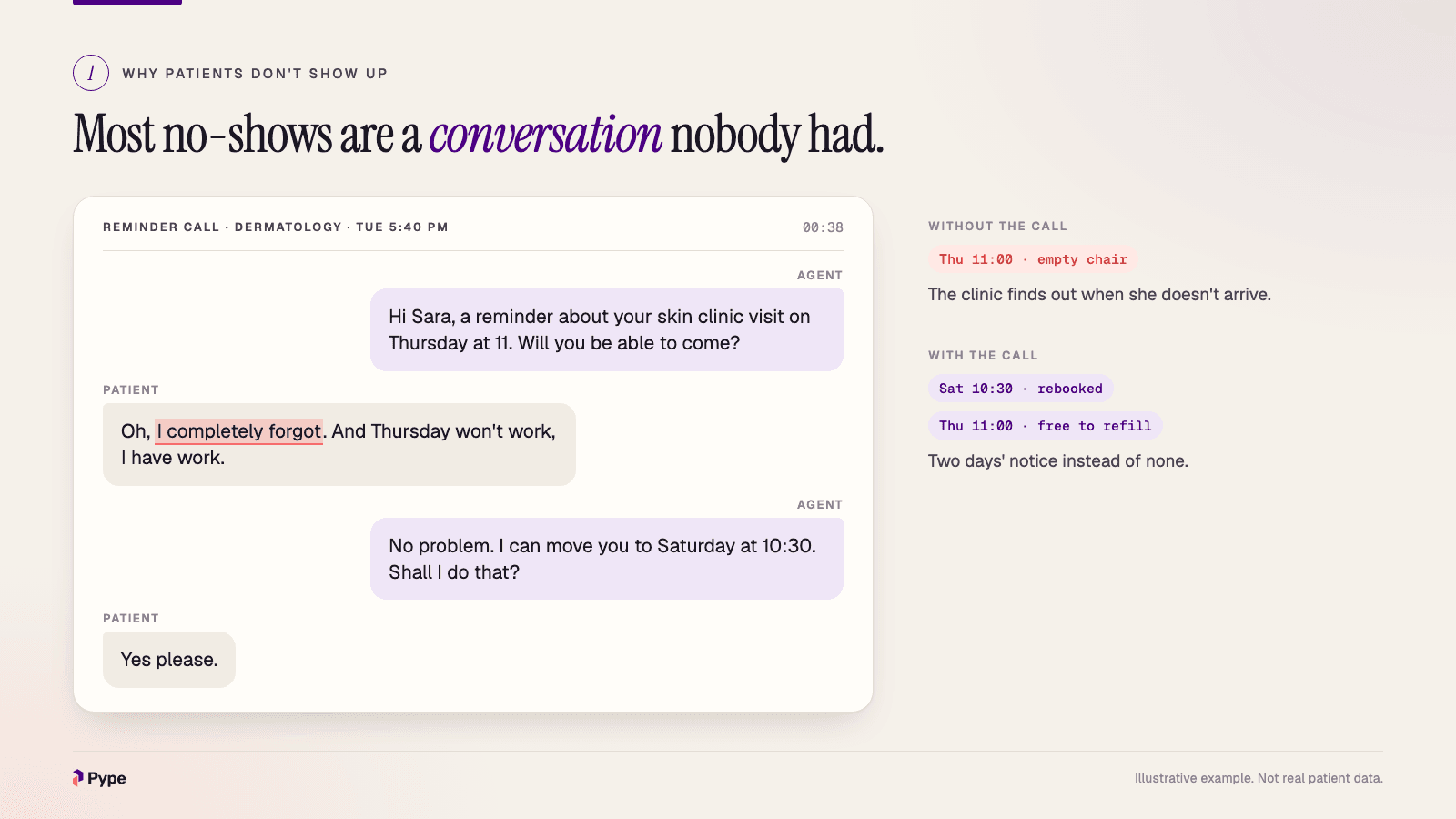
Here's what a lot of those no-shows look like up close:
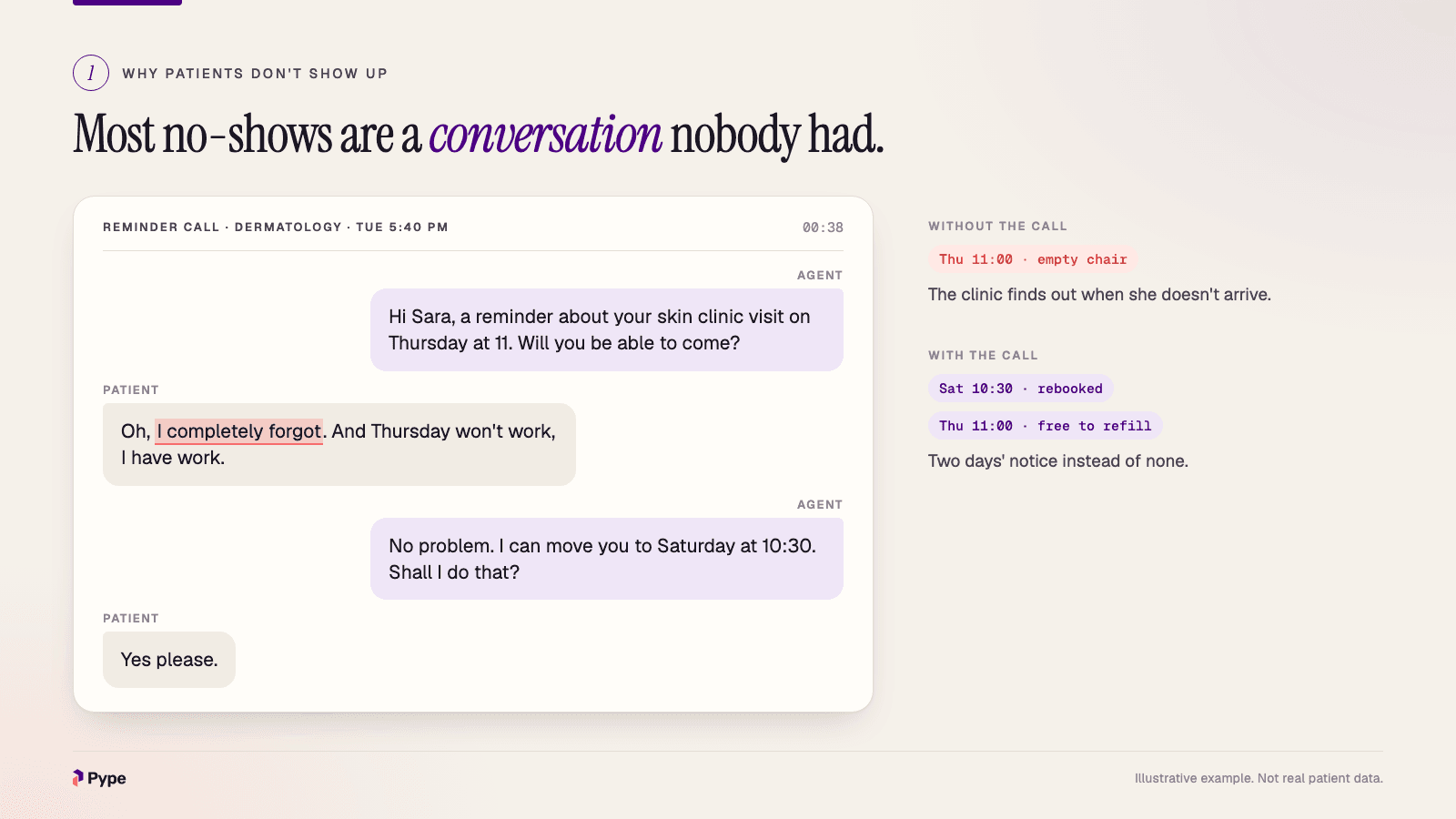
Without the call, the clinic finds out on Thursday at 11. With it, they find out on Tuesday.
A no-show is usually a conversation that never happened. The patient had a reason. Nobody asked.
Do appointment reminder calls actually reduce no-shows?
Yes. This is one of the better studied ideas in healthcare operations.
A 2025 meta-analysis of randomised trials in hospital outpatient clinics found that telephone reminders significantly improved attendance, while SMS reminders showed a smaller effect that wasn't statistically significant. A 2023 review in BMC Health Services Research rated phone call reminders as probably effective at reducing no-shows.
So the question was never whether to call. It was who's going to make 400 calls a day.
That's where most clinics get stuck. Reception teams are already answering the inbound phone line. Calls go out during working hours, when patients are at work themselves. So the calls get made for some appointments, some days, and the rest get a text.
How AI voice calls reduce patient no-shows (and why a text isn't enough)
An AI voice agent for patient appointment reminders does the same thing a good receptionist would do on a reminder call. It just does it for every patient. (If you're new to the idea, here's a plain guide to AI voice agents for healthcare.)
The real difference from a text message isn't the voice. It's that the patient can answer.
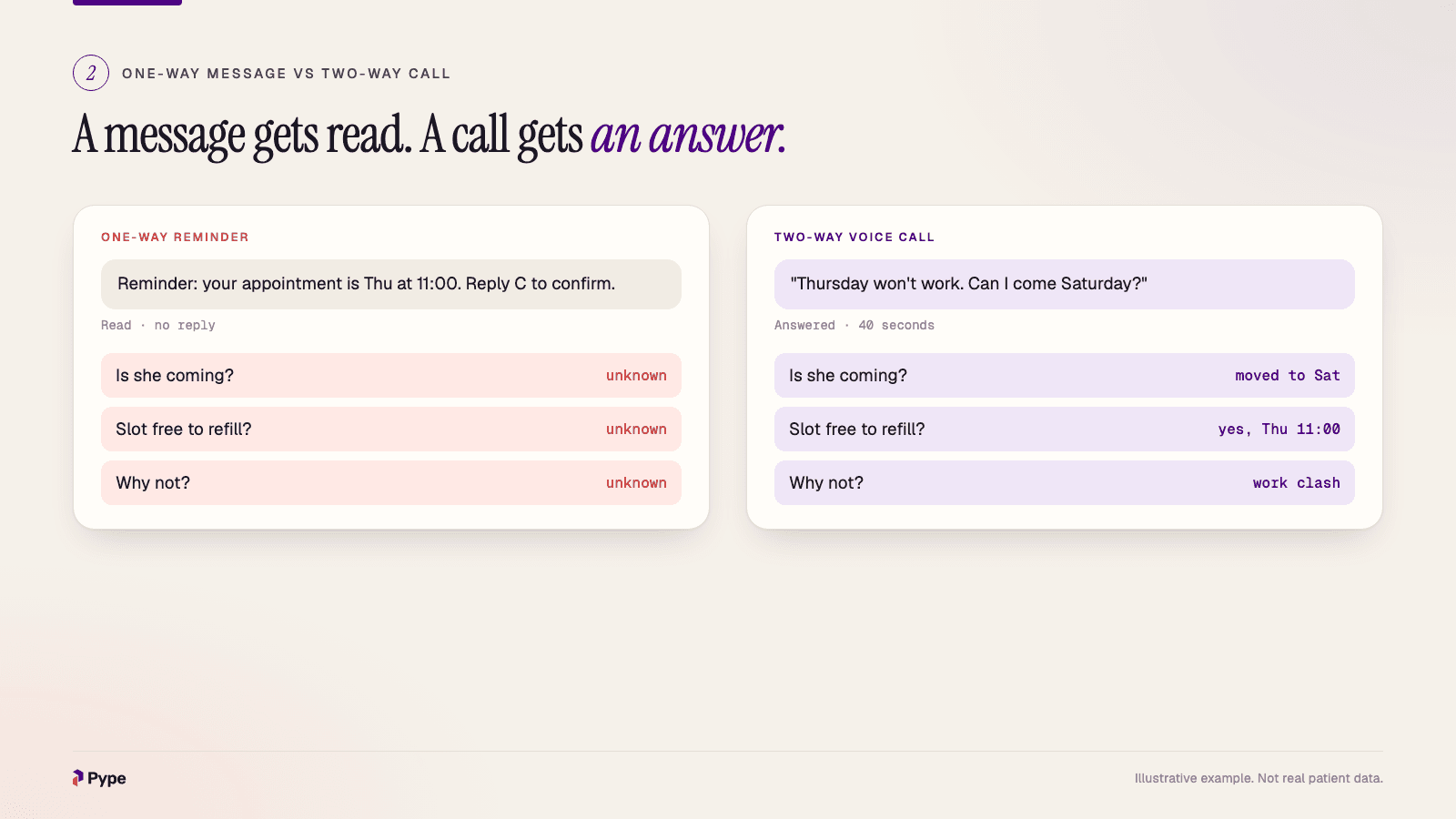
A read receipt tells you nothing about Thursday at 11.
On a two-way call, three useful things happen:
- The patient confirms. Saying "yes, I'll be there" out loud is a small commitment, and the clinic now knows for sure.
- The patient reschedules on the spot. No hold music, no calling back later. The new slot is booked before the call ends.
- The patient cancels early. This one gets underrated. An early cancellation isn't a failure, it's a slot you can give to someone on the waitlist.
You can't refill a slot you don't know is empty. That's the whole game.
Worked example: from 35% to 13.5% in 30 days
Let's take one real deployment. A multi-site healthcare provider had a no-show rate of about 35%. Their operations team simply didn't have the capacity to call patients before appointments. They'd tried WhatsApp reminders before, and it hadn't made a noticeable dent.
They started with AI reminder calls at one site and expanded to more sites within a month. The agent called patients ahead of their appointments, let them confirm, reschedule or cancel, answered quick questions (location, timings, consultation fees), and handed anything else to a human.
Here's what happened in the first 30 days:
| What we measured | Result |
|---|---|
| Reminder calls per day | About 400, fully automated |
| Pickup rate | 82%, with retries for missed calls |
| Average call length | About 40 seconds |
| Confirmed | 60% of patients reached |
| Rescheduled | 17% of patients reached |
| Cancelled early | 15% of patients reached |
| Callback or other question, handed to staff | The rest, about 8% |
| No-show rate | 35% down to 13.5%, roughly a 60% reduction |
| Slots recovered | 80+ a day |
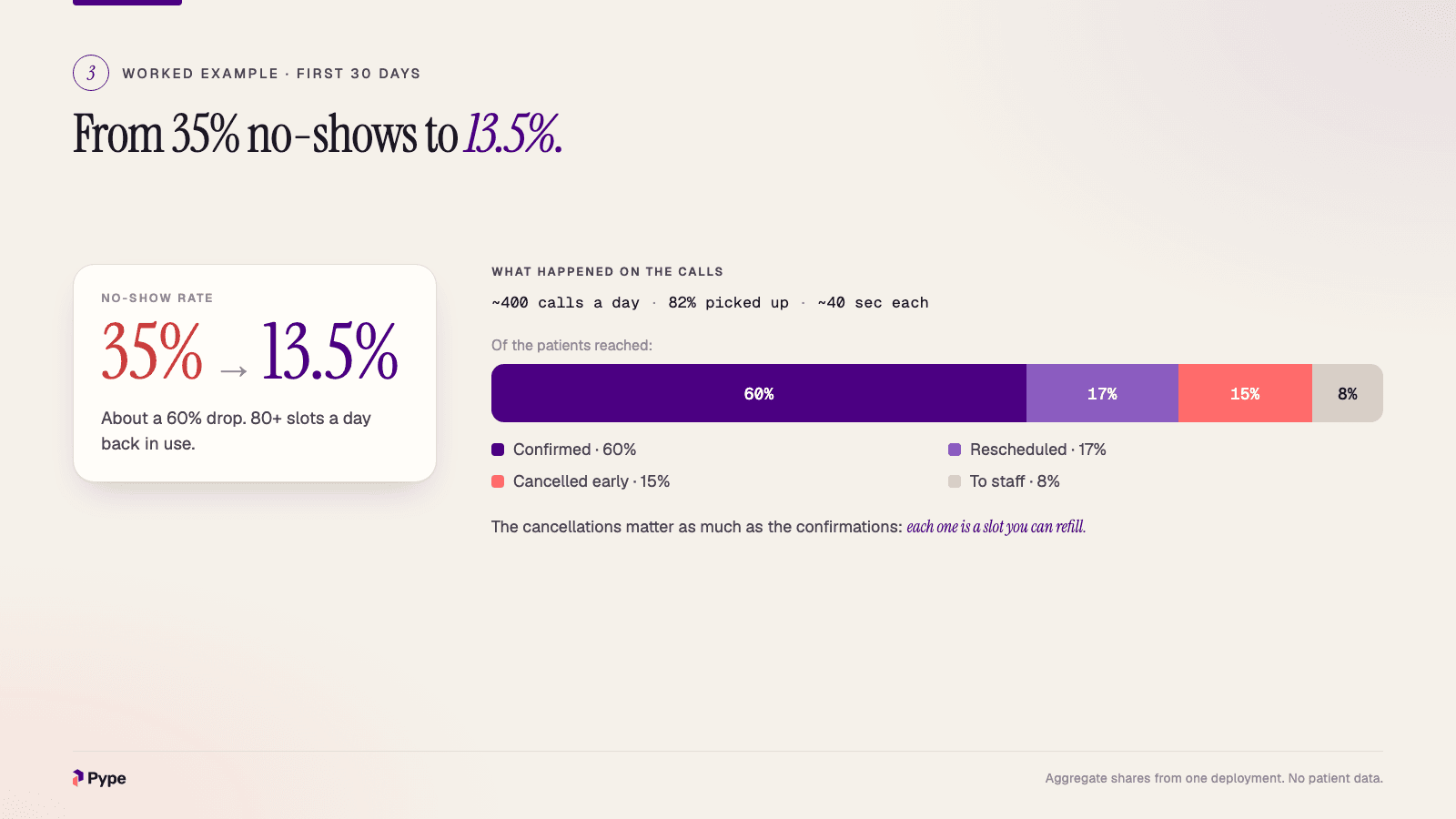
Every reschedule and early cancellation is a slot that would otherwise have sat empty.
A few things I'd point out.
The cancellations did as much work as the confirmations. 15% of patients reached said they weren't coming. Before, every one of those would have been a surprise empty chair.
The calls were short. Forty seconds on average. Patients don't want a long chat about their appointment, and a reminder call shouldn't try to have one.
It replaced work nobody had time for. Covering 400 calls a day by hand would have needed around four full-time people.
To be fair about it: this is one deployment over 30 days, compared against the provider's own earlier rate, not a controlled trial. But it lines up with what the research says, and the size of the drop is hard to ignore.
How to set up AI reminder calls that actually cut no-shows
If you're putting this in place, here's the flow I'd start with.
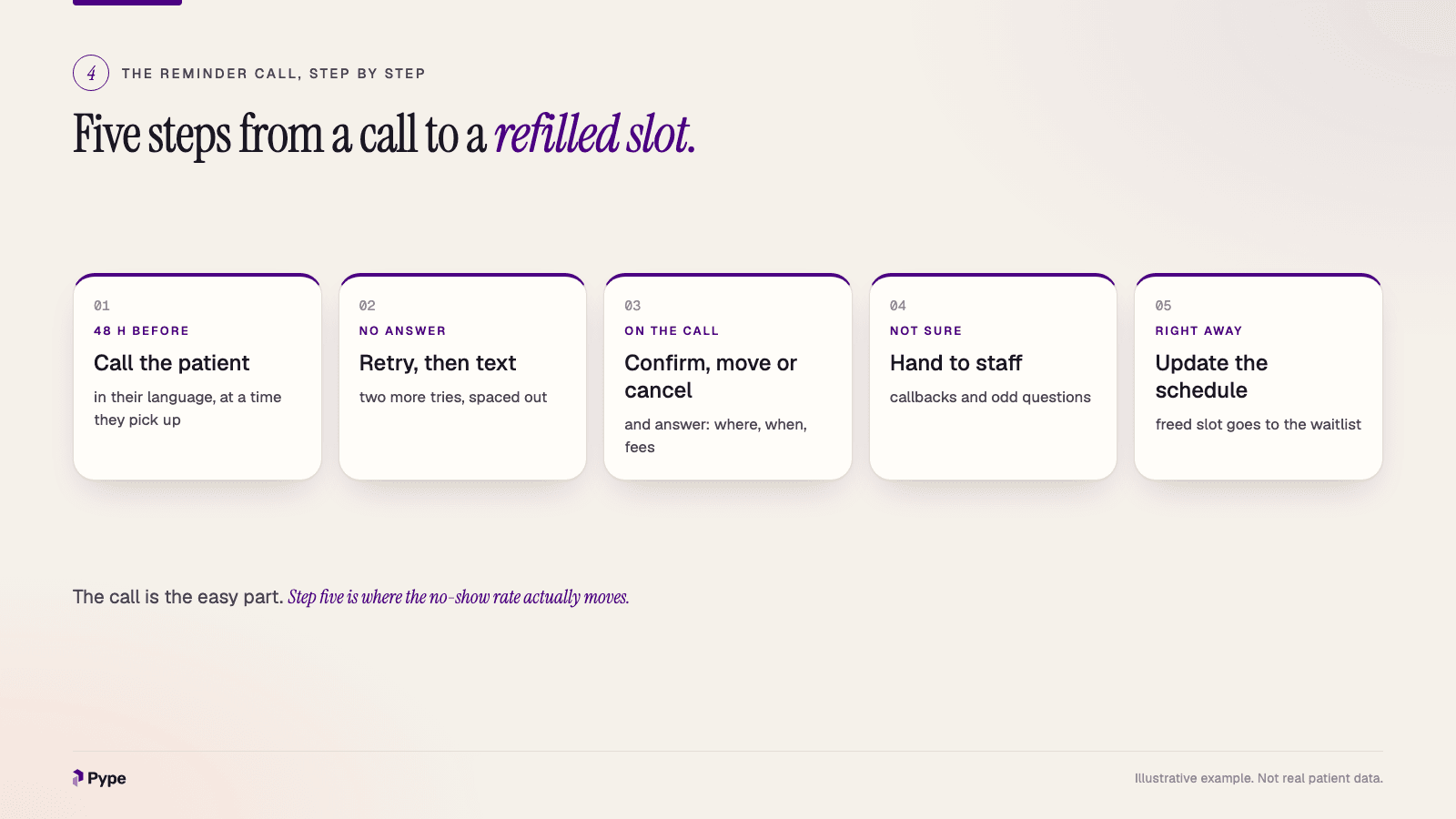
The call is the easy part. The schedule update is what moves the number.
- Call 24 to 48 hours before. Early enough to refill the slot, close enough that the patient knows their plans.
- Retry missed calls, then fall back to a text. One attempt isn't enough. Spread retries across the day, including early evening.
- Let the patient act on the call. Confirm, reschedule or cancel, right there. A reminder that says "call us to reschedule" just moves the problem.
- Hand off cleanly. Callbacks, billing questions, anything clinical: pass them to a person with a short summary.
- Write it back to the schedule straight away. If the cancelled slot only shows up in a report tomorrow, you've lost it. Feed it to your waitlist the same hour.
A couple of other patient no-show reduction strategies are worth stacking on top: focus first on the clinics with the highest no-show rates, and look at the reasons patients give. In the example above, the record of why people cancelled and rescheduled was almost as useful as the drop itself. A work clash and a transport problem need different fixes.
Where Pype fits
We build AI voice agents for healthcare, and reminder calls are one of them. Our approach is the one above: two-way calls, rescheduling on the call, clean handoff to staff, and every outcome written back to the schedule. If you want to see how we think about checking these agents once they're live, I wrote about it in how to build auditable AI agents for healthcare. There's also a broader look at the business case in why voice AI is transforming healthcare communication.
Key takeaways
- The surest way to reduce patient no-shows is a two-way call before every appointment.
- Research supports telephone reminders more strongly than text reminders.
- Early cancellations are a win, not a failure: they're slots you can refill.
- In one deployment, AI reminder calls took a provider from 35% to 13.5% no-shows in 30 days.
- The schedule update after the call matters as much as the call itself.
Nobody gets excited about reminder calls. But watching a clinic get 80 slots a day back feels pretty good :)
Frequently asked questions
How do you reduce patient no-shows?
Call patients 24 to 48 hours before the appointment and let them confirm, reschedule or cancel on the same call. Then update the schedule straight away so freed slots go to the waitlist.
How do you reduce patient no-shows with AI voice calls?
An AI voice agent calls every patient before their visit, retries missed calls, and handles confirmations, reschedules and cancellations on the call. Anything it can't handle goes to a staff member with a summary.
Are phone reminders better than text reminders?
The research leans that way. A 2025 meta-analysis of hospital outpatient trials found telephone reminders significantly improved attendance, while the effect of SMS reminders wasn't statistically significant. A call also lets the patient reschedule right away.
What is a good no-show rate for a clinic?
It depends heavily on the specialty and the patient population. The more useful target is your own baseline: measure it for a month before you change anything, then compare.
Will patients mind talking to an AI voice agent for appointment reminders?
In our experience, most patients just want the call to be short and useful. In the worked example above, calls averaged about 40 seconds and 82% of patients picked up. Anyone who wants a person can be handed to one.
What should an AI reminder call include?
The patient's name, appointment day and time, location, and a clear question: can you make it? Then options to confirm, reschedule or cancel, and answers to quick questions like directions or fees.
About the author
Ashish Tripathy is the founder of Pype AI, which builds voice AI agents for hospitals and healthcare providers. Pype also maintains Whispey, an open-source, OpenTelemetry-based observability tool for voice AI agents.