
After hours answering service for medical offices: covering nights and weekends without a bigger call center
After hours answering service for medical offices: covering nights and weekends without a bigger call center
How to choose and set up an after hours answering service for medical offices: what calls come in at night, which ones need a person right away, and where AI fits.
Ashish Tripathy, Founder, Pype AI | 19 October 2026 | 8 minute read
An after hours answering service for medical offices answers patient calls when the clinic is closed, sorts each call by how urgent it is, and makes sure the right thing happens next: a nurse or doctor now, a booking tonight, or a task for the morning team.
The answering part is easy. The sorting is what separates a good service from a message pad. A good one never asks the patient to decide whether their own symptom is an emergency.
Quick context. At Pype AI we build voice agents that talk to patients for hospitals: booking, reminders, follow-ups. After millions of minutes of these calls, nights and weekends are where I see clinics stretched the thinnest. So here's how I'd think about covering them, whichever option you pick.
What actually rings after hours
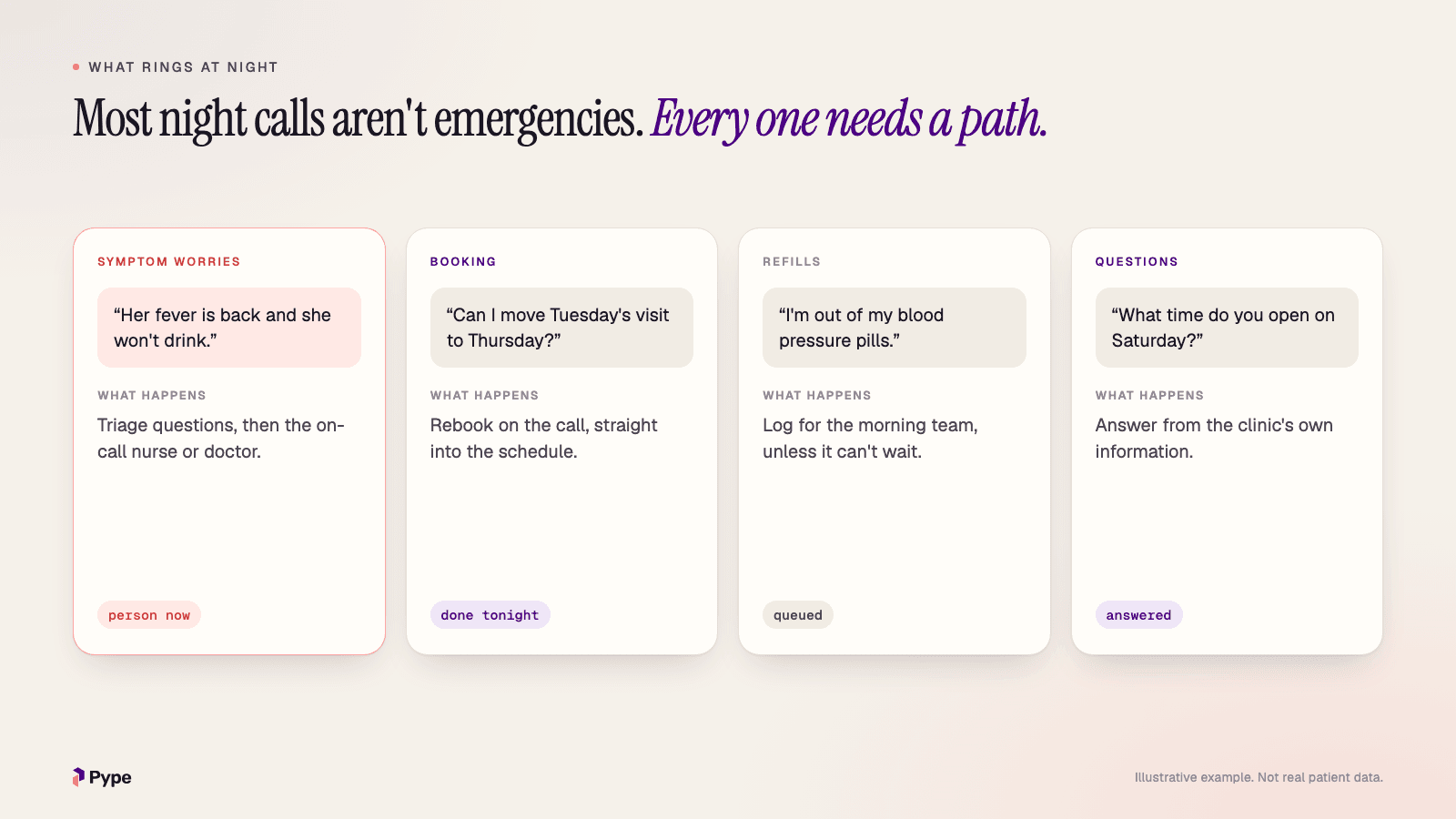
Most after-hours calls are not emergencies. But almost every one needs a clear path, and a few need a person within minutes.
Here's the rough mix most clinics see at night:
- Symptom worries. A fever that came back, a wound that looks wrong, a child who won't drink.
- Booking and rescheduling. "Can I move Tuesday to Thursday?" People call when they finally have a free minute, which is often after dinner.
- Refills. Usually fine for the morning, sometimes not.
- Simple questions. Opening hours, directions, which documents to bring.
 Most night calls aren't emergencies. Every one needs a path.
Your own mix will be different. Pull 30 nights of call logs before you choose anything. It's the cheapest research you'll ever do.
Plan for the whole mix, but design for the one call that can't wait.
The mistake most after-hours setups make
The most common failure is simple: the service asks the caller whether it's an emergency, and believes the answer.
This isn't a new finding. A study in the Journal of Family Practice (2003) looked at how 91 primary care practices in the Denver area handled after-hours calls. Most used answering services, and 93% of those required patients to decide whether their problem was serious enough to reach the on-call physician. When physicians reviewed calls that hadn't been forwarded, they said they would have wanted to speak to the patient in about half of them.
Let's take one call (an illustrative example, not a real one).
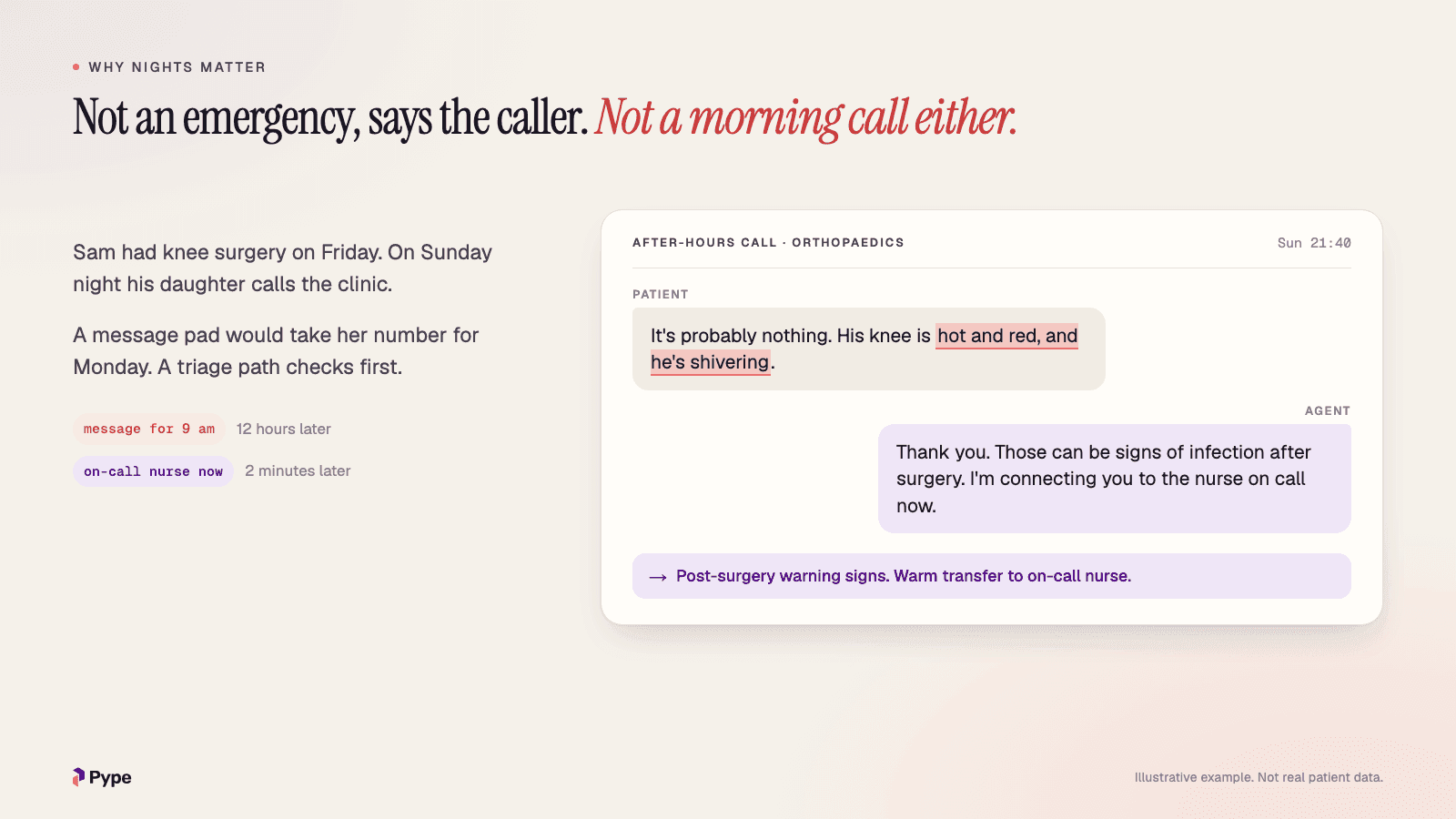
Sam had knee surgery on Friday. On Sunday at 9:40 pm his daughter calls the clinic. "It's probably nothing," she says. "His knee is hot and red, and he's shivering."
"It's probably nothing" is the caller's guess. Hot, red and shivering two days after surgery are possible signs of infection. A message-taking service writes down her number for the morning. A triage path hears the warning signs and connects her to the nurse on call.
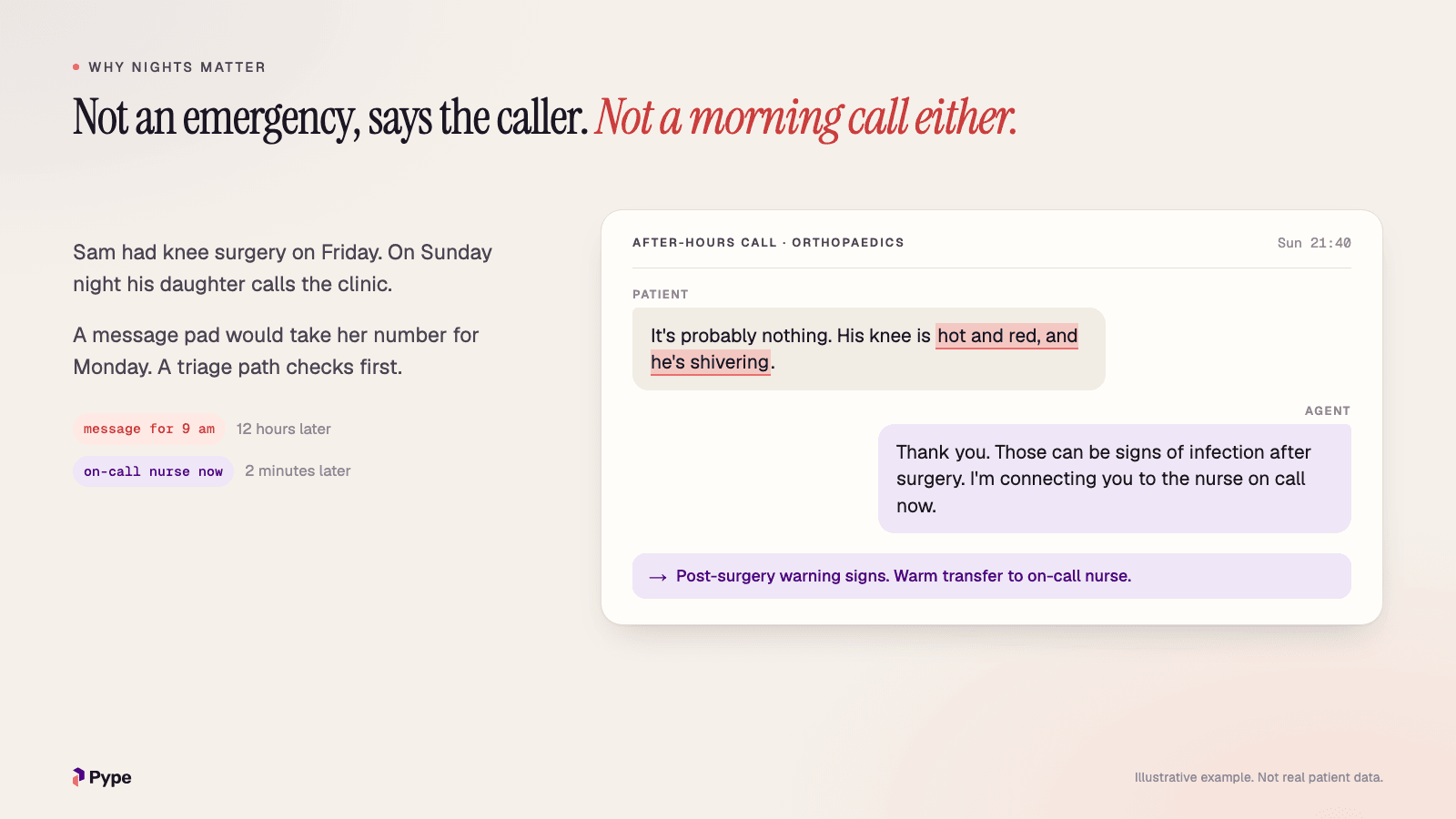 "Probably nothing" is a guess. Hot, red and shivering is a warning sign.
Never let the caller do the triage. Let written, signed rules do it.
Three ways to cover nights and weekends
There are three common models. None is perfect, and you can mix them.
| Model | What it does well | Where it falls short |
|---|---|---|
| Message-taking answering service | Answers every call, cheap, simple | Usually can't book, can't triage, and morning staff inherit a pile of messages |
| Nurse triage line | Real clinical triage, often using standard protocols such as the widely used Schmitt-Thompson protocols | Costs more per call, and nurses spend time on bookings and directions |
| AI voice agent plus an on-call nurse | Answers every call at once, books and reschedules, answers questions, hands symptom calls to a nurse with a summary | Needs clinician-signed escalation rules, testing, and someone reading the handoffs |
The third model is what most people mean by an AI medical phone answering service. It's not a replacement for clinical judgement. It's a way to stop nurses spending their nights on "what time do you open?"
Nurse lines do real work. An academic neurosurgery service that ran a nurse-led after-hours triage line handled 1,021 calls in a year. More than 71% were clinical, and nurses sent about 37% of those clinical calls on to the on-call physician. That's the kind of filtering you want, done by the right person.
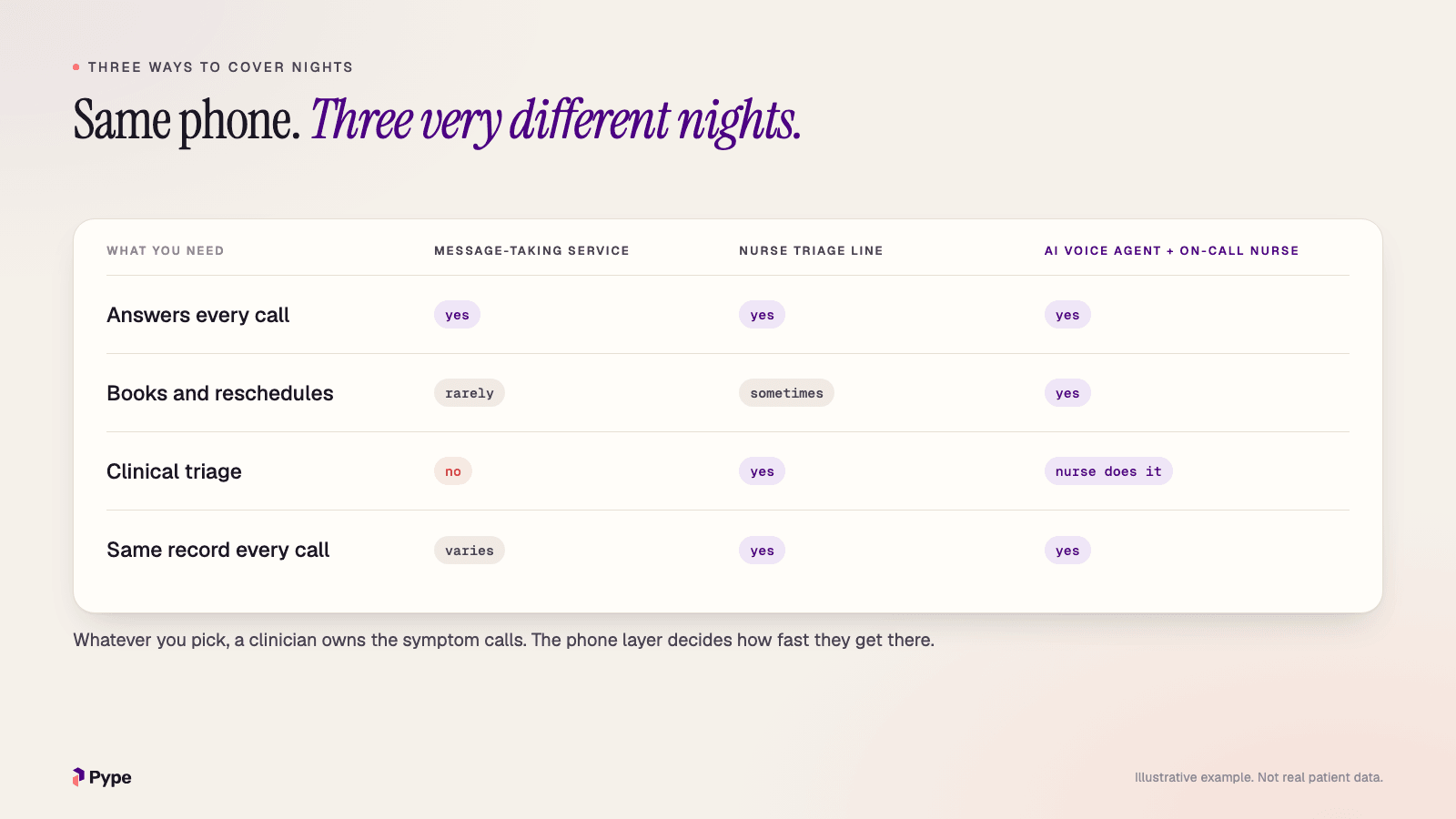 Whatever you pick, a clinician owns the symptom calls.
The phone layer decides how fast a call reaches the right person. It shouldn't decide the medicine.
How a medical office AI answering service handles a night call
If you're looking at a medical answering service with AI, here's what a good night call should look like, step by step.
| Step | What happens | Who owns the rule |
|---|---|---|
| 1. Answer | Picks up on the first ring, in the caller's language | Clinic |
| 2. Check for warning signs | Listens for the clinic's written warning signs before anything else | Clinician signs the list |
| 3. Route | Emergency: tell them to call 911 and alert on-call. Urgent: warm transfer to the nurse. Routine: handle it now | Clinician signs the routing |
| 4. Do the routine work | Books, reschedules, answers questions from the clinic's own information | Operations |
| 5. Hand off | Morning team gets a clean list: what came in, what was done, what's waiting | Operations |
| 6. Record | Every call keeps a transcript, the decision made and why | Compliance |
Two things matter more than any feature list. First, the warning sign list is written down and signed by a clinician, not left to the model's judgement. Second, every routing decision leaves a trail you can read on Monday. We wrote about that in how to build auditable AI agents for healthcare.
If the service handles patient information, it needs a Business Associate Agreement, and so does every vendor in its chain. Our post on the BAA chain behind a HIPAA-compliant AI voice agent walks through it.
How to set up after-hours coverage in five steps
Here's the plan I'd hand any clinic, whether you're hiring a service, building a nurse line, or trying an AI call center for healthcare.
- Pull 30 nights of calls. Who called, when, and why. Count them by type.
- Write the routing rules. Which calls wake a person, which are handled on the spot, which wait for the morning.
- Set the warning signs per specialty. Post-surgery, paediatrics, cardiology and obstetrics all have different lists. A clinician signs each one.
- Test 25 night calls before go-live. Fevers, refills, wrong numbers, bad lines, a caller who says "it's probably nothing."
- Read Monday's handoffs every week. Every escalation, and a sample of everything else. Fix the rules, then test again.
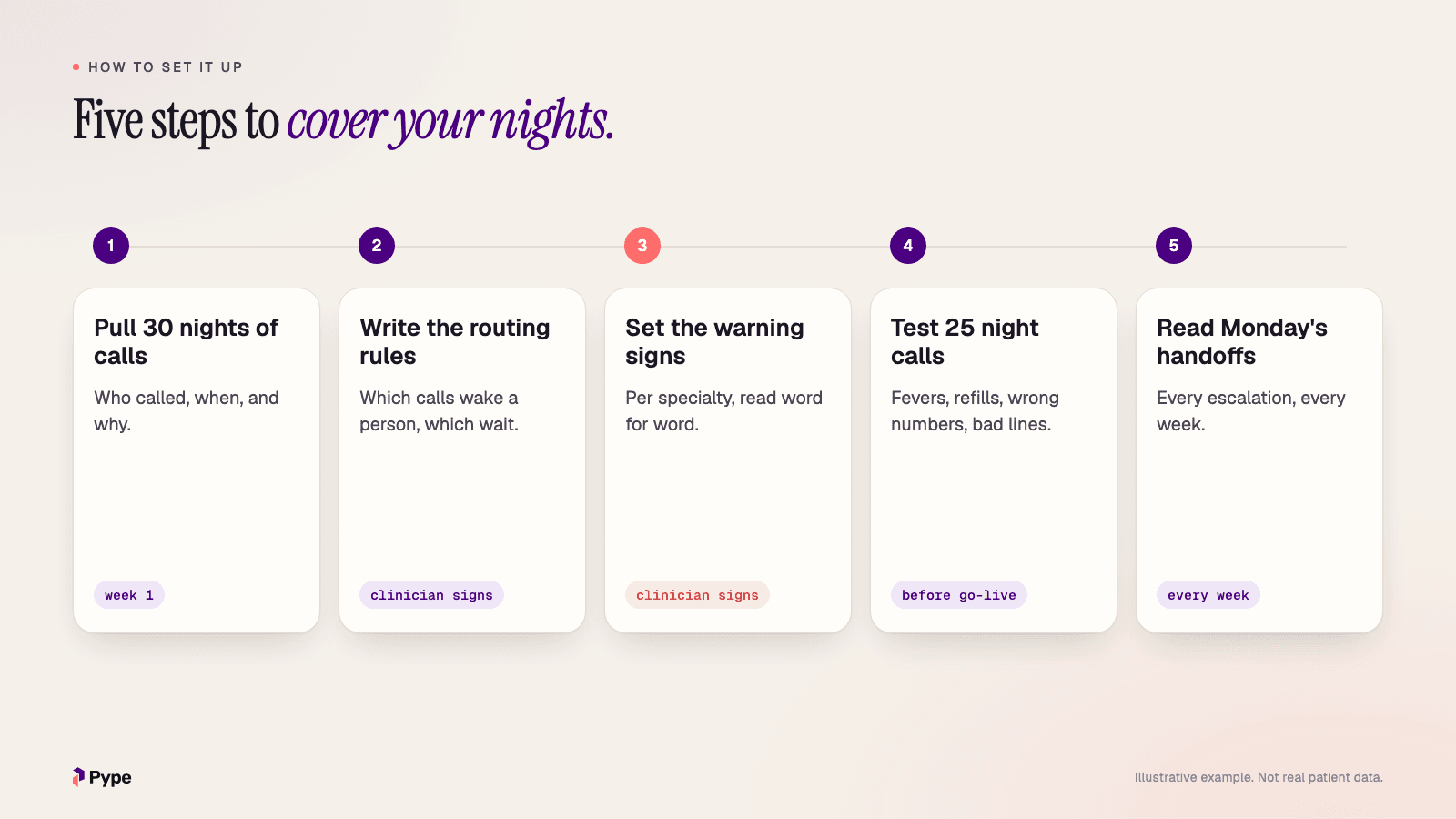 Step three is the one that keeps patients safe. Don't skip the signature.
One more tip. The evening calls are also your best chance to cut no-shows, because that's when people are free to reschedule. If that's a goal, our guide to reducing patient no-shows with AI voice reminder calls pairs well with this one.
How we think about it at Pype
When we set up after-hours coverage for a hospital, the clinicians write and sign the warning signs and routing rules, symptom calls go to a person, and every call leaves a record the team can review the next morning. The agent's job is to make sure nothing waits that shouldn't, and nothing wakes a nurse that doesn't need to.
Key takeaways
- An after hours answering service for medical offices should sort calls, not just take messages.
- Never ask the caller to decide whether it's an emergency. Use written, clinician-signed rules.
- Most night calls are routine. Handle those on the spot so nurses can focus on symptom calls.
- Message services, nurse lines and AI voice agents can be mixed. A clinician always owns triage.
- Test before go-live, and read the handoffs every week after.
Start with 30 nights of call logs and one specialty's warning sign list. It's an afternoon of work, and it'll tell you more than any vendor demo :)
Frequently asked questions
What is an after hours answering service for medical offices?
It's a service that answers patient calls when the clinic is closed, sorts each call by urgency, and makes sure it reaches the right next step: a nurse or doctor now, a booking on the spot, or a task for the morning team.
Can an AI answering service handle medical calls after hours?
Yes, for routine work like booking, rescheduling, refill requests and simple questions. Symptom calls should follow clinician-signed warning signs and be handed to a nurse or on-call doctor, not handled by the AI alone.
How does an after-hours service know which calls are urgent?
The good ones use a written list of warning signs per specialty, signed by a clinician, and check for them before anything else. They never rely on the caller saying whether it's an emergency.
Is a medical answering service with AI HIPAA compliant?
It can be, if the provider signs a Business Associate Agreement and every vendor that touches the call (speech, language model, telephony, storage) is covered too. Ask for the full chain, not just the front vendor.
What should the morning team get from the after-hours service?
A clean list of every call: who called, why, what was done, and what's still waiting. Escalations should include the reason and who they went to, so nothing has to be re-asked.
How much does an after-hours answering service cost?
It depends on the model and call volume. Message services usually charge per call or per minute, nurse lines cost more per call, and AI voice agents usually charge per minute. Compare the total cost of the nights, including morning staff time spent clearing messages.
About the author
Ashish Tripathy is the founder of Pype AI, which builds voice AI agents for hospitals and healthcare providers. Pype also maintains Whispey, an open-source, OpenTelemetry-based observability tool for voice AI agents.