
How AI Actually Calls Functions: The Simple Truth Behind LLM Tool Calling
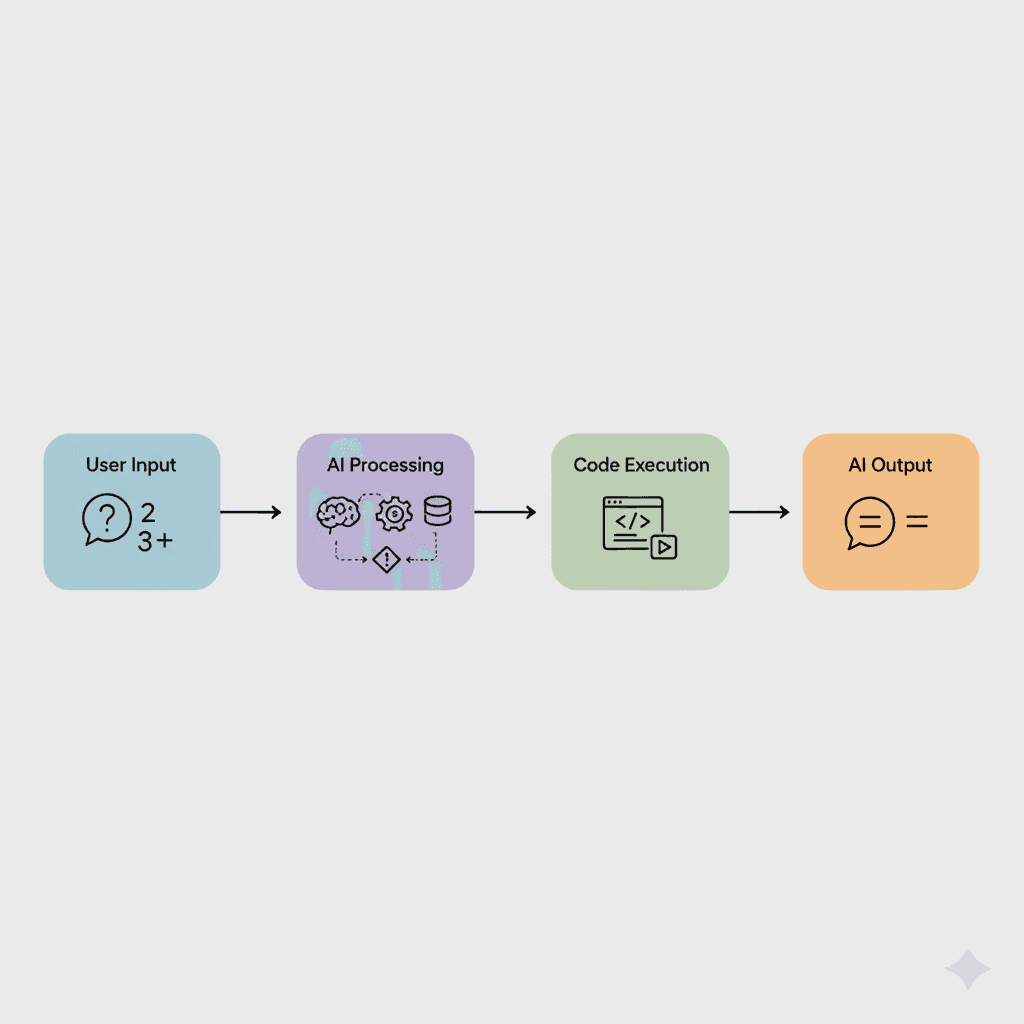
From "What's 15 plus 27?" to actual code execution - explained simply
The Magic You See Every Day
You ask ChatGPT "What's 15 plus 27?" and somehow it doesn't just give you generic math information—it actually runs a calculation and gives you the exact answer: 42. How does text become code execution? Let's break it down step by step.
What is Tool Calling, Really?
Simple explanation: Tool calling is when an AI decides to run actual code functions instead of just generating text.
Think of it like this:
- Without tool calling: AI writes an essay about addition
- With tool calling: AI runs
add_numbers(15, 27)and gives you the real result
Step 1: You Define What the AI Can Do
Let's use a simple calculator example. First, you write the actual function and tell the AI about it:
Write the Tool Function
def add_numbers(a, b):
    """Add two numbers together"""
    return a + b
Tell the AI About Your Function
tools = [
    {
        "name": "add_numbers",
        "description": "Add two numbers together",
        "parameters": {
            "a": {"type": "number", "description": "First number"},
            "b": {"type": "number", "description": "Second number"}
        }
    }
]
What this means: You have a real Python function, and you describe it to the AI so it knows when and how to use it.
Step 2: What Happens Inside the AI's "Brain"
When you ask "What's 15 plus 27?", here's what happens inside the neural network:
Layer 1-6: Basic Understanding
AI thinks: "User mentioned numbers '15' and '27' with 'plus'"
AI recognizes: This is a math addition problem
Layer 7-12: Making Connections
AI thinks: "15 + 27 = need to add numbers"
AI notices: I have an 'add_numbers' tool that can help
AI connects: "15" goes in parameter "a", "27" goes in parameter "b"
Layer 13-18: Decision Making
AI decides: "I should use the add_numbers tool"
AI extracts: a = 15, b = 27
AI plans: "I'll call add_numbers(a=15, b=27)"
Layer 19-24: Code Generation
AI generates:
{
    "tool_calls": [{
        "name": "add_numbers",
        "parameters": {"a": 15, "b": 27}
    }]
}
Key insight: The AI learned these patterns from training data—no one programmed specific rules like "if addition mentioned, call add_numbers function."
Step 3: Your Code Executes the Function
# The AI tells you to call this function:
tool_call = {
    "name": "add_numbers",
    "parameters": {"a": 15, "b": 27}
}

# Your code executes it:
result = add_numbers(15, 27)  # Returns 42

# You send the result back to the AI:
response = f"The result is {result}"
Step 4: AI Gives You the Final Answer
The AI gets the result (42) and responds naturally:
"15 plus 27 equals 42."
The Complete Flow
# Complete example
from openai import OpenAI

client = OpenAI()

def add_numbers(a, b):
    return a + b

tools = [
    {
        "type": "function",
        "function": {
            "name": "add_numbers",
            "description": "Add two numbers together",
            "parameters": {
                "type": "object",
                "properties": {
                    "a": {"type": "number", "description": "First number"},
                    "b": {"type": "number", "description": "Second number"}
                }
            }
        }
    }
]

# User asks: "What's 15 plus 27?"
response = client.chat.completions.create(
    model="gpt-4",
    messages=[{"role": "user", "content": "What's 15 plus 27?"}],
    tools=tools
)

# AI decides to call the tool
tool_call = response.choices[0].message.tool_calls[0]
function_name = tool_call.function.name
args = eval(tool_call.function.arguments)

# Execute your function
result = add_numbers(args['a'], args['b'])

# Send result back to AI
final_response = client.chat.completions.create(
    model="gpt-4",
    messages=[
        {"role": "user", "content": "What's 15 plus 27?"},
        response.choices[0].message,
        {"role": "tool", "content": str(result), "tool_call_id": tool_call.id}
    ]
)

print(final_response.choices[0].message.content)
# Output: "15 plus 27 equals 42."
Why This Is Powerful
Before tool calling: AI could only talk about math With tool calling: AI can actually calculate, call APIs, run code, control systems
The Magic Truth
The AI doesn't have rules like "if addition → call add_numbers". Instead:
- Pattern Recognition: During training, it saw thousands of examples of math questions → function calls
- Neural Learning: The 24+ layers learned to connect human language with structured function calls
- Emergent Behavior: Tool calling "emerges" from the neural network's learning, not explicit programming
Bottom Line
When you ask "What's 15 plus 27?", the AI:
- Processes your words through 24 neural layers
- Decides to call
add_numbers(15, 27) - Your code runs the function
- AI uses the result to give you a natural answer
It's pattern matching and learning—not magic, but still pretty amazing.