
Pype’s Voice Assisted PRO collection for Cancer patients published at ASCO 2026
Pype’s Voice Assisted PRO collection for Cancer patients published at ASCO 2026
An AI voice agent phoned cancer patients at home and asked them how they were doing. The design decision that mattered most was teaching it when to stop. Our study with Dr. Dinesh Pendharkar is published in the proceedings of the 2026 American Society of Clinical Oncology (ASCO) Annual Meeting.
Pype AI | 30 July 2026 | ASCO 2026 abstract e13658
A woman in her sixties is three weeks into a chemotherapy cycle. Her phone rings in the afternoon. It is not the hospital reception, and it is not a recorded message asking her to press one for appointments. It is a voice agent, and it wants to know how she has been feeling since her last visit. Has she had trouble sleeping. Has pain interfered with daily activities. On a scale of one to seven, how would she rate her overall quality of life this past week.
Nine minutes in, her answers get shorter. The pauses get longer. She is tired.
An ordinary automated system would keep going. Ours stops. It tells her they can finish another time, asks when suits her, and hangs up. Four days later it calls back and resumes at the exact question it left, without making her repeat the nine minutes she already gave.
That decision, to stop rather than push, is the most interesting thing we built. This post is about why it matters, what happened when we tested it with 90 cancer patients at a hospital in Faridabad, and what we got wrong.
The abstract is indexed as e13658 in the Care Delivery and Models of Care track, and it appears in the Journal of Clinical Oncology 2026 supplement. The work was led by Dr. Dinesh Pendharkar.
What is a patient-reported outcome?
If you work in oncology you can skip this section. If you are here because you build voice AI, this is the part worth reading slowly.
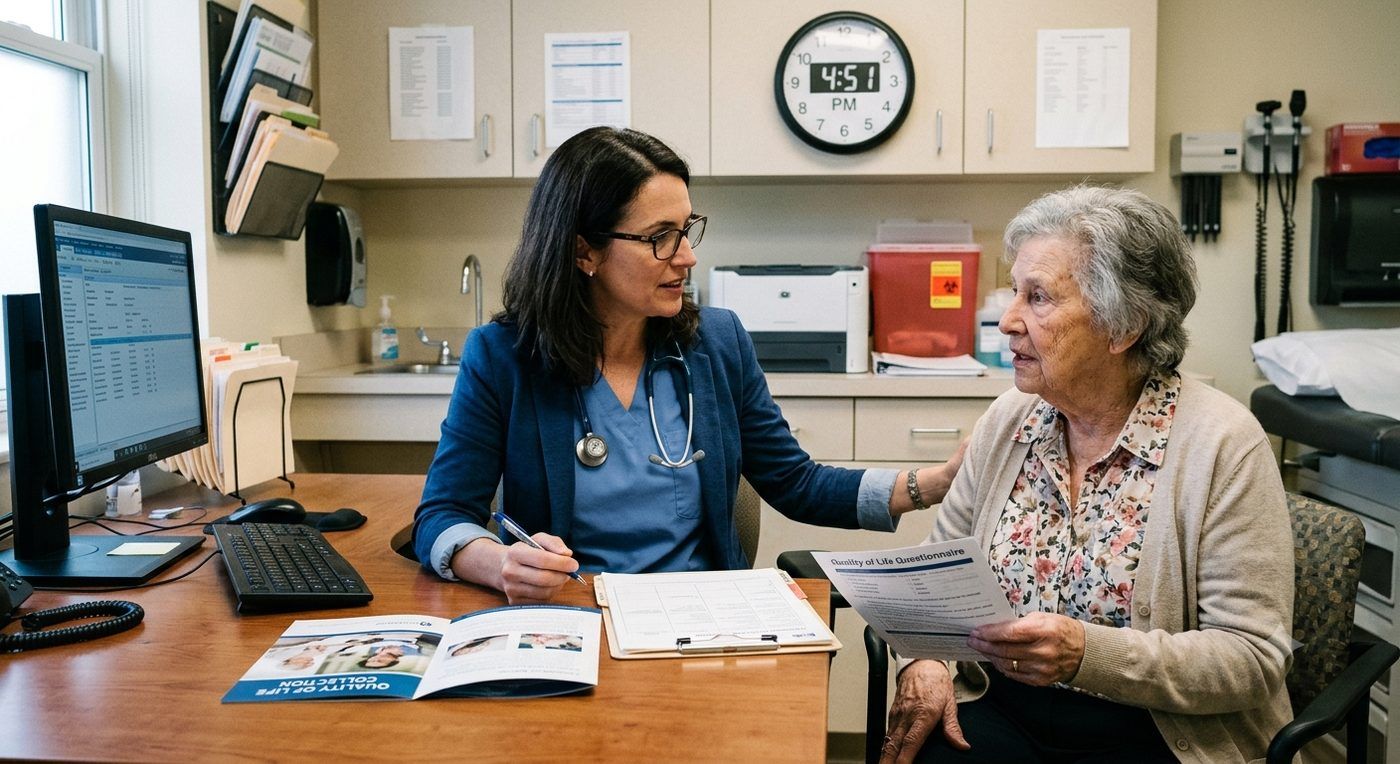 Quality of life collection usually competes with the last ten minutes of a clinic visit.
A patient-reported outcome, usually shortened to PRO, is any report about a patient's health that comes directly from the patient, without a clinician interpreting it. Not a scan. Not a blood count. The patient's own account of how they feel and what they can do.
In cancer care this usually takes the form of a standardised questionnaire covering things like pain, fatigue, nausea, appetite, sleep, mood, and whether the person can still manage stairs, work, or a conversation with their family. When such a questionnaire is validated and used in a study, it is called a PROM, a patient-reported outcome measure. When it is collected digitally rather than on paper, people call it ePRO.
Here is why it matters. A scan tells you where the tumour is. A PRO tells you what the treatment is doing to the person carrying it. Two patients can have identical imaging and radically different lives. One is working and eating normally. The other has not slept properly in three weeks and has stopped going out. Only one of those facts shows up on the scan.
This is not a soft measure. Quality of life is a primary or secondary endpoint in a large share of oncology trials, regulators consider it in labelling decisions, and in routine care there is good evidence that systematically collecting symptom data changes what clinicians do.
And it is the endpoint most likely to be missing when the analysis is finally run.
Why quality of life data goes missing
Anyone who has run a trial or a symptom monitoring programme knows the failure modes.
Paper questionnaires have to be printed, handed out, chased, collected, and then typed in by somebody. That somebody is usually a coordinator who has other work.
Electronic systems were meant to fix this, and they moved the problem rather than solving it. An app or a patient portal asks a person to own a smartphone, install something, remember a password, and read a form in a language and script they may not think in. For a 70 year old in a tier-two Indian city, midway through treatment, that is four separate barriers before the first question.
So adherence falls off across the schedule, assessment windows get missed, and the data that arrives is patchy. In the words of the abstract, quality of life outcomes are often simply unavailable in the primary analysis.
The interesting question is not whether technology can fix this. It is which part of the problem the technology is actually solving.
What is a healthcare voice agent?
A healthcare voice agent is an AI system that holds a spoken conversation with a patient over an ordinary telephone call. Not a menu tree. Not a recorded message. It listens to natural speech, understands intent, responds in real time, and completes a defined task: booking an appointment, confirming a follow-up, checking on symptoms, or in this case, administering a questionnaire.
Three things distinguish it from the automated phone systems people already dislike.
It does not require the patient to change behaviour. No app, no download, no login, no literacy requirement. The patient uses the phone they already own, in the way they already use it.
It understands the patient rather than matching keywords. Recognition has to work on the actual population, not on broadcast English. Ours was trained for multi-accent speech and optimised for North Indian dialects, which for our cohort was the difference between a working system and a decorative one.
It can hold context across a conversation and across calls. A phone tree forgets you the moment you hang up. An agent should not.
For patient-reported outcomes specifically, voice has one structural advantage over every other channel: the patient does not have to read anything. That single fact widens who you can collect data from.
What the call actually does
Each participant first received the written questionnaire with instructions, then called a designated number. From there the agent ran the interview: reading each item aloud, waiting, and capturing the patient's spoken response as a number.
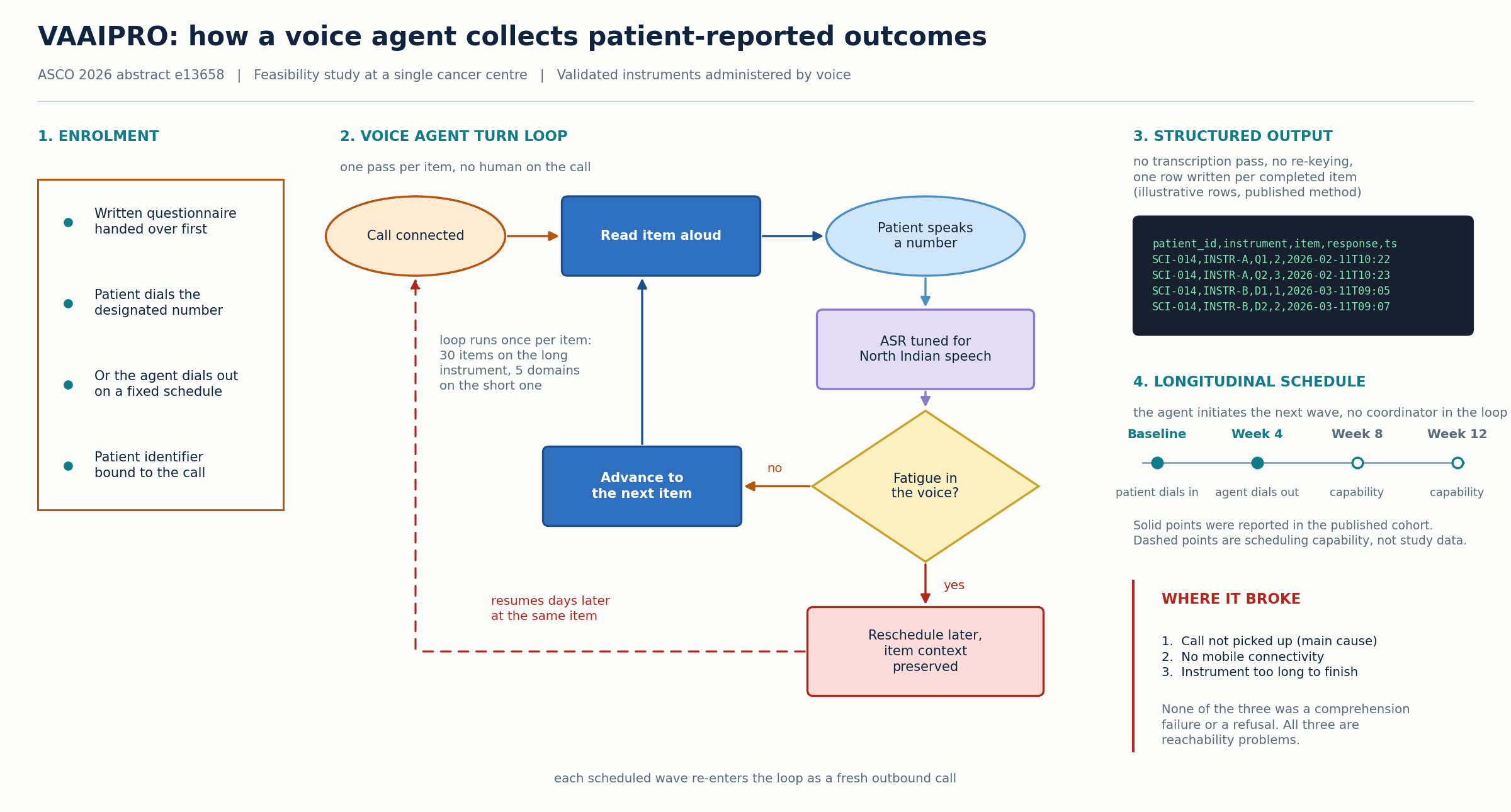 Figure 1. How a call runs, from enrolment through the per-item loop to structured output and the next scheduled wave. Fatigue detection routes a patient out of the loop and back in days later at the same item.
Four design decisions did most of the work.
Recognition built for the people actually calling. A speech stack tuned on clean English fails on exactly the population that most needs a non-text channel, and it fails quietly, by mis-scoring rather than by refusing. That is worse than an error.
Listening to how something is said, not only what is said. The agent analyses the voice signal in real time for markers of fatigue and exhaustion.
Stopping without losing the thread. When fatigue is detected the agent offers to reschedule, and preserves the questionnaire state across the interruption so the assessment resumes at the same item days later.
Writing structured data, not transcripts. Responses land directly in an analysis-ready format. No transcription pass, no manual entry, no reformatting between the patient speaking and the data being usable. The agent also runs the longitudinal schedule itself, dialling out at pre-specified dates, which takes the coordinator out of the scheduling loop.
Empathy is an engineering decision
The second and third of those decisions are the ones worth dwelling on, because they are usually treated as a nice-to-have and they are not.
A patient two weeks into a chemotherapy cycle does not announce that they are too tired to continue. Most people will not interrupt a system to say so, in the same way most people will not interrupt a doctor. What they do instead is get slower, quieter and shorter. They start giving the answer that ends the question rather than the answer that is true.
That last part is the whole problem. A tired patient who keeps answering is not giving you clean data. They are giving you a flat line down the middle of the scale, because that is the cheapest response to produce. An agent that grinds through all thirty items regardless does not collect more data than one that stops. It collects worse data and calls it complete.
So we built the agent to treat fatigue in the voice signal as a stop condition rather than as noise, to yield the turn instead of pressing on, and to come back later at the exact item it left.
We are calling that empathy, and we want to be precise about what we mean, because the word gets used loosely in this industry. We do not mean the agent sounds warm. Warmth is easy and mostly cosmetic. We mean the system gives up something it wants, a completed questionnaire right now, in response to a state the patient did not explicitly declare. That is a design constraint with a cost, and it is implemented in the turn-taking logic rather than in the script.
The reason to care is not only ethical. In this cohort, nobody failed because they could not understand the agent or the agent could not understand them, and nobody in the recorded reasons refused. Every loss we saw was logistical: an unanswered phone, no mobile signal, or an instrument too long to finish. For a system running multi-accent speech with people in active treatment, an outcome where the failures are all about reachability and none about the relationship is the result we care most about.
We should be honest about the limits of that claim. We did not run an empathetic agent against a pushy one and compare them. We cannot tell you the fatigue logic added a specific number of percentage points. What we can tell you is that we designed to avoid a particular failure mode, and that failure mode did not appear.
What the results showed
The long instrument, 30 items, went to 50 patients and took 12 minutes on average. On the first attempt, 25 answered it completely, 10 answered part of it, and 15 did not answer at all. A retry with the partial responders did not recover them. At the four week wave, 11 of those 25 baseline completers answered again. The most common reason for non-response was that the call was not picked up.
The short instrument, 5 domains, went to 40 patients and took 2.5 minutes on average. 37 of 40 responded completely. All three non-completions were an absence of mobile connectivity.
| Instrument | Items | Average call | n | Completed in full | Follow-up wave |
|---|---|---|---|---|---|
| Long | 30 | 12 minutes | 50 | 25 | 11 of 25 at week 4 |
| Short | 5 domains | 2.5 minutes | 40 | 37 | not assessed |
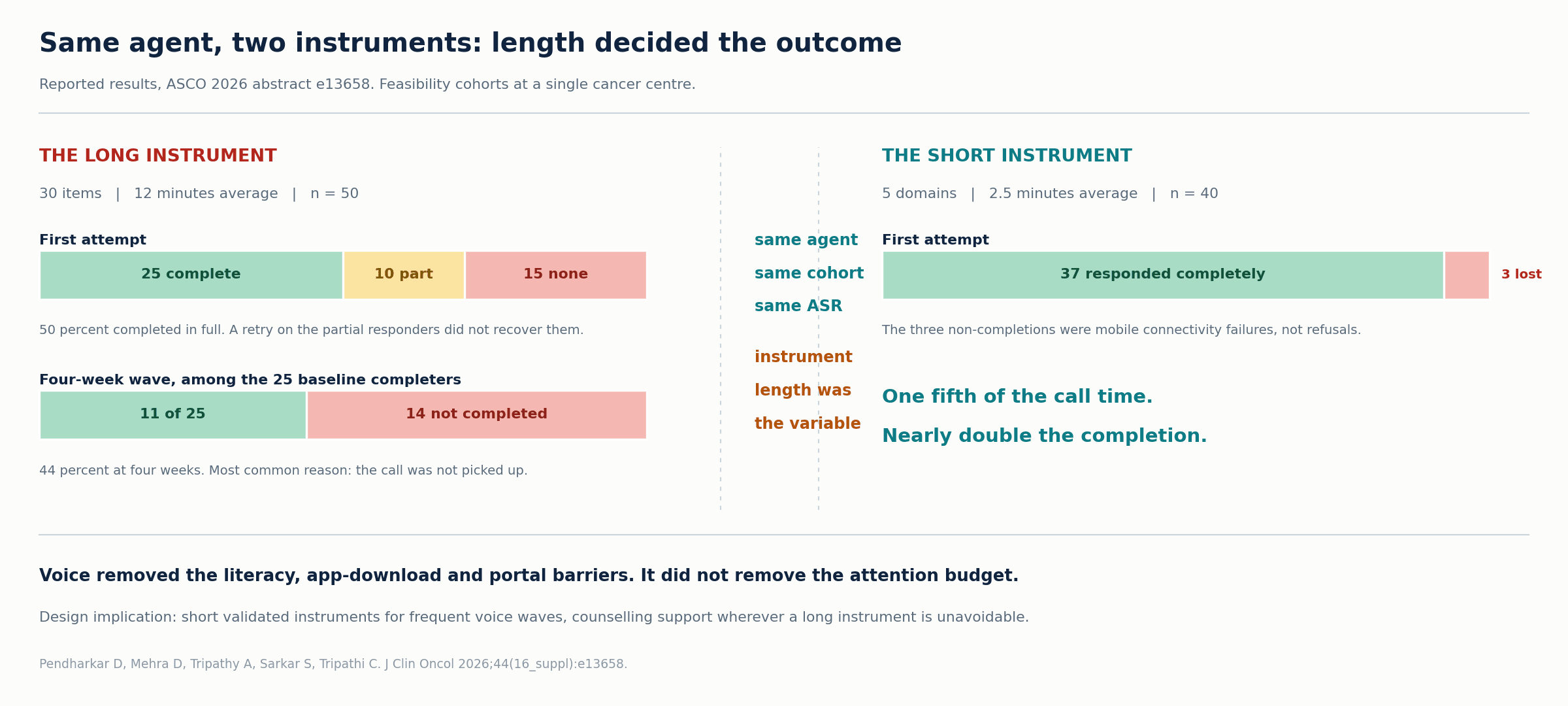
Figure 2. The same agent, the same cohort and the same recognition stack. Instrument length was the variable that changed.
It would be easy to publish the 37 of 40 and stop. The more useful result is the comparison.
Same agent. Same patients. Same recognition stack. Near-universal completion on a two and a half minute instrument, and roughly half that on a twelve minute one. The only thing that changed was how long we asked people to stay on the phone.
That reframes what voice actually solved. Voice removed the barriers electronic systems get blamed for: no app, no login, no reading, no smartphone. Those went away, and the short instrument went to 37 of 40.
What voice did not remove is the attention a person has available while unwell. Twelve minutes of sustained numerical answers is a demanding task in active treatment, and no interface design turns it into a two minute one. Our co-authors put it plainly in the conclusions: questionnaire length may hinder completion, and this can be mitigated with better patient counselling and support.
What the doctor gets
The reason to do any of this is that it changes what a clinician can see between visits.
Symptom data that arrives on schedule rather than at the next appointment. A deterioration reported in week three is actionable in week three. The same information collected at a week eight visit is a history lesson.
Data that is already structured. Responses arrive scored and analysis-ready, with a timestamp per item. Nobody transcribes a call, nobody keys in a paper form, nobody reconciles two spreadsheets before a review.
Coverage that is not filtered by digital literacy. If your PRO data only comes from patients who could use a portal, your evidence describes a subset of the people you treat, and usually the healthier and better resourced subset. That is a scientific problem as much as an access one.
Coordinator time back. The scheduling, dialling, chasing and re-keying all move to the system. In our study the agent initiated the longitudinal waves itself.
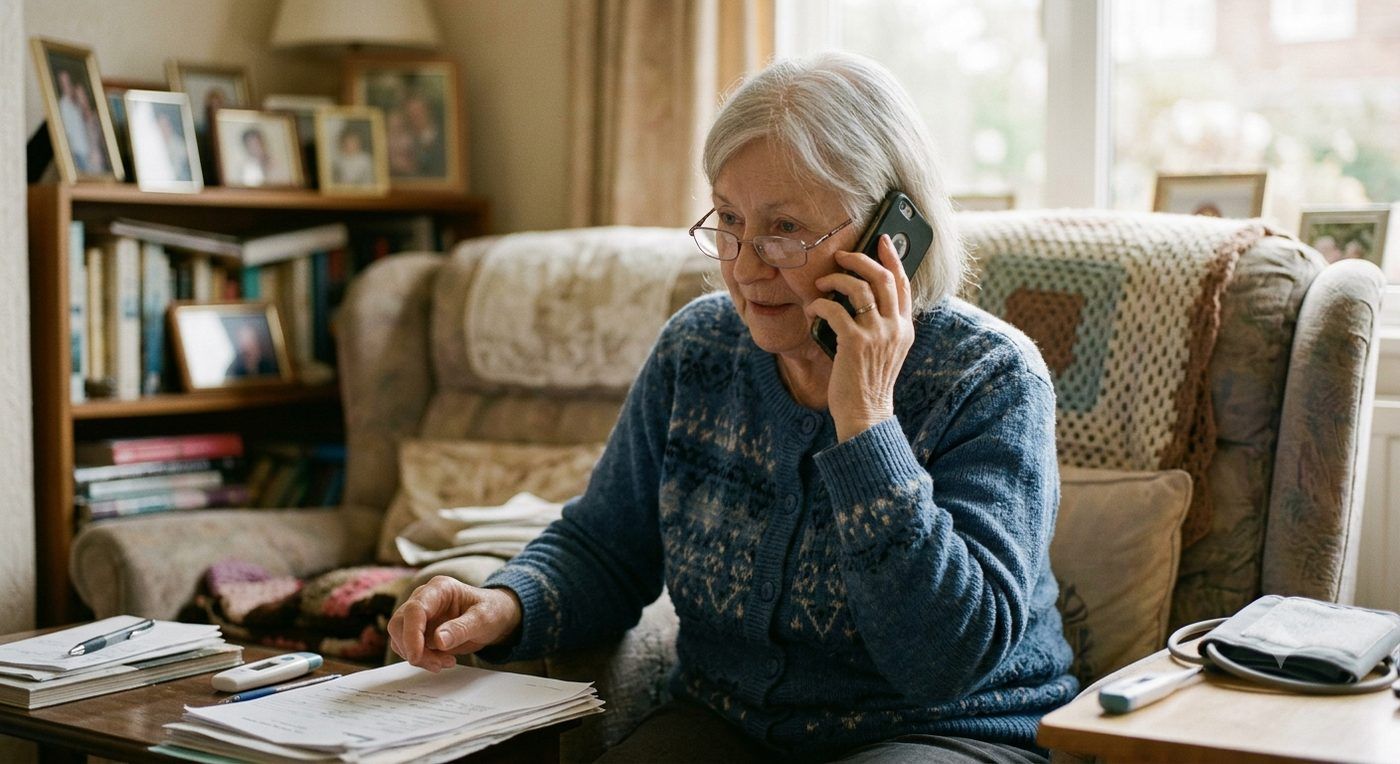 The assessment happens at home, on the phone the patient already owns.
What the patient gets
Nothing to install and nothing to remember. No app, no portal, no password. The phone rings and they talk.
Their own language, spoken, not read. For a patient who is not comfortable reading a clinical form, this is the difference between participating and being excluded.
Their own home, at a time that works. No travel, no waiting room, no borrowing a relative's smartphone.
A conversation that ends when they are tired. They do not have to ask. They do not have to feel rude. The system notices and offers.
Their voice actually reaching the team. The point of asking someone how they feel is that somebody reads the answer. Collected outcomes only matter if a reported deterioration reaches a human quickly, and that integration is the next piece of work for us.
Where it broke
Three failure modes account for essentially all of the loss, and none of them is what people expect from a voice AI system.
-
The call was not picked up. The most common reason for non-response on the long instrument. This is a reachability problem, not a speech problem. It responds to call-window optimisation, retry policy, caller identity and advance notification, not to a better model.
-
There was no mobile connectivity. All three non-completions on the short instrument. This is infrastructure, and the honest answer is that a share of any Indian cohort will not be reachable by voice on a given day.
-
The instrument was too long to finish. Ten of fifty started the long instrument and stopped part way. The retry did not recover them.
What is absent from that list is comprehension failure.
On the limitations
This was a feasibility study, and we would rather say so than let a headline number travel without it.
- The cohorts are small, at 50 and 40 patients.
- There was no randomised comparison against paper or portal collection.
- Participants received the written questionnaire before calling, so this measured voice-assisted completion of a familiar instrument rather than cold voice-only administration.
- Psychometric equivalence between voice-administered and self-administered scores has not been established here and should not be assumed.
- The abstract was accepted as publication only.
What our team took from it

We measure tumour response with precision, and we measure how the patient actually feels with whatever is left of the clinic day. What struck me here is that patients did speak to the system, in their own language, from their own homes. The short instrument was completed almost universally. The long one was not.
Dr Dinesh Pendharkar, First author.
The hard problem was never speech recognition. It was what happens when a patient goes quiet at question nineteen. We built the agent to hear fatigue, stop rather than push, and come back days later at the same item. What surprised us was how cleanly length predicted completion.
Ashish Tripathy, Co-founder and CTO, Pype AI.
A publication-only abstract is not a product launch, and we would rather say so. What it establishes is that voice is a credible collection channel in a working cancer centre. The next step is a larger cohort and a formal comparison against paper and portal.
Dhruv Mehra, Co-founder and CEO, Pype AI.
What this means if you are building or buying one
Match the instrument to the channel. A short validated measure by voice can run at a cadence that is unrealistic on paper, and reach people portals miss. For longitudinal monitoring, cadence and coverage usually beat instrument breadth. Where a long instrument is unavoidable, plan for counselling before the first call and for administration split across sessions.
Design the stop condition before the script. Most voice agent work goes into what the system says. In healthcare, more of it should go into when the system yields. Fatigue, confusion, distress and a third party picking up the phone are all states that should change the agent's behaviour, and none of them will be announced.
Spend the engineering on reachability. If the dominant failure is an unanswered phone, then call windows, retry logic, caller ID and advance notification are where the next percentage points are, not in the model.
Report the number that does not flatter you. A vendor who only shows you the good instrument is showing you a demo, not a product.
What comes next
The abstract's conclusion sets the bar: if widely adopted and rigorously validated, this approach could substantially transform quality of life data capture. The operative words are rigorously validated.
- A larger cohort with a pre-registered protocol and a formal comparison against paper and portal collection.
- Psychometric work on whether voice-administered scores are equivalent to self-administered ones.
- More Indian languages, with recognition performance reported per language rather than in aggregate.
- Reachability engineering, reported transparently as contact rate, completion rate and time to completion.
- Integration into clinician-facing workflows, so a reported deterioration reaches a human quickly.
A note on instrument licensing
The validated instruments used in this study are copyrighted works, licensed by the organisations that developed them. This post therefore describes them by length and structure rather than by name, and reproduces no item wording, response options or scoring logic. Both are named in the published abstract.
We think this deserves stating plainly rather than leaving in a footnote, because it is a real operational requirement and it is frequently missed by teams building in this space.
A licence is required for every study, including academic ones, and it does not transfer between studies. Permission is granted per protocol, not per organisation and not per platform.
The licence must sit with the hospital or the study sponsor. In any deployment, the institution running the study is responsible for holding a current, valid licence covering both the instrument and its electronic or voice mode of administration. Pype AI provides the collection technology. We do not supply, sublicense or grant rights to any third-party instrument, and we ask partner sites to confirm their licence position before a study begins.
Mode of administration is part of the licence. Moving an instrument from paper to voice is a change the agreement has to cover. Developers vary in how they treat this, and some publish an official telephone script. Ask before building.
The instrument cannot be altered. Item wording, item order and the recall window are fixed. A voice agent has to read the instrument as validated. Where an instrument is unsuitable for voice, the answer is to choose a different validated instrument, not to abridge one.
Citation
Pendharkar D, Mehra D, Tripathy A, Sarkar S, Tripathi C. Patient-reported outcomes based on voice-based artificial intelligence (VAAIPRO): A fast and innovative QOL data collection application. Journal of Clinical Oncology. 2026;44(16_suppl):e13658.
DOI: 10.1200/JCO.2026.44.16_suppl.e13658
Presented as a publication-only abstract, Care Delivery and Models of Care, 2026 ASCO Annual Meeting. Research sponsor: none.
Frequently asked questions
What is a patient-reported outcome (PRO)?
A patient-reported outcome is any report of a patient's health that comes directly from the patient, without interpretation by a clinician. In oncology it usually covers symptoms, functioning and quality of life. A validated questionnaire used to capture it is called a PROM, and collecting it digitally is called ePRO.
What is a healthcare voice agent?
An AI system that holds a natural spoken conversation with a patient over an ordinary phone call and completes a defined task, such as scheduling, follow-up, or symptom and outcome collection. Unlike a phone menu, it understands free speech, holds context, and does not require the patient to install anything.
Can an AI voice agent collect validated patient-reported outcome measures?
Yes. In this feasibility study a voice agent administered two validated instruments over an ordinary telephone call, reading each item aloud and capturing responses directly into a structured format. 37 of 40 patients completed the shorter instrument in full.
What completion rate does voice-based ePRO collection achieve in oncology?
It depends almost entirely on instrument length. In this study the short 5-domain measure, averaging 2.5 minutes, was completed by 37 of 40 patients. The 30-item measure, averaging 12 minutes, was completed in full by 25 of 50 on the first attempt, and by 11 of those 25 at four weeks.
Why do patients stop answering long questionnaires by phone?
In this cohort the failures were logistical rather than cognitive. The most common reason for non-response was an unanswered call. Others were caused by absent mobile connectivity. Length itself also reduced completion, which the authors suggest can be mitigated with counselling and support.
How does the agent handle a patient who becomes tired mid-assessment?
It analyses the voice signal in real time for fatigue. When fatigue is detected it offers to reschedule at a convenient time, preserving the questionnaire context so the assessment resumes at the same item rather than restarting.
Does this work for patients who are not digitally literate?
Voice removes the need to read a form, install an app or log into a portal. Recognition in this study was optimised for multi-accent North Indian dialects, and no non-completion was attributed to comprehension failure. Connectivity, not digital literacy, was the recorded barrier.
Does a voice agent replace nurses or coordinators?
No. It removes the repetitive part, the dialling, chasing, transcribing and re-keying. Clinical judgement, and any conversation triggered by a concerning answer, stays with the care team. The design goal is that a reported deterioration reaches a human faster, not less often.
Is VAAIPRO available for use in trials or routine care today?
This was a feasibility study and the abstract was accepted as publication only. We are working with partner sites on larger validation studies. If you are running a trial or a symptom monitoring programme and want to discuss it, please get in touch.
About VAAIPRO
VAAIPRO is a voice-based AI application for patient-reported outcome collection. It administers validated instruments by telephone, detects fatigue in the voice signal, reschedules interrupted assessments while preserving questionnaire context, schedules longitudinal waves automatically, and writes responses directly into an analysis-ready format.
About Pype AI
Pype AI builds voice AI for healthcare. Our agents handle patient communication across appointment access, follow-up and outcome collection for hospital networks, with clinical safety and measurable task completion as the design constraints. (Add funding, locations and named customers only where cleared for public use.)