
Multi‑Agent Voice Architecture: An Interactive Overview

Let's build intuition for how a production multi‑agent voice system works — without diving into code. We'll walk through the moving parts, how they talk to each other, and why the design scales cleanly when you add more agents or update them independently.
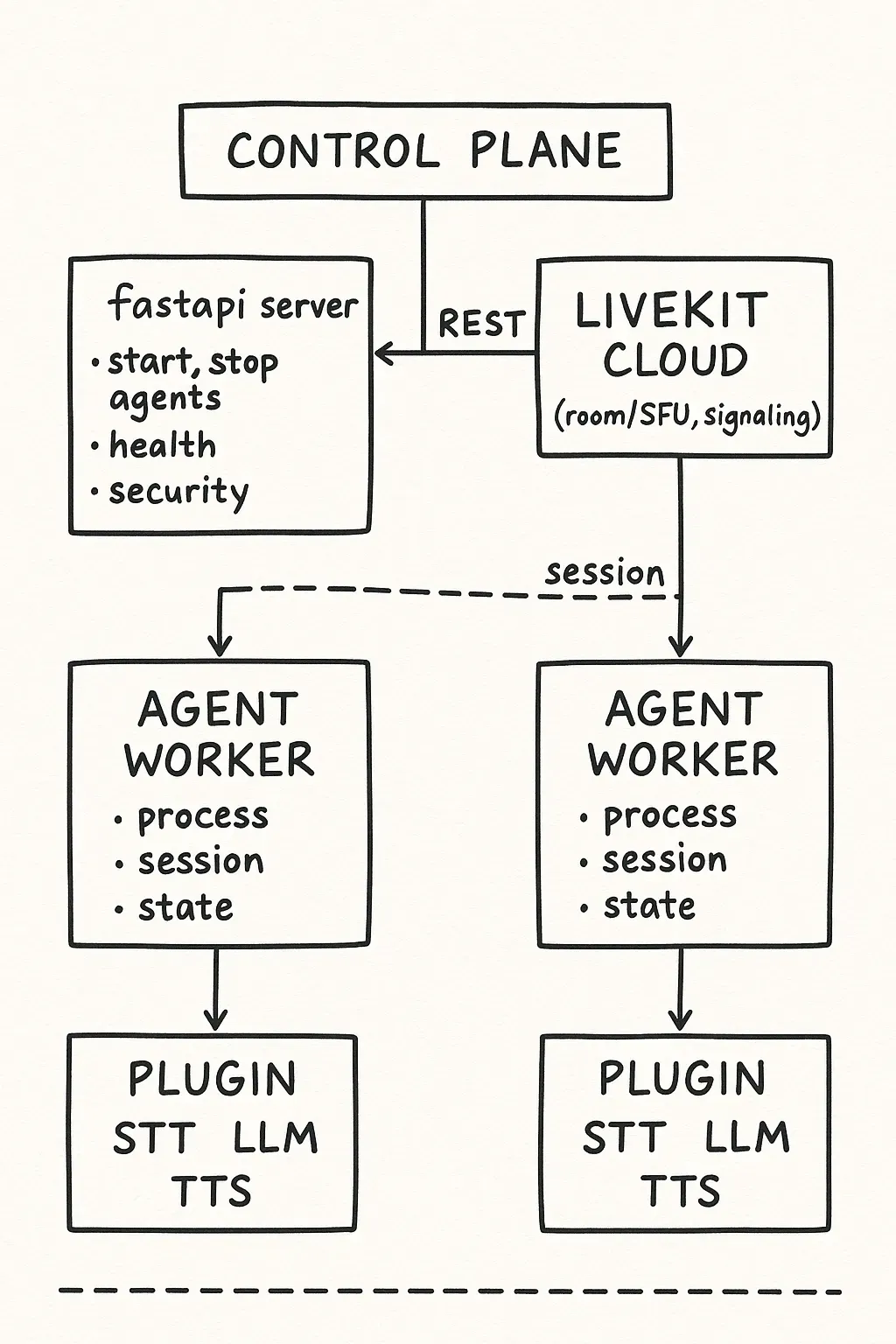
1) Mental Model: Control Plane + Isolated Workers
The system has a lightweight control plane (a web server) that acts as the "air traffic controller."
Each agent runs inside its own isolated worker process — a "plane" managed by the controller.
Sessions (phone/web calls) are handled inside workers; the controller never touches media.
Why this matters:
- Isolation prevents one agent's spikes or crashes from affecting others.
- You can start, stop, or update one agent without restarting the whole system.
2) The Control Plane (FastAPI Server)
- Hosts a simple HTTP API to create agents, start/stop them, check status, and dispatch sessions.
- Tracks which agents are active and persists that state so restarts are safe.
- Runs a health monitor to restart workers if they crash or exceed limits.
- Secures endpoints with API keys or session cookies.
Think of it as a coordinator, not a media processor. It's small, stateless, and easy to scale.
3) Agent Workers (One Process per Agent)
- Each agent lives in its own long‑running worker process.
- Workers integrate with the real‑time media layer (e.g., WebRTC/SIP) to handle audio, events, and metrics.
- If an agent worker crashes, only that agent is affected; the control plane can auto‑restart it.
Benefits:
- Predictable performance and resource usage.
- Clean blast radius during updates or failures.
- Simpler debugging — logs and metrics are agent‑scoped.
4) Session Entrypoints and Lifecycle
When a session starts, the worker invokes an entrypoint that:
- Initializes session context (who's calling, when it started).
- Wires event handlers for conversation items, metrics, and close events.
- Generates responses (STT → LLM → TTS) and streams them back in real time.
On shutdown, the entrypoint cleans up resources (models, network clients, buffers) to prevent leaks.
Outcome:
- Turn‑by‑turn transcripts with aligned metrics (e.g., TTFT, tokens/sec, TTS duration).
- Consistent lifecycle across all agents, even if they use different models or voices.
5) Creating and Updating Agents
- Agents are defined by configuration: prompt, STT/LLM/TTS/VAD backends, optional tools, and greeting behavior.
- A generator turns that configuration into a runnable agent bundle with a small runtime config.
- Updating an agent is a two‑step workflow: stop worker → update config/bundle → start worker.
This lets teams iterate safely and deploy features agent‑by‑agent.
6) Persistence, Health, and Recovery
- The control plane saves the list of active agents to disk.
- On restart, it restores those agents automatically.
- A background monitor checks worker health and memory usage; if something goes wrong, it restarts the affected worker.
This is a "self‑healing" loop — small glitches don't require manual intervention.
7) Security and Access
- The control plane enforces access (API keys, cookies).
- Workers don't expose public APIs; they only handle session jobs.
- You get a single, consistent place to authorize and audit operator actions.
8) Why This Architecture Works
- Isolation by default: process boundaries are the strongest guardrails.
- Operational clarity: simple lifecycle commands (start/stop/status) per agent.
- Performance headroom: avoid noisy‑neighbor problems; tune each agent independently.
- Developer experience: config‑driven agents make it easy to add or swap providers.
- Reliability: persistence + health monitoring + graceful cleanup keeps the system steady under load.
9) Typical Flows
- Start an agent: controller spins up a dedicated worker for that agent.
- Stop an agent: controller gracefully terminates its worker.
- Dispatch a call: controller or telephony routing points the session to the right agent worker.
- Update an agent: stop → update → start; other agents keep running.
10) Key Design Principles
- Keep the control plane thin and stateless.
- Give every agent its own process and lifecycle.
- Treat media handling and session logic as worker concerns, not server concerns.
- Make creation/update flows configuration‑first and repeatable.
- Bake in metrics and turn alignment for observability from day one.
If you're new to system design, take away this simple picture: a single coordinator plus many isolated workers. Each agent is a worker; each session runs inside its agent's worker; the coordinator just keeps everything tidy, healthy, and secure. That's how you scale to many agents — and keep shipping without fear.